The MFI Framework — How ZSM-5’s Two-Channel Architecture Defines Everything
ZSM-5, short for Zeolite Socony Mobil–5, belongs to a family of synthetic zeolites whose framework carries the three-letter code MFI. Before any discussion of acidity, catalysis, or industrial applications makes sense, one thing has to be clear: what the MFI skeleton actually looks like and why its geometry matters more than any other single property.
The answer begins with a five-membered ring.
The Pentasil Building Block — From Five-Membered Rings to MFI Topology
Every ZSM-5 crystal is assembled from pentasil units — clusters of eight five-membered rings in which each vertex is either a silicon or aluminum atom, with an oxygen atom bridging every pair of vertices. These pentasil units link together through shared oxygen bridges, forming chains that run in one direction. Neighboring chains then connect side-by-side through more oxygen bridges, producing corrugated sheets perforated by ten-ring holes.
Stack those sheets on top of each other — connected, again, by oxygen bridges — and the full three-dimensional MFI framework emerges. The crystallographic unit cell contains 96 tetrahedral sites (the T-sites, occupied by Si or Al), 192 oxygen sites, and a variable number of charge-balancing cations determined by how much aluminum sits in the framework.
This hierarchy — ring → cage-like unit → chain → sheet → crystal — is not architectural trivia. The ten-ring openings in those sheets become the channel windows that determine which molecules enter, which react, and which leave. Everything ZSM-5 does as a catalyst and adsorbent traces back to that geometry.
Straight Channels, Sinusoidal Channels, and the ~9 Å Intersection
ZSM-5’s channel system is what separates it from every other zeolite. Two sets of channels run through the crystal in perpendicular directions, and they are not the same shape.
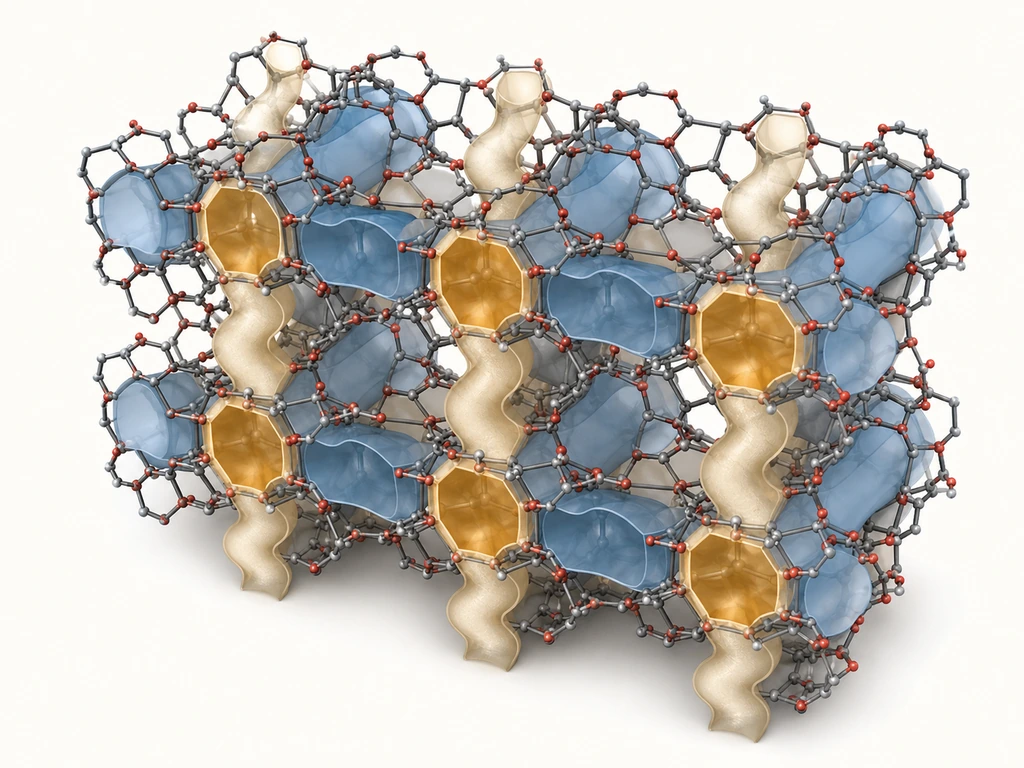
The straight channels run parallel to the crystallographic b-axis. Their openings are ten-membered rings — meaning ten oxygen atoms define the pore perimeter — with an elliptical cross-section measuring approximately 5.3 by 5.6 Å. The sinusoidal (or zig-zag) channels run along the a-axis, also ten-ring openings, but nearly circular at roughly 5.1 by 5.5 Å.
Where these two channel systems cross, the framework opens into intersection cavities roughly 9 Å across. These cavities are the actual reaction vessels of ZSM-5 — the spaces where molecules meet acid sites, rearrange their bonds, and depart as different species. The channel windows act as gatekeepers; the intersections act as workstations.
This places ZSM-5 squarely in the medium-pore zeolite category. Its ~5.5 Å windows sit between the small-pore zeolites — eight-ring materials like SAPO-34 whose ~4 Å openings admit only the slimmest molecules — and the large-pore zeolites such as Y and Beta, whose twelve-ring windows near 7 Å welcome bulkier feedstocks but also trap coke precursors more readily. That intermediate pore size, combined with the three-dimensional connectivity of intersecting channels, is the geometric foundation of everything that follows.
At high temperature, the ZSM-5 unit cell is orthorhombic — commonly assigned to Pnma, although Pn2₁a and P2₁2₁2₁ have also been reported depending on sample composition and measurement conditions. Representative lattice parameters span approximately a ≈ 20.1 Å, b ≈ 19.7–19.9 Å, and c ≈ 13.1–13.4 Å; the classic Olson et al. (1981) values are a = 20.07 Å, b = 19.92 Å, and c = 13.42 Å, while more recent synchrotron measurements fall toward the lower end of the b and c ranges. For high-silica ZSM-5 and silicalite, a transition to monoclinic P2₁/n can occur below roughly 300–350 K. The transition temperature decreases as aluminum content increases, so more aluminum-rich samples may remain orthorhombic at room temperature.
Silicalite — What Happens When You Remove All the Aluminum
At the compositional extreme of the MFI family sits silicalite: the all-silica end-member, reported by Flanigen and co-workers in 1978. It shares the exact same channel architecture as ZSM-5 but carries essentially no framework aluminum — and therefore almost no charge, no counter-cations, and no Brønsted acidity.
The consequence is striking. Without the polarity that aluminum provides, silicalite becomes hydrophobic and organophilic. It pulls organic molecules out of water rather than the reverse, and it remains thermally stable in air beyond 1,100 °C. Silicalite proves a point that has deep implications for industrial ZSM-5: the MFI skeleton itself — independent of its acid sites — already performs molecular sieving through geometry alone. Add aluminum back in, and you add controlled chemical reactivity on top of that physical selectivity. The two levers — pore geometry and framework acidity — operate in parallel, and the next section takes the acidity lever apart in detail.
The Si/Al Ratio Dial — From Acidity to Hydrophobicity in One Parameter
If the MFI channel architecture is the hardware, the silicon-to-aluminum ratio is the firmware. Every aluminum atom substituted into the silica framework carries one negative charge. When that charge is balanced by a proton, the result is a bridging hydroxyl group — Si–(OH)–Al — that behaves as a strong Brønsted acid site. Counting framework aluminum atoms is, to a first approximation, counting active sites. This is the Haag-Lago-Weisz rule, demonstrated in a landmark 1984 study showing that the hexane-cracking activity of H-ZSM-5 tracks its framework aluminum content with enzyme-like linearity down to a few parts per million.
Counting Acid Sites — The Haag-Lago-Weisz Rule and Why It Matters
The arithmetic is straightforward enough to be useful in practice. With 96 T-sites per unit cell, a molar SiO₂/Al₂O₃ ratio R corresponds to 192/(R + 2) aluminum atoms per unit cell. At R = 23, that yields nearly eight potential acid sites per cell. At R = 280, fewer than 0.7. At silicalite compositions, essentially zero.
Each of those aluminum-associated protons is a Brønsted acid site — the bridging hydroxyl that donates a proton to an adsorbed hydrocarbon, initiating the carbocation chemistry that drives cracking, isomerization, alkylation, and a dozen other refinery reactions. The infrared signature of this site — a sharp O–H stretch near 3,610 cm⁻¹ — is one of the most studied vibrational bands in heterogeneous catalysis.
One critical distinction: the nominal Si/Al ratio printed on a product specification sheet is not necessarily the framework ratio. Steam exposure at high temperature — exactly the conditions inside an FCC regenerator or an MTP reactor — can expel aluminum from the framework. The resulting extra-framework aluminum species are not catalytically innocent; they can block pores, modify acidity, or, in some cases, create Lewis acid sites with their own chemistry. ²⁷Al MAS NMR distinguishes tetrahedral framework aluminum from octahedral extra-framework species, and any serious ZSM-5 characterization program includes this measurement.
The Industrial Si/Al Spectrum — From R=23 to Silicalite
Commercial ZSM-5 spans roughly two orders of magnitude in Si/Al ratio, and the choice of where to land on that spectrum is the single most consequential specification decision when selecting a grade.
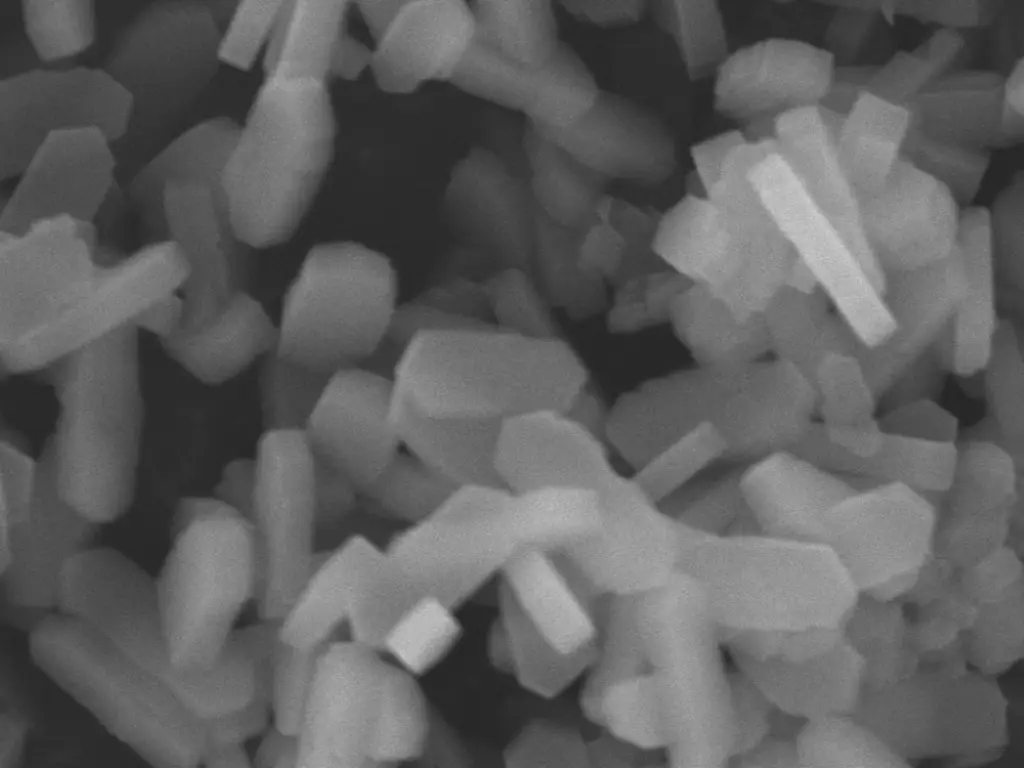
At the aluminum-rich end (R ≈ 23–30), acid site density is highest. This is the territory of FCC additives that crack low-octane gasoline-range olefins into propylene and butylenes, and of methanol-to-hydrocarbons catalysts where high activity per unit volume matters more than ultimate catalyst lifetime. The trade-off: more aluminum means a more hydrophilic framework and faster coke accumulation through bimolecular side reactions.
The middle range (R ≈ 50–80) balances activity against stability. Catalytic dewaxing catalysts and many aromatics processing formulations operate here — enough acidity to get the job done, enough silica to survive hydrothermal regeneration cycles without rapid dealumination.
Moving higher (R ≈ 200–300), the framework becomes progressively more hydrophobic. Water competes less effectively for adsorption sites, which matters enormously in applications where the feed stream carries moisture. These grades serve as selective adsorbents for volatile organic compounds in humid air — a role conventional low-silica zeolites cannot fill because they saturate with water before touching the target organic.
At the far end (R > 800, approaching silicalite), acidity is negligible and the material behaves as a pure shape-selective sieve. Applications shift entirely from catalysis to separations: removing trace organics from water, separating xylene isomers by diffusion rate rather than chemical reaction, or serving as a low-dielectric-constant filler in electronic materials.
FCC, MTG, MTP
Dewaxing, Aromatics
Separations, Electronics
From NH₄-ZSM-5 to H-ZSM-5 — Activation and the Sodium Trap
Commercial ZSM-5 is almost never shipped in its catalytically active form. It arrives as either the ammonium-exchanged powder (NH₄-ZSM-5) or, less commonly for catalytic grades, the sodium form (Na-ZSM-5). The distinction matters because an industrial user who loads Na-ZSM-5 directly into a reactor expecting acidity will get nothing.
The activation path for NH₄-ZSM-5 is calcination in air at 500–550 °C. The ammonium ion decomposes, releasing ammonia gas and leaving a proton behind on the framework — converting the material to H-ZSM-5, the active form. For Na-ZSM-5, an additional step is required: ion exchange with an ammonium salt solution (typically ammonium nitrate) to replace Na⁺ with NH₄⁺ before calcination. Residual sodium, even at levels below 0.1 wt% as Na₂O, can neutralize acid sites and depress activity measurably, which is why sodium content is a key quality-control parameter on any industrial specification sheet.
Shape Selectivity — When Pore Geometry Becomes a Molecular Gatekeeper
The idea that a catalyst could discriminate among molecules by size rather than by chemical reactivity was demonstrated by Weisz and Frilette in 1960 and grew into one of the organizing principles of zeolite science. ZSM-5 is its most commercially successful embodiment. Because the ten-ring openings are close in size to common fuel and petrochemical molecules, small differences in molecular cross-section translate into enormous differences in what the crystal admits, transforms, and releases.
Reactant, Product, and Transition-State Selectivity — Three Faces of the Same Gate
Three mechanisms operate at different stages of a molecule’s journey through the MFI channel system.
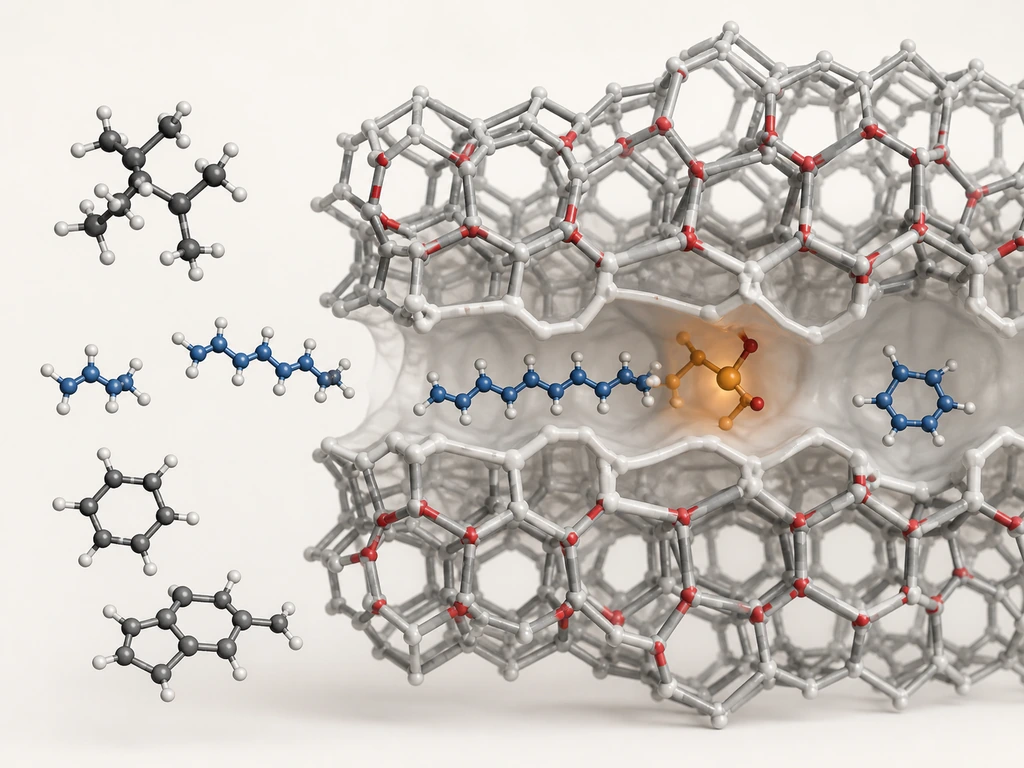
Reactant selectivity happens at the pore mouth. Linear paraffins with kinetic diameters near 4.3 Å enter ZSM-5 channels freely. Branched isomers and cyclic molecules, bulkier by a fraction of an ångström, are partly or fully excluded. Catalytic dewaxing exploits this: straight-chain waxes that would crystallize at low temperature are selectively cracked inside the pores, improving diesel pour point and lubricant cold-flow properties, while the valuable branched hydrocarbons pass through untouched.
Product selectivity happens on the way out. Among the three xylene isomers formed inside ZSM-5 crystals, para-xylene — roughly 5.8 Å across at its widest — diffuses through the ten-ring channels substantially faster than ortho- and meta-xylene, each roughly 6.8 Å across. Published values depend strongly on temperature, loading, and measurement method: molecular-dynamics simulations at 700 K report p-xylene:o-xylene:m-xylene diffusion ratios near 83:3:1, while experiments at 373 K have reported values near 1000:10:1. In these datasets, the para/ortho difference is roughly 28–100 times, demonstrating strong kinetic discrimination without implying a universal 1,000–10,000-fold advantage. The stream exiting the crystal is therefore enriched in the para isomer beyond its thermodynamic equilibrium share — a result of pore geometry rather than different chemical functionality.
Transition-state selectivity governs what reactions can happen at all. The ~9 Å intersection cavities are too small to accommodate the bulky bimolecular transition states that lead to polyaromatic coke. This is the structural reason ZSM-5 resists deactivation far longer than large-pore zeolites like Y, whose ~12 Å supercages comfortably host coke-forming condensation reactions. The coke that does form on ZSM-5 deposits preferentially on the external crystal surface and near pore mouths — sealing the crystal from the outside in, slowly, rather than filling it from the inside out.
A caution on the numbers: kinetic diameters are derived quantities, and real molecules are flexible, vibrating objects — not rigid billiard balls. Ortho-xylene is not strictly forbidden from MFI channels. It is merely so slow that on practical catalytic timescales it might as well be. The right mental model is strong kinetic discrimination, not an absolute sieve. That subtlety is exactly what makes shape selectivity tunable through crystal size, surface modification, and operating temperature.
Hierarchical ZSM-5 — When You Need the Best of Both Worlds
Everything described so far happens inside channels barely half a nanometer wide, and this is also ZSM-5’s structural weakness. Molecules must diffuse along narrow, sometimes single-file paths to reach active sites and escape again. In a conventional micron-sized crystal, the characteristic diffusion time scales with the square of the crystal size — meaning sites near the center can be effectively unreachable, while products that linger react further into heavier species and eventually into coke.
The remedy is to shorten the diffusion path, and an entire subfield — hierarchical zeolites — has grown up around doing exactly that. One route is post-synthetic: controlled desilication in alkaline solution carves mesopores into existing microporous crystals, adding highways that connect to the microporous streets. This approach, systematized by Pérez-Ramírez and co-workers, can increase the mesopore surface area from below 50 m²/g to over 300 m²/g. The other route is direct synthesis of nanocrystals or ultrathin sheets. In a celebrated 2009 result, Choi and colleagues grew MFI nanosheets just one unit cell thick — approximately 2 nm along the b-axis — that resisted deactivation in methanol-to-gasoline service dramatically longer than conventional crystals.
The trade-off is real: more external surface means more reactions happening outside the shape-selective channel environment, which can erode the very product selectivity that makes ZSM-5 valuable. Hierarchical ZSM-5 is not a universal upgrade. It is a tool for situations where diffusion limitation, not selectivity, is the binding constraint.
From Refinery to Renewable Carbon — Where ZSM-5 Works at World Scale
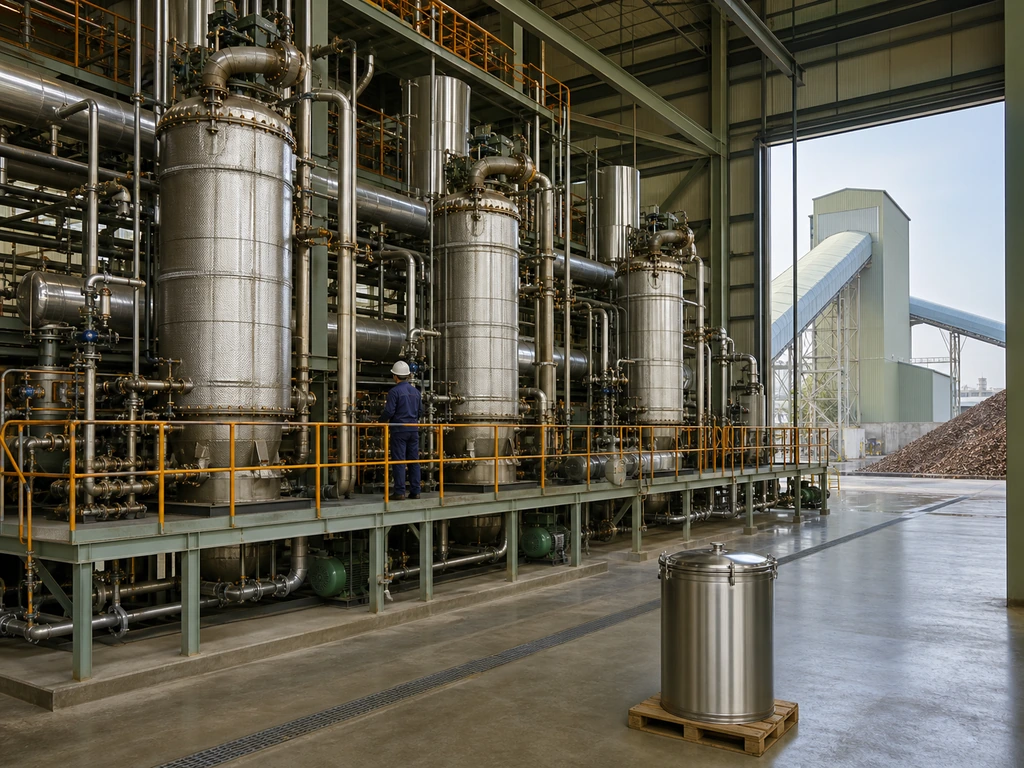
The structure, acidity, and shape selectivity described above converge in a set of industrial processes that collectively consume thousands of tons of ZSM-5 annually. The table below maps each major application to its typical Si/Al window and the specific selectivity mechanism it exploits.
| Application | Typical Si/Al Ratio | ZSM-5’s Role | Selectivity Mechanism |
|---|---|---|---|
| FCC propylene/octane additive | 23–50 | Selectively cracks low-octane gasoline-range olefins into propylene and butylenes | Reactant selectivity (linear olefins only) |
| Methanol-to-gasoline/propylene (MTG/MTP) | 25–50 | Converts methanol to hydrocarbons via dual-cycle mechanism (aromatic pool + olefin pool) | Transition-state selectivity (coke suppression) + product selectivity |
| Catalytic dewaxing | 50–80 | Cracks straight-chain waxes out of diesel and lubricant fractions | Reactant selectivity (n-paraffins in, branched out) |
| Para-xylene production | 50–300+ | Toluene methylation / xylene isomerization with para enrichment beyond equilibrium | Product selectivity (p-xylene diffuses fastest) |
| VOC adsorption (hydrophobic) | >300 | Selectively adsorbs organic vapors from humid air streams | Physical sieving (high-silica framework repels water) |
| Biomass catalytic fast pyrolysis | 23–50 (Ga-modified) | Upgrades biomass pyrolysis vapors into aromatic hydrocarbons (BTX) | Transition-state + acid site synergy |
Two observations emerge. First, no single Si/Al ratio works for everything — the “best” ZSM-5 is always application-specific. Second, emerging applications in renewable carbon and environmental catalysis are pushing ZSM-5 into compositions and morphologies that were not commercially available two decades ago, which means the supplier landscape matters more now than it did when standard off-the-shelf grades covered most needs.
Specifying ZSM-5 — How to Choose the Right Grade and Evaluate Suppliers
Understanding the structure is the foundation. Putting that understanding to work — actually specifying and sourcing the right ZSM-5 for a particular process — is where the literature typically goes silent and the engineer is left to figure things out through trial, error, and vendor conversations.
Four Questions Before You Order
Start with the application requirements and work backward to the material specification.
First, what acid site density does the reaction need? This sets the Si/Al ratio target. Cracking and methanol conversion demand high aluminum content (R ≈ 23–50). Adsorption applications where acidity is a liability point toward R > 300. Most industrial processes fall somewhere in between, and the right answer is usually found through catalyst testing rather than literature precedent alone.
Second, how severe is the hydrothermal environment? If the material will see steam at high temperature — inside an FCC regenerator, a methanol-to-propylene reactor, or any swing-adsorption cycle with wet purge gas — specify a higher Si/Al ratio than the reaction alone would dictate, or ask about phosphorus-stabilized formulations. Framework aluminum lost to steam is gone permanently; no regeneration cycle brings it back.
Third, is diffusion a bottleneck? If deactivation curves show rapid initial activity loss, or if product selectivity drifts with time-on-stream, the crystal size may be too large. Conventional ZSM-5 crystals span 0.5 to several microns. Nanocrystalline grades and hierarchical (mesopore-containing) variants shorten diffusion paths at some cost in mechanical robustness and, for hierarchical materials, some loss of shape selectivity at external surfaces.
Fourth, what cation form do you need? NH₄-ZSM-5 is the standard precursor — calcine it in-house to generate the active H-form. Na-ZSM-5 requires an additional ion-exchange step. If the intended use is as an adsorbent rather than a catalyst, the sodium form may be exactly what you want.
What to Check on the Certificate of Analysis
When a shipment arrives, five numbers on the certificate of analysis deserve attention. XRD relative crystallinity should exceed 90% versus a reference standard — lower values indicate amorphous material or incomplete crystallization. BET surface area typically falls between 350 and 450 m²/g for well-crystallized ZSM-5, with the micropore contribution dominating. Na₂O content should sit below 0.1 wt% for catalytic grades — residual sodium is a direct acid-site poison. Particle size D50 should match the specification, especially if diffusion-limited deactivation is a concern. And if framework Si/Al ratio matters to the application, confirm it by ²⁷Al MAS NMR rather than relying on bulk XRF, which cannot distinguish framework from extra-framework aluminum.
Evaluating Suppliers Beyond the Specification Sheet
Price dispersion in the ZSM-5 market is wide. Industrial bulk orders range from single-digit to double-digit dollars per kilogram depending on Si/Al ratio, crystal size, and order volume, while research-grade quantities from laboratory suppliers can exceed $2,000 per kilogram. But price per kilogram is a poor primary filter. More revealing questions include: Does the supplier offer customization across the full parameter space — Si/Al ratio, crystal size, cation type — or only a fixed catalog of standard grades? Is there an in-house pilot plant capable of formulating and testing application-specific variants, or does “custom” mean adjusting the label on an existing product? Are free samples and application-specific test reports provided regardless of order size?
These questions matter because ZSM-5 is not a commodity where one supplier’s R=50 is interchangeable with another’s. Differences in crystal morphology, trace cation content, binder chemistry, and activation protocol create performance variation that a specification sheet alone does not capture. During qualification, request batch-specific composition, crystallinity, surface-area, particle-size, and cation-form data, then validate the proposed grade under representative reaction conditions.
JALON can provide ZSM-5 zeolite powder with selectable Si/Al ratios ranging from aluminum-rich grades to near-silicalite compositions, crystal sizes from submicron to multi-micron, and sodium, ammonium, or exchanged cation forms. Its technical team can support grade qualification with XRD, BET surface-area testing, particle-size analysis, chemical titration, traceable samples, and application-specific specification review.
If your application sits between two standard commercial grades — or if you are developing a process for which no off-the-shelf ZSM-5 exists — the supplier’s formulation development capability matters more than its catalog breadth. The right conversation starts not with “what grades do you stock” but with “here is what my reaction needs; can you formulate for it.”
References
- Argauer, R.J. & Landolt, G.R. Crystalline Zeolite ZSM-5 and Method of Preparing the Same. U.S. Patent 3,702,886, 1972.
- Kokotailo, G.T., Lawton, S.L., Olson, D.H. & Meier, W.M. Structure of Synthetic Zeolite ZSM-5. Nature 272, 437–438, 1978.
- Olson, D.H., Kokotailo, G.T., Lawton, S.L. & Meier, W.M. Crystal Structure and Structure-Related Properties of ZSM-5. Journal of Physical Chemistry 85, 2238–2243, 1981.
- Flanigen, E.M. et al. Silicalite, a New Hydrophobic Crystalline Silica Molecular Sieve. Nature 271, 512–516, 1978.
- Haag, W.O., Lago, R.M. & Weisz, P.B. The Active Site of Acidic Aluminosilicate Catalysts. Nature 309, 589–591, 1984.
- Chen, N.Y. & Garwood, W.E. Some Catalytic Properties of ZSM-5, a New Shape-Selective Zeolite. Journal of Catalysis 52, 453–458, 1978.
- Pérez-Ramírez, J. et al. Hierarchical Zeolites. Chemical Society Reviews 37, 2530–2542, 2008.
- Choi, M. et al. Stable Single-Unit-Cell Nanosheets of Zeolite MFI. Nature 461, 246–249, 2009.
- Corma, A. Inorganic Solid Acids and Their Use in Acid-Catalyzed Hydrocarbon Reactions. Chemical Reviews 95, 559–614, 1995.
- IZA Structure Commission. MFI: Type Material.


 EN
EN  DE
DE  ES
ES  JA
JA  RU
RU  PT
PT  FR
FR  AR
AR  KO
KO  TH
TH  ID
ID