Pressure swing adsorption is one of those technologies that sits at the intersection of elegant physics and hard-nosed industrial economics. If you work in gas separation — whether you are specifying an oxygen generator for a hospital, evaluating biogas upgrading options, or troubleshooting a hydrogen purification train — PSA is the process you keep running into. But how exactly does it work, and why does it matter which adsorbent sits inside those towers?
This guide walks through the full picture: what PSA is, the four-step cycle that drives it, the materials that make it possible, and where it delivers the strongest ROI across applications from medical oxygen to renewable natural gas.
What Is Pressure Swing Adsorption?
Pressure swing adsorption (PSA) is a gas separation technology that uses pressure changes to selectively trap and release specific gas molecules from a mixture — typically air — at near-ambient temperatures. It belongs to a family of processes called non-cryogenic air separation, which means it does not need to cool gases to cryogenic temperatures to separate them (Sircar, 2002).
The first thing to get straight — and this trips up a surprising number of people — is the difference between adsorption and absorption. Absorption means one substance soaks into the volume of another, like a sponge taking in water. Adsorption means molecules stick to the surface of a solid material without penetrating its interior. In PSA, gas molecules adhere to the internal pore surfaces of a microporous solid — typically a zeolite or carbon molecular sieve — under pressure. When the pressure drops, they release. The name “pressure swing” comes from this back-and-forth between high pressure (to capture) and low pressure (to release).
Here is the core insight that makes PSA intelligible: a PSA system is not a continuous process in the way a distillation column is. It is a cyclic batch process — one tower adsorbs while another regenerates — and the switching between them is fast enough that the product stream looks continuous. Typically, the system operates at 4 to 8 bar(g) during the adsorption phase, then drops to near-atmospheric pressure during regeneration.
Think of it like this: you have two sponges, each capable of soaking up a specific liquid. You press one sponge into the mixture (adsorption under pressure), then squeeze it out (desorption by releasing pressure), while the other sponge is already pressing in. The result is an uninterrupted output — but only because the two halves take turns.
The economic advantage over delivered gas can be substantial, but costs vary with electricity tariffs, utilization, plant size, maintenance, transport, and local supply contracts. In a 2024 healthcare cost model for a 500 LPM plant operating continuously on grid electricity, liquid medical oxygen and third-party cylinder refilling cost approximately 2.59 and 3.13 times as much per cubic meter as on-site PSA production, respectively (Manhas et al., 2024). Site-specific lifecycle analysis is therefore more reliable than a universal dollar-per-cubic-meter estimate.
How Does Pressure Swing Adsorption Work?
PSA encompasses two distinct separation mechanisms. Equilibrium selectivity, used by zeolites, is driven primarily by differences in electrostatic affinity and adsorption capacity. Kinetic selectivity, used by carbon molecular sieves, exploits differences in diffusion rate — for example, O₂ enters CMS micropores much faster than N₂. Neither mechanism is simple mechanical straining by a mesh. Pressure swings make both processes reversible, allowing the adsorbent to be regenerated and cycled rather than consumed.
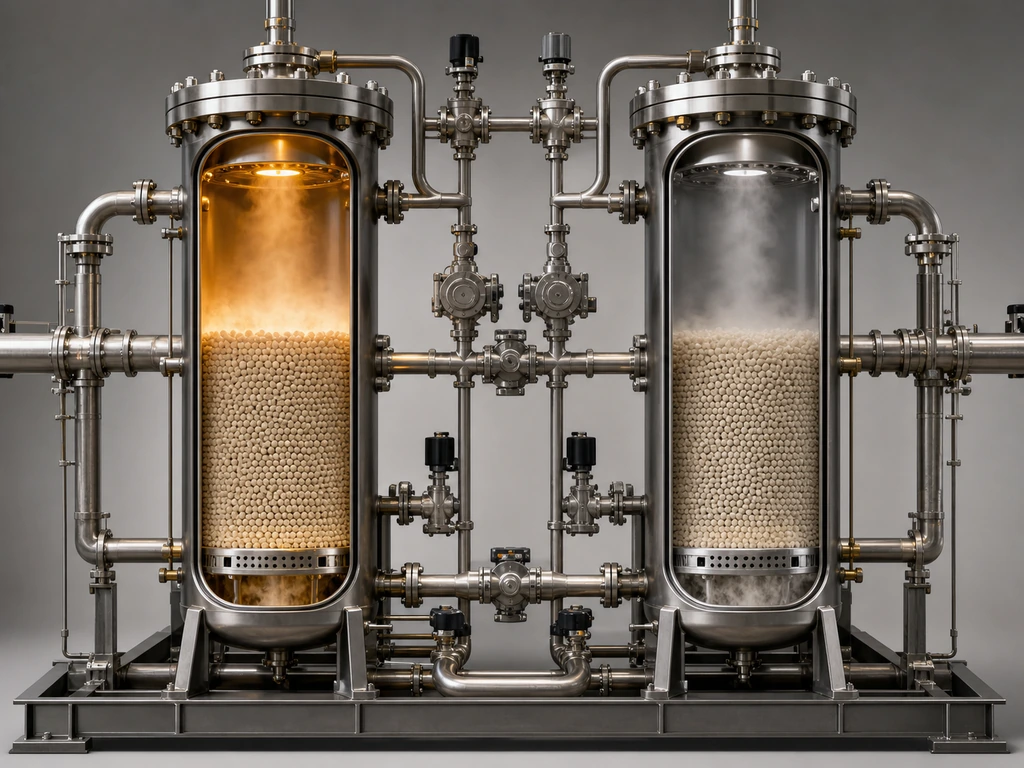
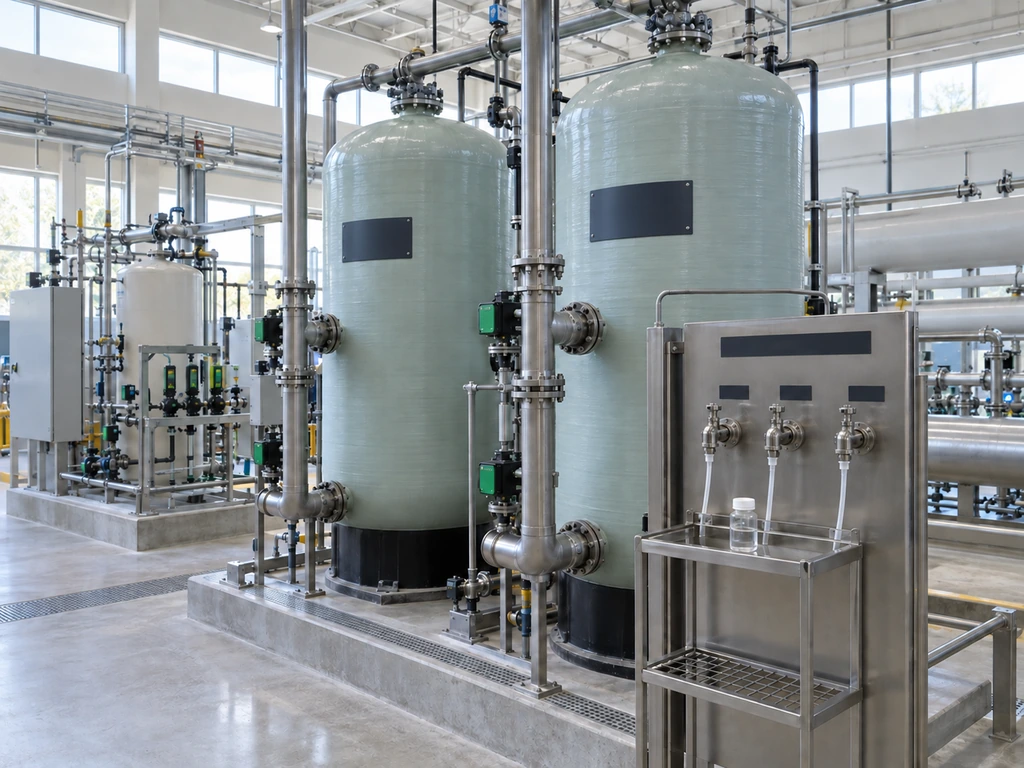
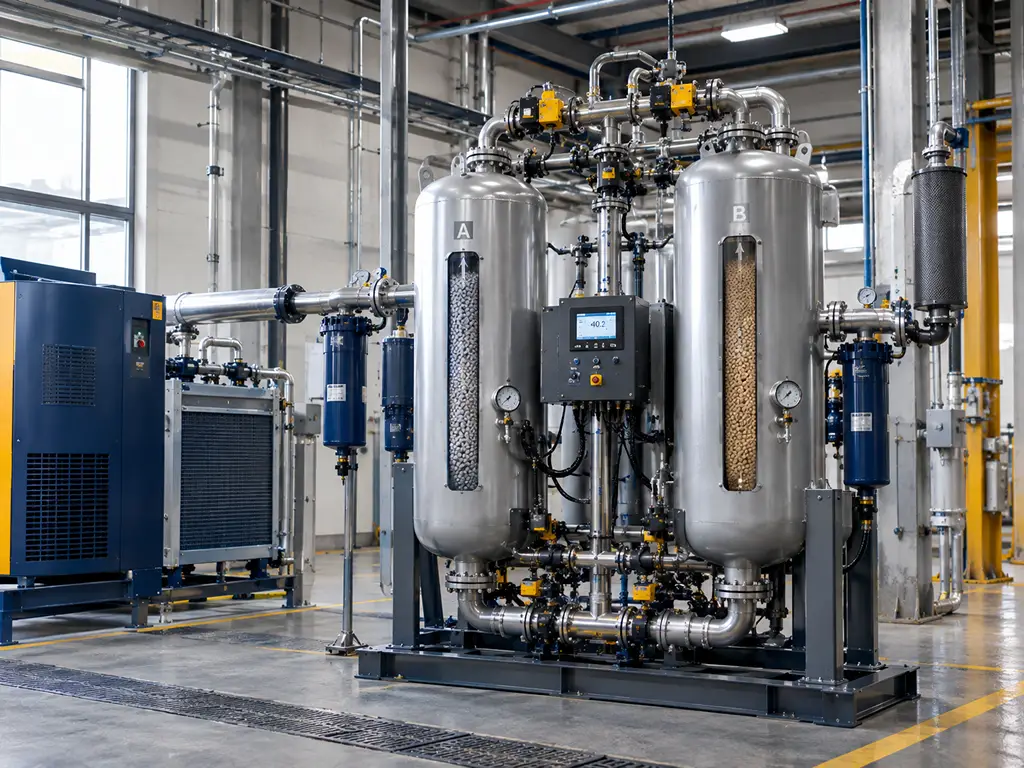
A typical PSA system consists of two adsorption towers filled with adsorbent material, a set of switching valves, a programmable logic controller (PLC) governing the cycle timing, and a buffer tank to smooth out the product flow.
Step 1 — Pressurization and Feed
Compressed air — or whatever feed gas the process is designed for — enters the first adsorption tower. The pressure climbs to the operating setpoint, typically 4 to 8 bar for oxygen and nitrogen PSA, or 5 to 10 bar for biogas upgrading. Hydrogen PSA units often run higher, at 20 to 30 bar, because of the different thermodynamics involved.
Why pressurize first? Because adsorption is governed by what chemical engineers call an adsorption isotherm — a curve that describes how much gas a given adsorbent can hold at a given pressure. For most PSA-relevant gas-adsorbent pairs, this curve follows the Langmuir model: capacity rises sharply with pressure at low pressures, then plateaus. Operating at the right pressure means maximizing how much target gas each kilogram of adsorbent can capture per cycle, which directly determines system size and capital cost. The pressurization step typically occupies 10 to 30 percent of the total cycle time.
Step 2 — Selective Adsorption
This is the heart of the process. At operating pressure, the adsorbent selectively captures the target gas molecules while the desired product gas passes through.
In an oxygen PSA system, the zeolite preferentially adsorbs nitrogen (N₂), water vapor, and carbon dioxide — allowing oxygen (O₂) to flow through as the product. The selectivity comes down to electrostatics. A nitrogen molecule carries a quadrupole moment of roughly 1.52 × 10⁻²⁶ esu·cm² — about four times stronger than oxygen’s quadrupole moment of 0.39 × 10⁻²⁶ esu·cm². Zeolite surfaces are studded with exchangeable cations (Li⁺, Na⁺, Ca²⁺) that create strong local electric fields. Nitrogen, with its larger quadrupole, interacts much more strongly with these fields than oxygen does. It is not that oxygen cannot adsorb — it does, weakly — but nitrogen wins the competition for surface sites by a wide margin.
A lithium-exchanged low-silica X zeolite (Li-LSX), the current industry standard for oxygen PSA, can adsorb roughly 0.6 to 0.8 millimoles of nitrogen per gram at 1 bar and 25°C. That number is the fundamental spec that determines how much zeolite a given system needs and, by extension, how large the adsorption towers must be.
Product purity depends on the application. For oxygen PSA, the practical ceiling is about 95 percent. The reason is instructive: air contains roughly 0.93 percent argon, and argon’s adsorption behavior on zeolite is nearly identical to oxygen’s. PSA cannot separate argon from oxygen with standard zeolites, so the best achievable purity in a single-stage system is roughly 95 percent O₂, with the remaining ~5 percent being mostly argon (ACS I&EC Research, 2006). For applications that require 99.5 percent or higher, cryogenic distillation remains the only option.
For nitrogen PSA, the separation works differently: carbon molecular sieves (CMS) exploit the fact that oxygen molecules diffuse through narrow micropores roughly 30 to 50 times faster than nitrogen molecules. The oxygen gets trapped inside the pores while nitrogen passes through. Product nitrogen purity can reach 99.999 percent using this kinetic separation mechanism.
Step 3 — Depressurization and Desorption
Once the adsorbent in the first tower approaches saturation — meaning its surface sites are nearly full of captured nitrogen (or CO₂, depending on the application) — the feed gas is switched to the second tower. The first tower is then depressurized, typically back to near-atmospheric pressure for standard PSA, or pulled down to roughly 0.3 to 0.5 bar absolute in a vacuum pressure swing adsorption (VPSA) configuration.
The physics reverses: as pressure drops, the equilibrium point on the adsorption isotherm shifts downward. The adsorbed gas molecules no longer have enough driving force to stay on the surface, so they desorb — they release from the zeolite and exit the tower as a waste stream (often called “tail gas” or “off-gas”). In an oxygen PSA system, this tail gas is mostly nitrogen (85–90 percent) with some residual oxygen and moisture, and it is vented to the atmosphere.
This is why you need at least two towers: while one is adsorbing, the other is regenerating. The product stream never stops because the system alternates between the two.
Step 4 — Purge and Pressure Equalization
After depressurization, a small portion of the product gas — typically 10 to 30 percent of the output — is routed back through the regenerated tower as a purge. This flushes out any residual desorbed gas lingering in the void spaces, ensuring the tower starts its next adsorption cycle clean. Without adequate purging, residual nitrogen or CO₂ would contaminate the product stream on the next cycle, causing gradual purity decay.
Before the valves switch and the towers swap roles, many industrial PSA systems perform a pressure equalization step: the two towers are briefly connected to each other, allowing the high-pressure gas in the freshly saturated tower to partially pressurize the freshly regenerated tower. This simple step recovers roughly 10 to 15 percent of the compression energy that would otherwise be wasted — a meaningful number when you consider that electricity is the single largest operating cost in a PSA plant.
The entire cycle — pressurize, adsorb, depressurize, purge — typically repeats every 60 to 120 seconds for smaller systems, or every 3 to 10 minutes for large industrial units. Then the towers swap roles and the cycle begins again.
The Adsorbent Materials That Power PSA Systems
If the pressure-swing cycle is the engine of PSA, the adsorbent is the fuel that determines what that engine can do. Choosing the right material is not a minor detail — it governs three things: the maximum purity you can achieve, the size (and therefore capital cost) of the system, and how long the adsorbent lasts before performance degrades enough to require replacement. These three dimensions — selectivity, adsorption capacity, and cyclic stability — form a universal framework for evaluating any PSA adsorbent.
Zeolite Molecular Sieves — The Workhorse of PSA Oxygen and Biogas
Zeolites are crystalline aluminosilicates with a remarkably regular pore structure. Their framework is built from SiO₄ and AlO₄ tetrahedra linked together to form cages and channels of precise dimensions. The aluminum atoms introduce a negative charge into the framework, which is balanced by exchangeable cations — most commonly sodium (Na⁺), but also lithium (Li⁺), calcium (Ca²⁺), potassium (K⁺), or silver (Ag⁺) depending on the application. These cations sit at specific positions inside the pores and create intense localized electric fields. That matters because it is these fields that selectively attract nitrogen over oxygen.
The zeolite types most relevant to PSA break down by pore opening size — and the naming convention is refreshingly literal:
- 3A (pore opening ~3 Å): admits only water molecules; used for dehydration, not gas separation
- 4A (~4 Å): admits water, CO₂, and small molecules; common in dehydration and light gas removal
- 5A (~5 Å): admits straight-chain hydrocarbons; used in hydrogen purification and n-paraffin separation
- 13X (~10 Å): admits most gas molecules including branched hydrocarbons; the general-purpose workhorse for air separation, CO₂ removal, and biogas upgrading
For oxygen PSA specifically, the industry has largely converged on Li-LSX (lithium-exchanged low-silica X zeolite). With a silicon-to-aluminum ratio near 1.0 and lithium exchange levels above 95 percent, Li-LSX delivers nitrogen adsorption capacities of 0.6 to 0.8 mmol/g at 1 bar — roughly double what a conventional 13X sodium zeolite achieves at the same conditions. That capacity difference translates directly into smaller towers, lower capital costs, or higher throughput for the same footprint.
Batch traceability and quality-control granularity are often more important than nominal specifications when evaluating adsorbent suppliers. Request measured batch data for cation exchange level, adsorption capacity, particle-size distribution, binder content, bulk density, crush strength, and moisture, together with the applicable test methods and acceptance limits.
Carbon Molecular Sieves — Precision Pores for Nitrogen Generation
Carbon molecular sieves (CMS) operate on an entirely different separation mechanism than zeolites. Instead of equilibrium selectivity — where the adsorbent prefers one molecule over another because of electrostatic attraction — CMS relies on kinetic selectivity: the rate at which different gas molecules diffuse into the micropores.
CMS is an amorphous carbon material with pore openings engineered to roughly 3 to 4 angstroms. Oxygen molecules have a kinetic diameter of 3.46 Å; nitrogen molecules are slightly larger at 3.64 Å. That 0.18-angstrom difference — about one-fiftieth the width of a hydrogen atom — is enough to create a dramatic diffusion rate difference: oxygen diffuses into CMS pores roughly 30 to 50 times faster than nitrogen. So when compressed air flows through a CMS bed, the oxygen rushes into the pores and gets trapped, while the slower nitrogen passes through as the product.
This kinetic mechanism gives CMS-based nitrogen PSA a key advantage: extremely high product purity, up to 99.999 percent. The trade-off is that CMS typically operates at slightly higher pressures (5 to 10 bar) than zeolite-based oxygen PSA, and the nitrogen yield per kilogram of adsorbent is lower.
A useful way to think about the difference: zeolite separation is about who gets caught (equilibrium); CMS separation is about who runs faster (kinetics). Both are adsorption, but the physics are entirely distinct — and that dictates which material you choose for which application.
Activated Carbon and Specialty Sorbents — Targeting CO₂ and Trace Impurities
Activated carbon is the unsung workhorse in many PSA systems. With a specific surface area of 800 to 1,500 square meters per gram — roughly two to three times that of a typical zeolite — activated carbon offers enormous physical adsorption capacity. It is not as chemically selective as zeolite, but for applications where the target is CO₂ (which has a strong quadrupole moment and readily adsorbs on carbon surfaces), it can be highly effective.
In biogas PSA, activated carbon is sometimes used as the primary CO₂ adsorbent, or in combination with zeolites in a layered bed configuration. It also protects the main zeolite or CMS bed from contamination: placed upstream, an activated carbon (or silica gel, or activated alumina) guard bed strips out water vapor, heavy hydrocarbons, and trace contaminants before they can damage the more expensive — and more performance-sensitive — downstream adsorbent.
Water is particularly destructive to zeolites. Water molecules coordinate strongly with zeolite cations, and once a cation site is occupied by water, it can no longer attract nitrogen or CO₂. This deactivation is partially reversible through thermal regeneration, but repeated exposure gradually reduces capacity.
PSA Oxygen Generation — How Industries Produce On-Site O₂
If you operate a facility that consumes oxygen regularly, the economics of on-site PSA generation are difficult to ignore. Delivered oxygen — whether in high-pressure cylinders or as cryogenic liquid — carries costs that go far beyond the gas itself: transportation, rental fees for cylinders or tanks, demurrage charges, and the administrative overhead of managing deliveries. A PSA generator replaces all of that with an electrical connection and a compressed air feed.
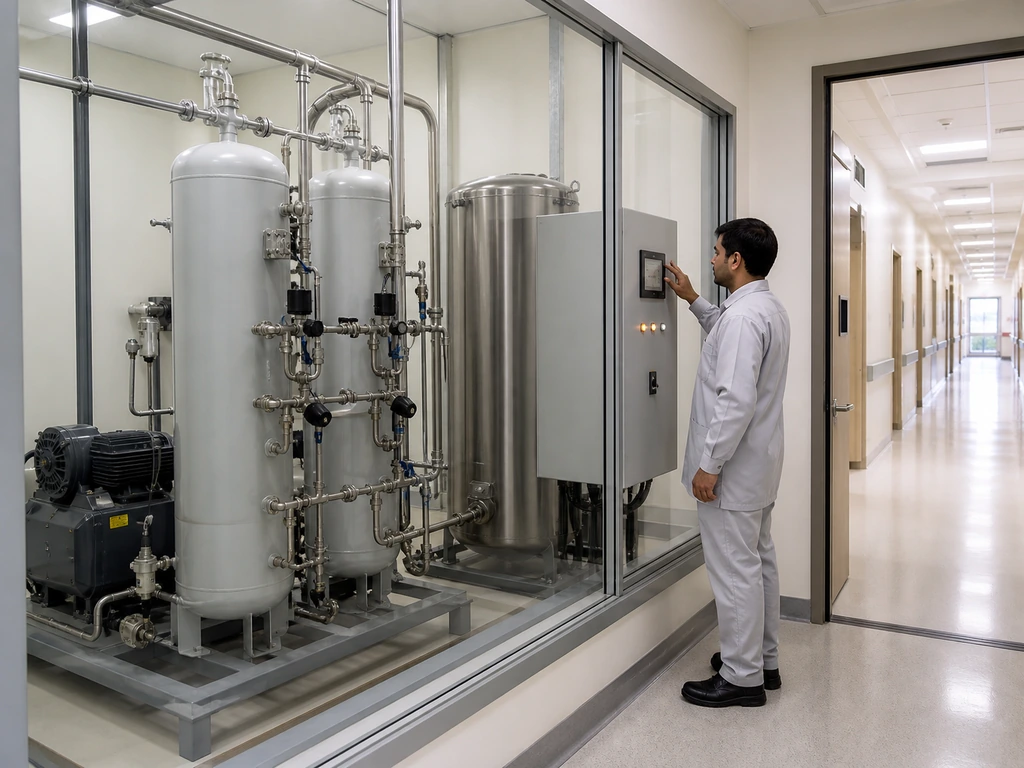
The numbers bear this out. A 2024 analysis published in a peer-reviewed medical journal found that PSA plants operating at full capacity (24 hours per day) on grid electricity achieved the lowest per-cubic-meter cost among all oxygen supply modes evaluated (Manhas et al., 2024). The typical energy consumption for PSA oxygen production at 90 to 93 percent purity ranges from 0.4 to 0.8 kWh per cubic meter — comparable to running a small household appliance.
| Industry | Typical O₂ Purity | PSA Fit | Key Consideration |
|---|---|---|---|
| Medical / Hospital | 93% ±3% | ✅ Core | Rapid deployability proven in pandemic surge |
| Glass Manufacturing | 90–95% | ✅ Strong | Replaces liquid oxygen; cuts transport costs |
| Wastewater Treatment | 90–93% | ✅ Strong | Aeration basin oxygenation |
| Aquaculture | 90–93% | ✅ Strong | Dissolved oxygen control in fish farms |
| Metal Cutting / Laser | 93–95% | ✅ Strong | Assist gas for laser and plasma cutting |
| Chemical Oxidation | 90–95% | ✅ Strong | Process oxidation reactions |
| Pulp & Paper Bleaching | 90–93% | ✅ Strong | Pulp delignification and bleaching |
| Ozone Generation | 90–93% | ✅ Strong | Feedstock for ozone generators |
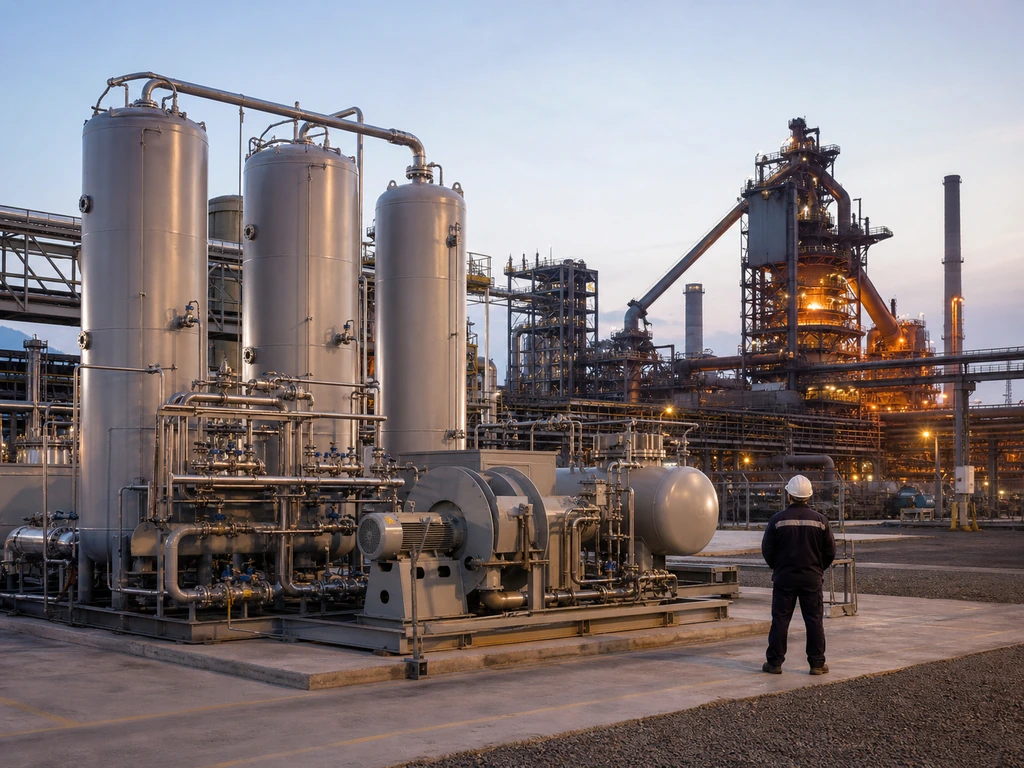
The 95 percent purity ceiling — dictated by argon, as discussed earlier — is rarely a problem for these applications. Most industrial and medical processes do not need 99.5 percent oxygen. For those that do, the answer is usually cryogenic distillation, not PSA.
PSA for Biogas Upgrading — The Fastest-Growing Application
Of all the industrial applications for pressure swing adsorption, biogas upgrading is the one that is expanding fastest — and the one that is least well-covered by accessible technical literature. If you search for “PSA biogas upgrading,” you will find academic papers behind paywalls and brief mentions on industry association websites. What you will not find is a clear, practical guide that connects the technology to the economics. This section fills that gap.
How PSA Upgrades Raw Biogas to Biomethane
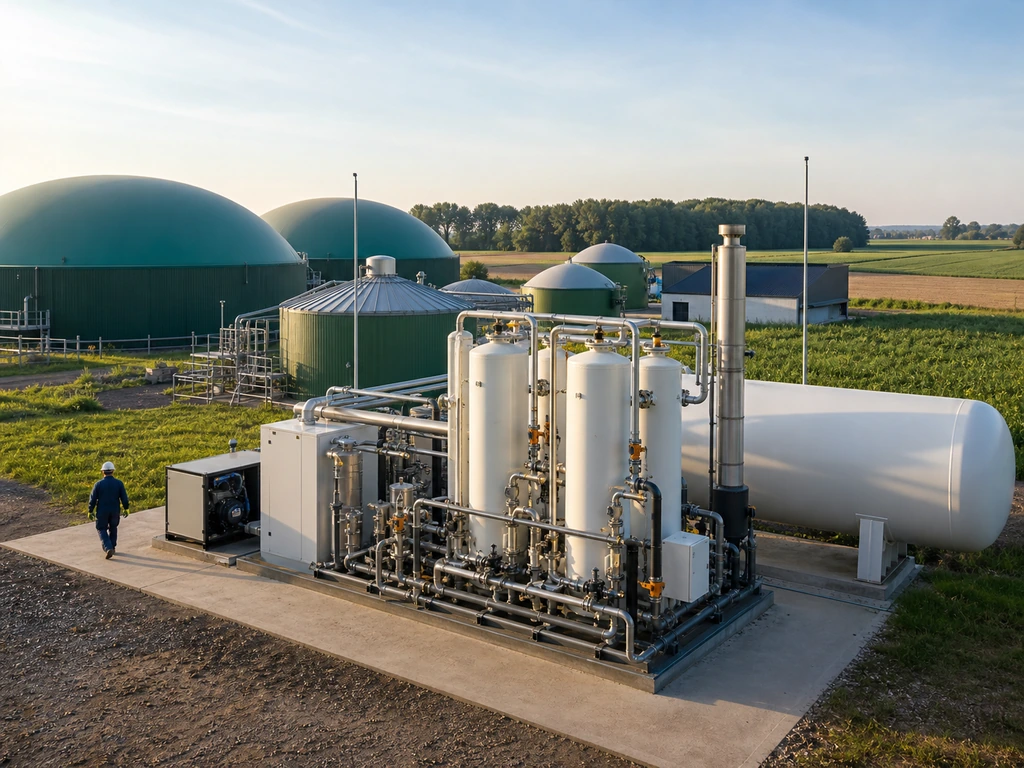
Raw biogas from an anaerobic digester is roughly 55 to 65 percent methane (CH₄), 35 to 45 percent carbon dioxide (CO₂), and trace amounts of hydrogen sulfide (H₂S), water vapor, and siloxanes. To inject this gas into a natural gas pipeline or use it as vehicle fuel, the methane content must be raised to at least 97 percent — the standard for pipeline-grade renewable natural gas (RNG) in most jurisdictions.
PSA achieves this by exploiting the large difference in how CO₂ and CH₄ interact with zeolite surfaces. CO₂ has a quadrupole moment of approximately -4.1 × 10⁻²⁶ esu·cm² — nearly three times the magnitude of nitrogen’s — which means it binds strongly to zeolite cations. Methane, by contrast, has zero quadrupole moment: it is a symmetrical, non-polar molecule that interacts much more weakly with zeolite surfaces. The selectivity ratio (CO₂ over CH₄) for a standard 13X zeolite at 1 bar and 25°C is roughly 20 to 30.
The process flow looks like this: raw biogas first passes through pretreatment — H₂S removal (typically via activated carbon or iron oxide beds) and dehydration (via condensation or desiccant drying) — to protect the PSA adsorbent from contaminants. The cleaned biogas is then compressed to 5 to 10 bar and fed into the adsorption towers, where CO₂ is selectively adsorbed. Conventional PSA typically recovers about 75 to 85 percent of the incoming methane; optimized systems with vacuum-assisted regeneration and tail-gas recovery can reach approximately 90 to 98 percent. Recovery should therefore be specified together with the exact cycle configuration rather than quoted as a single generic PSA value.
Adsorbent Selection for Biogas PSA — Why It’s Different from Oxygen PSA
It is tempting to assume that “zeolite is zeolite” and the same material that works for oxygen PSA will work for biogas. That assumption is expensive.
In oxygen PSA, the goal is to capture nitrogen (small quadrupole, moderate affinity) while letting oxygen pass. In biogas PSA, the goal is to capture CO₂ (large quadrupole, very strong affinity) while letting methane pass. The adsorbent properties that optimize one process do not necessarily optimize the other. For biogas, the ideal adsorbent needs:
- High CO₂/CH₄ selectivity: 13X zeolite at 20–30 is adequate; specialized formulations can push this higher, improving methane recovery
- Good CO₂ working capacity: at 1 bar, 13X zeolite adsorbs roughly 3 to 4 mmol/g of CO₂ — more than it adsorbs N₂ in oxygen service, because CO₂’s stronger quadrupole means more molecules cram onto the surface
- Tolerance to trace H₂S: even after pretreatment, residual H₂S can irreversibly bind to zeolite cations, gradually poisoning the adsorbent. Front-end H₂S removal to below 10 ppm is essential for long adsorbent life
- Hydrothermal stability: biogas is often saturated with water vapor; the adsorbent must withstand repeated exposure to humidity without structural collapse
Carbon molecular sieves offer an alternative approach for biogas: instead of equilibrium selectivity, they use kinetic selectivity — CO₂ diffuses into CMS pores faster than CH₄ does. The choice between zeolite and CMS for biogas PSA depends on the specific gas composition, desired methane recovery, and operating pressure, and is best made with input from an adsorbent manufacturer who can model the full process.
The Economics of Biogas PSA — When Does It Make Financial Sense?
For a project developer or plant operator, the question is not whether PSA can upgrade biogas — it clearly can — it is whether PSA is the right choice at a given scale and market.
Biogas-upgrading capital cost should be expressed against installed treatment capacity, not as a price per cubic meter of gas. As a rough order-of-magnitude example, a 500 Nm³/h raw-biogas plant may require approximately $1.8 million to $2.5 million in CAPEX, depending on cycle configuration, pretreatment, automation, methane-recovery target, and adsorbent specification (Market Growth Reports, 2026). Operating costs are often quoted per cubic meter of raw biogas processed and are dominated by compression power, maintenance, and periodic adsorbent replacement.
The scale economics are important. Below roughly 100 Nm³/h of raw biogas, water scrubbing or membrane separation tends to be more cost-effective. Between 100 and 2,000 Nm³/h, PSA occupies a sweet spot where its combination of moderate capital cost, low operating complexity, and simultaneous dehydration makes it attractive. Above 2,000 Nm³/h, amine scrubbing — which offers higher methane recovery — becomes increasingly competitive.
The revenue side is what makes the math work. In the United States, renewable natural gas projects earn revenue from two main sources: the commodity value of the gas itself, and environmental credits. The federal Renewable Identification Number (RIN) program under the Renewable Fuel Standard generates roughly $2 to $3 per million BTU for D3 RINs (cellulosic biofuel). In California, the Low Carbon Fuel Standard (LCFS) adds another significant revenue stream — credits have historically traded at $100 to $200 per metric ton of CO₂ equivalent reduction. For a typical 500 Nm³/h biogas PSA plant producing roughly 250 Nm³/h of RNG, the combined gas value plus environmental credits can drive project payback periods into the 3-to-5-year range, depending on feedstock cost and local incentive structures.
PSA vs. Other Gas Separation Technologies — How to Choose
Choosing a gas separation technology is ultimately a three-variable problem: scale, purity requirement, and budget. The following matrix provides a structured comparison across the four main industrial options.
| Dimension | PSA | VPSA | Cryogenic | Membrane |
|---|---|---|---|---|
| Separation Principle | Pressure-driven adsorption | Vacuum + pressure adsorption | Boiling point difference | Selective permeation |
| O₂ Purity (max) | 90–95% | 90–93% | 99.5%+ | 30–45% (O₂ enrichment) |
| N₂ Purity (max) | 95–99.999% | N/A | 99.999%+ | 95–99.5% (up to ~99.9%) |
| Optimal Scale | Small–medium (1–200 Nm³/h) | Medium–large (100–5,000+) | Large (>5,000 Nm³/h) | Small–medium (1–100 Nm³/h) |
| Energy (O₂) | 0.4–0.8 kWh/Nm³ | 0.3–0.5 kWh/Nm³ | 0.2–0.4 kWh/Nm³ (large plants) | N/A |
| Capital Cost | Moderate | Moderate–high | Very high | Low–moderate |
| Startup Time | Minutes | Minutes | Hours | Minutes |
| Footprint | Compact | Moderate | Large | Most compact |
| Adsorbent/Membrane Life | Zeolite: 3–5 yr | Zeolite: 3–5 yr | N/A | Membrane: 3–5 yr |
A few practical decision rules emerge from this comparison. If you need 90 to 93 percent oxygen at small to medium scale, standard PSA is usually the default choice. VPSA adds vacuum-assisted regeneration and becomes attractive at larger scales where electricity savings justify the additional equipment. For very large, continuously operated plants requiring 99.5 percent or higher purity, cryogenic separation offers both the required purity and lower specific energy consumption. Membrane systems occupy the low-capital, compact end of the spectrum: they are well suited to oxygen enrichment and to nitrogen production in the economically favorable 95–99.5 percent purity range, with some systems approaching 99.9 percent.
The trade-off worth internalizing: every percentage point of purity you do not actually need is money left on the table in capital and operating costs.
Pressure swing adsorption has been a commercial technology for over five decades, but it is far from static. Advances in adsorbent materials — particularly in lithium-exchanged zeolites with higher nitrogen capacity and in structured adsorbents that reduce pressure drop — continue to push down the cost per cubic meter of separated gas. The fastest growth is in biogas upgrading, where PSA is competing with membrane and amine-based systems for a share of a global biogas upgrading market projected to grow at a compound annual rate above 11 percent through the mid-2030s.
For the engineer evaluating a PSA system, the most important questions are not about the general principle — those are well understood — but about the specifics: which adsorbent formulation, which cycle configuration, and which supplier provides the technical support and quality consistency needed for stable operation. JALON supports PSA projects with application-specific molecular sieve grades, batch-level quality documentation, and engineering input for oxygen generation, biogas upgrading, and hydrogen purification. Its team can review feed composition, cycle conditions, purity targets, and bed requirements before recommending a formulation. Get those decisions right, and PSA can deliver reliable, cost-effective gas separation over years of continuous operation.
References
- Sircar, S. Pressure Swing Adsorption. Industrial & Engineering Chemistry Research, 2002, 41(6), 1389–1392.
- ACS Publications. High-Purity Oxygen Production by Pressure Swing Adsorption. Industrial & Engineering Chemistry Research, 2006.
- Manhas, V. et al. Cost Analysis of Different Medical Oxygen Sources for a Health Facility. PMC, 2024.
- Market Growth Reports. PSA Biogas Upgrading Market Size, Share & Outlook | 2035. 2026.
- Si, H. et al. Review: Pressure Swing Adsorption for Oxygen Production. Chemical Engineering Journal, 2025.
- American Biogas Council. Pressure Swing Adsorption — Processing.


 EN
EN  DE
DE  ES
ES  JA
JA  RU
RU  PT
PT  FR
FR  AR
AR  KO
KO  TH
TH  ID
ID