What a Zeolite Framework Is Made Of
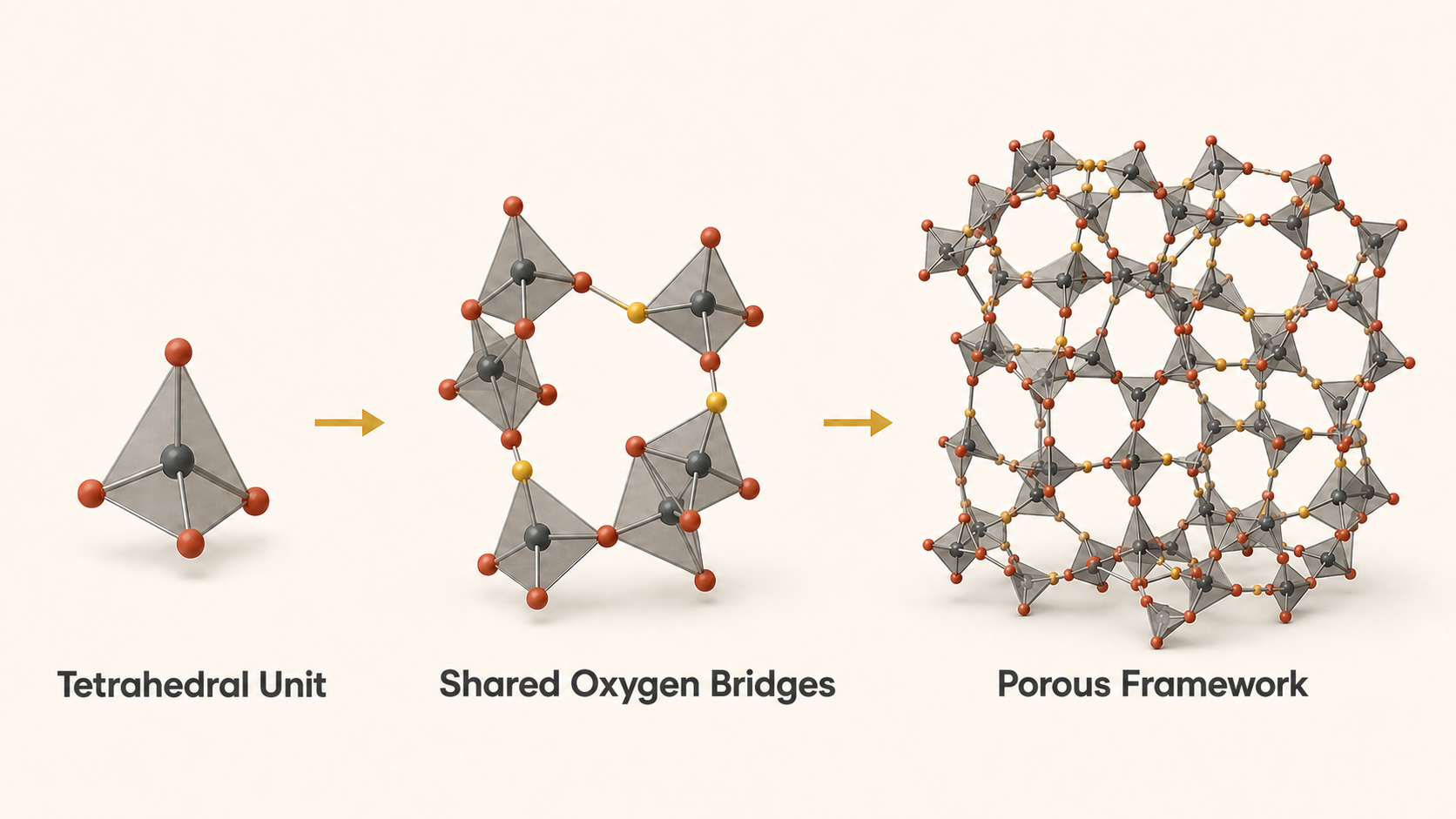
Every zeolite starts with a single geometric fact: a tiny tetrahedron, four oxygen atoms arranged around one central atom — usually silicon or aluminum. Chemists call this a TO₄ unit, where T stands for the tetrahedral atom at the center. Si–O bonds stretch roughly 1.61 Å; Al–O bonds run a bit longer at about 1.75 Å. The difference matters: swap silicon for aluminum, and the framework picks up a negative charge that changes everything downstream.
These tetrahedra do not float in isolation. Each oxygen atom bridges exactly two T atoms, linking tetrahedron to tetrahedron in what is called corner-sharing. The result is a continuous, three-dimensional scaffold. It is crystalline, not amorphous; rigid, not layered like clay. This framework is threaded with channels and cavities of molecular dimensions, which is why zeolites can act as sieves at the scale of individual molecules.
The general chemical formula captures the essentials: Mₓ/ₙ[(AlO₂)ₓ(SiO₂)ᵧ]·zH₂O. A metal cation M balances the charge from each aluminum substitution, plus removable water sits in the pores. But the formula only tells you what atoms are present. To understand what a zeolite can actually do, you need to look at how those tetrahedra are connected. That is where framework types come in.
How Framework Types Define Pore Architecture
Before examining individual frameworks, it helps to have a mental ruler. Three characteristics define any zeolite’s pore architecture: ring size (the diameter of the aperture that molecules must pass through), channel dimensionality (whether those channels run in one, two, or three dimensions), and cage topology (how internal void spaces are arranged). Every framework type is a unique combination of these three variables.
Ring Size — The Gatekeeper of Molecular Access
A zeolite’s pore opening is defined by a ring: a closed loop of n tetrahedral atoms bridged by n oxygen atoms. The number of T atoms in that loop — conventionally 8, 10, or 12 — sets the aperture size, and the aperture size determines which molecules can enter.
Eight-membered rings open windows of roughly 3.8 to 4.3 Å. This is small-pore territory: water (kinetic diameter 2.65 Å), ammonia, and small linear molecules pass through, but anything bulkier is excluded. The LTA framework, the structural basis of commercial 3A, 4A, and 5A molecular sieves, belongs to this class. Swap the cation in the LTA pore from sodium to potassium, and the effective opening shrinks from ~4.1 Å to ~3 Å. Same framework, different gatekeeper.
Ten-membered rings create medium-pore zeolites with apertures around 5.1 to 5.6 Å. The MFI framework, known commercially as ZSM-5, is the flagship here: its intersecting 10-ring channels can discriminate between straight-chain and branched hydrocarbons with remarkable precision.
Twelve-membered rings open large pores of roughly 7.0 to 7.5 Å. The FAU framework, the structural backbone of zeolites X and Y, falls into this class. Its 12-ring aperture at 7.4 Å is the industrial standard for large-pore zeolites, spacious enough to admit substituted aromatics and the heavier fractions processed in fluid catalytic cracking.
A practical example: n-butane has a kinetic diameter of approximately 4.3 Å. It slips through 5A zeolite (Ca-exchanged LTA, ~5 Å effective opening) but is excluded by 4A zeolite (Na-exchanged LTA, ~4 Å). The difference between a 4A and a 5A sieve is literally a single angstrom. And that angstrom determines whether a multi-million-dollar dehydration process works or bleeds product.
Framework Type Codes — The Three-Letter Language of Zeolites
If you have ever scanned a zeolite product datasheet and wondered what LTA, FAU, or MFI actually mean, you are not alone. These three-letter codes are assigned by the Structure Commission of the International Zeolite Association (IZA-SC), the global authority that catalogs every confirmed zeolite framework topology. As of 2025, the IZA database lists over 255 distinct framework types, each with a unique three-letter designation (IZA Structure Commission, 2025).
The code describes topology (how the tetrahedra are connected), not chemical composition. LTA stands for Linde Type A, named after the company that first synthesized it. FAU derives from the mineral faujasite. MFI stands for Mobil Five (now ZSM-5), named for the Mobil Oil researchers who created it. Once a topology is catalogued, any material sharing that connectivity carries the same three-letter code, whether it is an aluminosilicate, a silicoaluminophosphate, or a pure-silica variant.
Among the 255+ frameworks, only a handful dominate industrial use. The so-called Big Five high-silica zeolites — FAU, *BEA, MOR, MFI, and FER — account for the vast majority of commercial catalyst and adsorbent production. Eight framework types (these five plus LTA, CHA, and HEU) cover nearly every major industrial zeolite application in existence.
LTA, FAU, and MFI — Three Frameworks That Run the Industry
If you understand these three, you understand 80% of the zeolites you will encounter in practice.
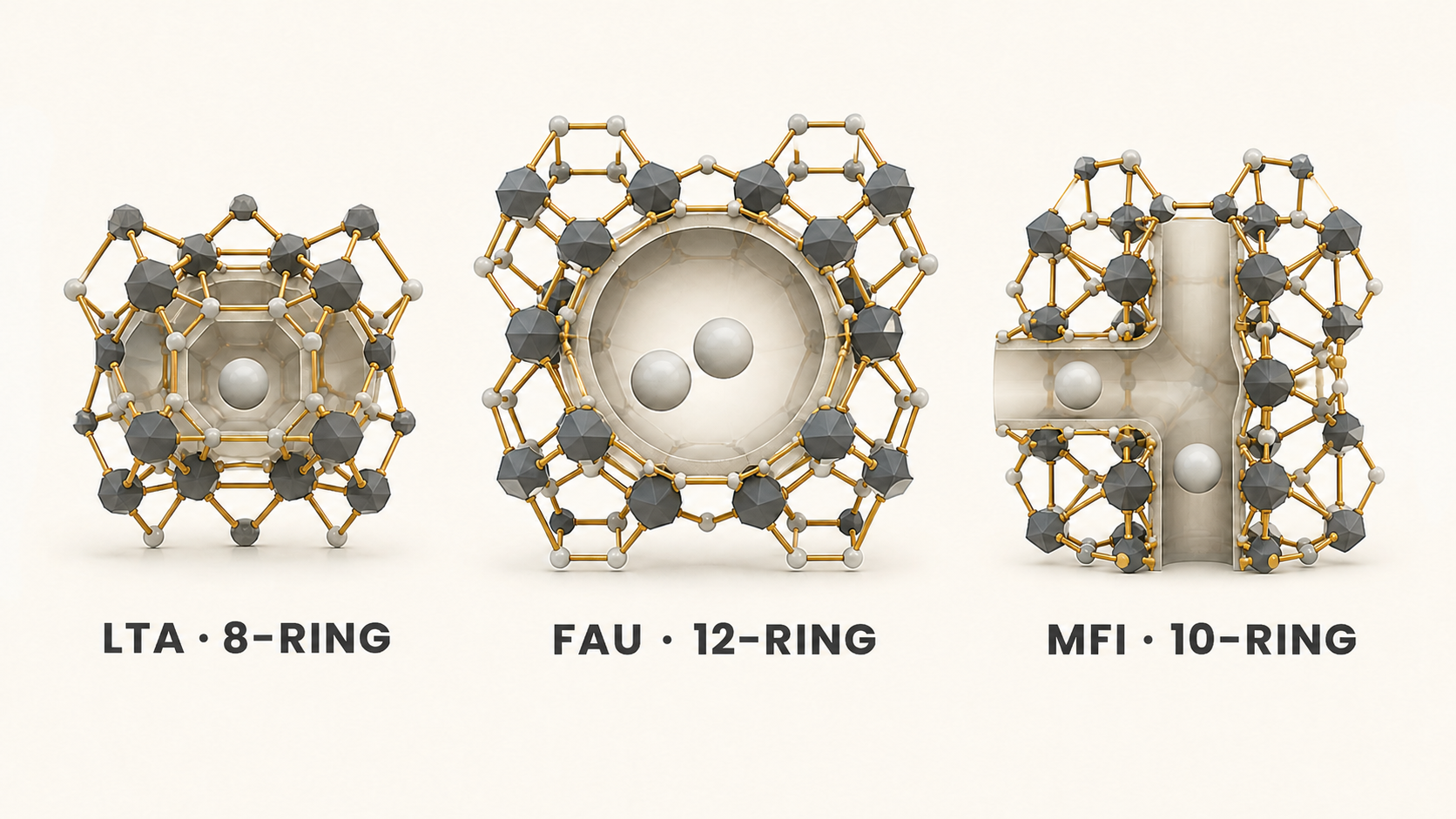
LTA (Linde Type A) is a small-pore, 8-ring framework built from two nested cage types: the sodalite cage (β-cage, internal diameter ~6.6 Å) and the larger α-cage (~11.4 Å), connected through double four-membered rings. The 8-ring aperture (~4.1 Å in sodium form) makes LTA the workhorse for selective water removal. Ethanol dehydration, refrigerant drying, and insulating glass anti-fogging all depend on 3A molecular sieves, which are simply LTA with potassium cations narrowing the effective pore to ~3 Å.
FAU (Faujasite) is a large-pore, 12-ring framework. Its sodalite cages connect via double six-membered rings to form a supercage roughly 12 Å across, accessible through a 7.4 Å 12-ring window. This is large enough to admit most industrially relevant molecules. That is why FAU-based materials anchor both ends of the refining spectrum: 13X zeolite (Si/Al ≈ 1.0–1.5, hydrophilic) for air pre-purification and CO₂ removal, and ultrastable Y zeolite (USY, typically Si/Al > 6 after dealumination, hydrophobic and thermally robust) for fluid catalytic cracking — the single largest catalytic process on Earth by tonnage.
MFI (ZSM-5) is a medium-pore, 10-ring framework with a distinctive two-dimensional channel system: straight elliptical channels (5.3 × 5.6 Å, running along the b-axis) intersected by nearly circular sinusoidal channels (5.1 × 5.5 Å, along the a-axis). This architecture gives MFI its celebrated shape selectivity. Straight-chain molecules navigate the channels freely while branched isomers bottleneck. ZSM-5 exploits this in xylene isomerization, dewaxing, and the methanol-to-gasoline process, where the framework literally selects which products can exit.
| Framework | Ring Size | Pore Opening | Channel Dimensionality | Representative Products | Signature Application |
|---|---|---|---|---|---|
| LTA | 8-ring | ~4.1 Å (Na⁺ form) | 3D (cage-based) | 3A, 4A, 5A molecular sieves | Ethanol dehydration, gas drying |
| FAU | 12-ring | ~7.4 Å | 3D (cage-based) | 13X, CaX, LiLSX, USY | Air separation, FCC catalysis |
| MFI | 10-ring | ~5.5 Å | 2D (intersecting channels) | ZSM-5, Silicalite-1 | Shape-selective catalysis, xylene isomerization |
The Si/Al Ratio — Composition as a Hidden Structural Lever
Most discussions of zeolite structure stop at geometry. But the framework’s chemical composition — specifically the ratio of silicon to aluminum — acts as a master control knob, systematically tuning acidity, hydrophobicity, thermal stability, and ion-exchange capacity without altering the underlying topology. If framework type is the engine, the Si/Al ratio is the tuning.
How the Si/Al Ratio Shapes Zeolite Behavior
The controlling principle is a rule proposed by Walter Loewenstein in 1954: in aluminosilicate frameworks, two AlO₄ tetrahedra cannot share an oxygen atom. The Al–O–Al linkage is energetically unfavorable, which means every aluminum must be surrounded by silicon neighbors. The practical consequence is a hard floor (Si/Al cannot drop below 1) and a range that extends upward to infinity, corresponding to pure-silica zeolites with zero aluminum (Fletcher et al., Chemical Science, 2017).
Every aluminum substitution creates one negative charge on the framework. At Si/Al = 1, the framework is densely charged, strongly hydrophilic, and packed with charge-balancing cations. This is the domain of LTA-based 3A, 4A, and 5A sieves, which excel at water adsorption precisely because water is drawn into their polar, cation-rich pores. As Si/Al rises, the charge density drops, the framework becomes increasingly hydrophobic, and the remaining acid sites (bridging hydroxyls, Si–OH–Al) become fewer in number but individually stronger. At the extreme — Silicalite-1, the all-silica MFI variant with Si/Al → ∞ — the material is completely hydrophobic, catalytically inert, and thermally stable beyond 1,000°C.
The transition is not linear. Moving Si/Al from 1 to 3 produces a far more dramatic change in hydrophilicity and ion-exchange capacity than moving it from 10 to 100. For industrial practitioners, the practical band of interest sits between roughly Si/Al = 1 (maximum ion exchange) and Si/Al = 5–10 (catalytic-grade acidity with workable stability).
What the Si/Al Ratio Means for Real-World Zeolite Selection
The FAU family provides the clearest demonstration of composition-driven performance differentiation. The framework is identical — same supercage, same 12-ring aperture — but varying the Si/Al ratio produces materials optimized for entirely different jobs.
The takeaway for anyone specifying a zeolite: identifying the right framework type is only half the job. The Si/Al ratio must match the application, and not all off-the-shelf products cover the full compositional range.
For processes operating at the edges of standard specifications, working with a manufacturer that can adjust the Si/Al ratio — along with crystal type, cation form, and particle size distribution — turns what would be a compromise into a solution engineered for the specific separation or catalytic challenge at hand. If you are evaluating options, discussing your separation requirements with a technical team (contact Jalon) can clarify whether a standard product covers your operating window or whether a tailored composition is warranted.
From Structure to Performance — How Pore Geometry Drives Adsorption
Two industry cases make the structure-to-performance relationship concrete.
Case 1: Why ethanol dehydration typically uses 3A rather than 4A. Water molecules have a kinetic diameter of 2.65 Å, comfortably smaller than the 3 Å aperture of potassium-exchanged LTA. Ethanol, at about 4.3 Å, is excluded. A 4A sieve also generally excludes bulk ethanol because its effective opening is near 4 Å, but 3A provides a wider exclusion margin and reduces co-adsorption of smaller polar impurities such as methanol. The angstrom-level difference created by the exchanged cation therefore improves selectivity and process robustness.
Case 2: Why PSA oxygen generators use lithium-exchanged LSX. Nitrogen and oxygen are nearly identical in size (N₂ at 3.64 Å, O₂ at 3.46 Å), so geometric sieving alone cannot separate them efficiently. The solution lies in surface chemistry: N₂ has a quadrupole moment of approximately −4.7 × 10⁻⁴⁰ C·m² (reported experimentally as −4.65 ± 0.08 × 10⁻⁴⁰ C·m²), which interacts strongly with the high charge density of Li⁺ cations. The commonly cited Li⁺ effective radius of 0.76 Å is the Shannon value for coordination number 6; its effective size in a zeolite varies with the local coordination environment. Lithium-exchanged low-silica X zeolite (Li-LSX, FAU framework) preferentially adsorbs nitrogen from compressed air via this electrostatic interaction. Under PSA cycling — adsorption at 2–4 bar, desorption at near-ambient pressure — the nitrogen is retained while oxygen passes through, delivering product purity of 93% ± 3%. The structure (FAU’s large supercage for high N₂ capacity) and the chemistry (Li⁺’s polarizing power) work together. Neither alone would deliver commercial performance.
The principle these cases share: zeolite selection is never purely geometric. It is the interaction of aperture size (what fits), framework topology (how it moves through), and surface chemistry (how strongly it sticks) that determines whether a zeolite works in practice.
Matching Zeolite Structure to Industrial Application — A Practical Reference
Selecting the right zeolite starts with three questions: What is the kinetic diameter of your target molecule? What are the operating conditions — temperature, water content, acid environment? Do you need catalysis, or is this a pure adsorption/separation task?
The table below maps the major industrial framework types to their real-world applications. Use it as a starting point, then verify against your specific process conditions. As the Si/Al discussion above makes clear, the framework code alone does not tell the full story.
| Framework | Ring/Pore | Si/Al Range | Product Examples | Core Industrial Use | Key Molecular Selectivity |
|---|---|---|---|---|---|
| LTA (K⁺) | 8-ring / ~3 Å | ~1 | 3A Molecular Sieve | Ethanol dehydration, insulating glass, refrigerant drying | Adsorbs H₂O (2.65 Å), excludes ethanol (4.3 Å) |
| LTA (Na⁺) | 8-ring / ~4 Å | ~1 | 4A Molecular Sieve | General gas drying, natural gas dehydration | Adsorbs H₂O, CO₂; excludes n-butane |
| LTA (Ca²⁺) | 8-ring / ~5 Å | ~1 | 5A Molecular Sieve | n-/iso-paraffin separation, H₂ purification | Adsorbs n-alkanes, excludes branched isomers |
| FAU (X) | 12-ring / ~7.4 Å | 1.0–1.5 | 13X, LiLSX, CaX | Air separation (PSA/VPSA O₂), CO₂ capture, natural gas sweetening | Li-LSX preferentially adsorbs N₂ over O₂ |
| FAU (Y/USY) | 12-ring / ~7.4 Å | 2.5–3.5 (NaY synthesis); >3.5 after dealumination | USY, HY | Fluid catalytic cracking, hydrocracking | Catalytic — Brønsted acid sites crack C–C bonds |
| MFI | 10-ring / ~5.5 Å | 10–∞ | ZSM-5, Silicalite-1 | Xylene isomerization, dewaxing, methanol-to-gasoline | Shape-selective — straight chains pass, branched bottleneck |
| CHA | 8-ring / ~3.8 Å | 5–50 | SSZ-13, SAPO-34 | Diesel SCR (NOₓ reduction), methanol-to-olefins | Cu-SSZ-13: dynamic Cu sites reduce NOₓ with NH₃ |
| MOR | 12-ring / 6.5 × 7.0 Å main channel; 8-ring / 2.6 × 5.7 Å side-pocket entrance | 5–30 | Mordenite | Alkylation, hydroisomerization | One-dimensional main channels with side pockets — rapid coking risk |
The structures behind these applications are not academic curiosities. They are the reason a refinery runs at 95% yield instead of 85%, or an oxygen concentrator lasts five years instead of two. Understanding the framework gives you the tool. Verifying that your supplier can deliver the right framework, at the right Si/Al ratio, with the right cation form and particle size, is what turns that understanding into a reliable industrial result.
References
- International Zeolite Association Structure Commission. Database of Zeolite Structures. 2025.
- Fletcher, R.E., et al. Violations of Löwenstein’s Rule in Zeolites. Chemical Science, 2017.
- Corma, A. From Microporous to Mesoporous Molecular Sieve Materials and Their Use in Catalysis. Chemical Reviews, 1997.
- Baerlocher, Ch.; McCusker, L.B.; Olson, D.H. Atlas of Zeolite Framework Types, 6th ed. IZA-SC, 2007.
- Breck, D.W. Zeolite Molecular Sieves: Structure, Chemistry, and Use. Wiley, 1974.


 EN
EN  DE
DE  ES
ES  JA
JA  RU
RU  PT
PT  FR
FR  AR
AR  KO
KO  TH
TH  ID
ID