How Do Molecular Sieves Work? A Practical Guide to Pores, Adsorption, and Separation
What Is a Molecular Sieve?
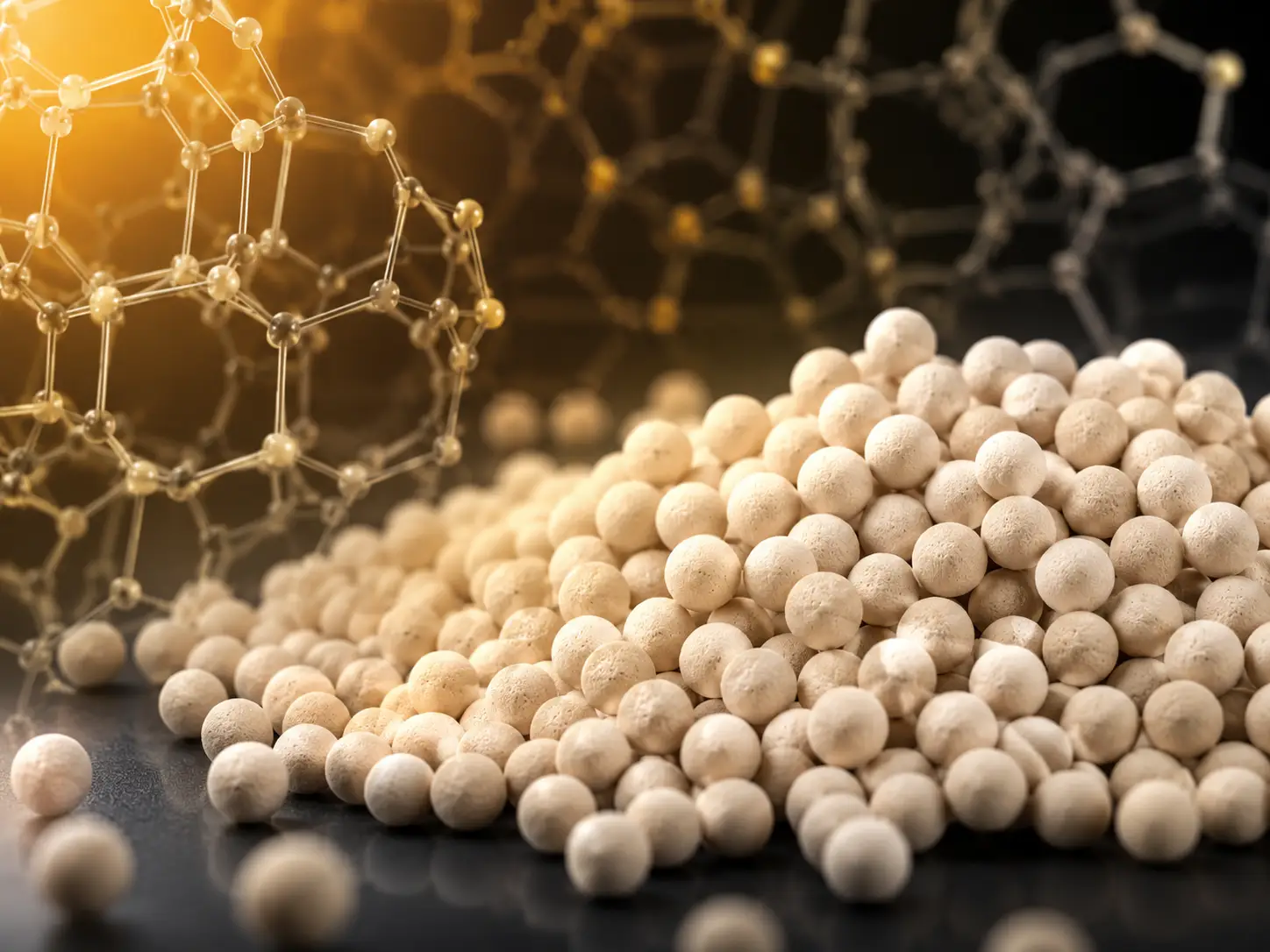
A molecular sieve is a crystalline material with uniform, angstrom-scale pores that selectively adsorb molecules according to size and chemical affinity. Its pore openings are typically just 3 to 10 angstroms wide, allowing it to separate molecules at a scale ordinary filters cannot reach.
Most commercial sieves are synthetic zeolites: crystalline aluminosilicates with repeating cage-and-channel structures. This precision enables applications ranging from dehydration to petrochemical separations and medical oxygen production. For example, 3A captures water while excluding ethanol, making it the preferred adsorbent for fuel-grade ethanol dehydration; 4A can also be used where its ~4 Å opening excludes ethanol.
Inside the Crystal Structure
To understand how a molecular sieve actually works, you need to zoom in. Past the visible bead or pellet. Past the binder that holds the crystals together. Into the atomic framework itself, at the scale of shared oxygen atoms and cation exchange sites. This is where the sieve’s true mechanism lives.
The Zeolite Framework: Tetrahedra at Work
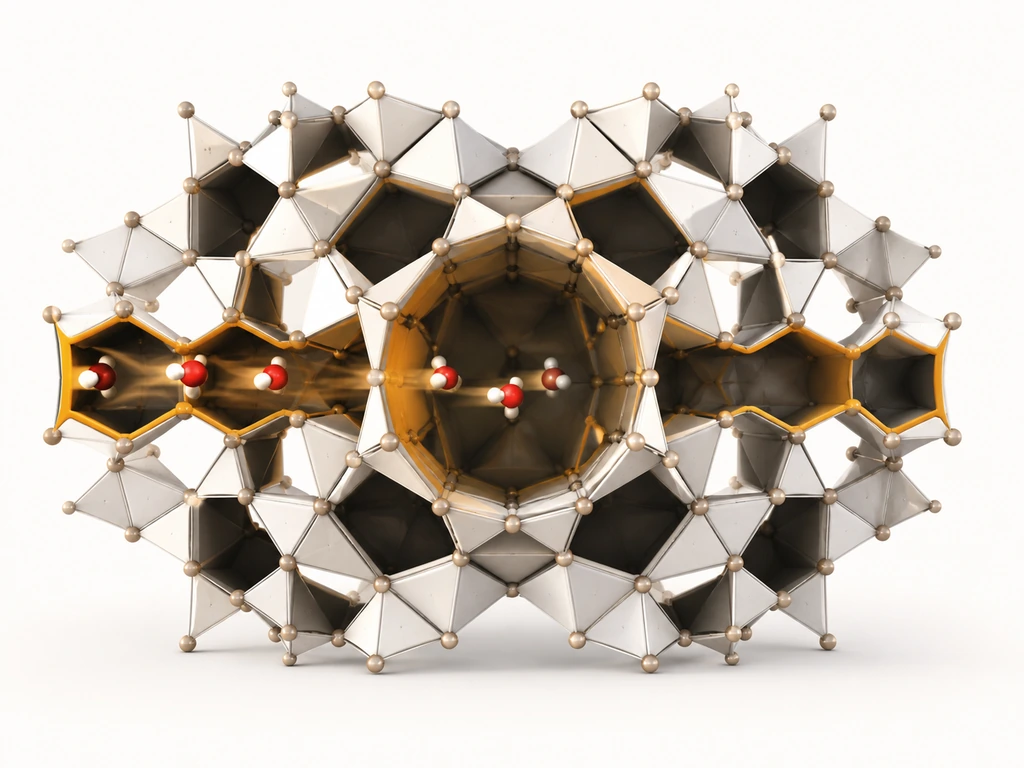
The fundamental building block of every zeolite molecular sieve is the tetrahedron: a central silicon or aluminum atom bonded to four oxygen atoms. These SiO₄ and AlO₄ tetrahedra connect by sharing oxygen vertices — think of Lego bricks snapping together at their corners — to form a three-dimensional lattice. The resulting framework follows a general chemical formula:
Mx/n[(AlO₂)x(SiO₂)y]·mH₂O
Here, M represents exchangeable cations (typically Na⁺, K⁺, or Ca²⁺) that balance the negative charge introduced by each aluminum atom. The water molecules (“mH₂O”) occupy the pores and cavities in the as-synthesized material; they’re removed during activation to create the empty adsorption volume.
The two most important commercial framework types are LTA (Linde Type A) and FAU (Faujasite). In the LTA structure, sodalite cages — also called β-cages, each about 6.6 Å in internal diameter — connect through double four-membered oxygen rings to form a larger central cavity: the α-cage, or supercage. The FAU framework uses double six-membered rings to link its sodalite cages, producing an even larger supercage roughly 12 Å across. This architectural difference between LTA and FAU is what separates the 3A/4A/5A family from the 13X family.
Pores, Cages, and Channels
Think of the zeolite framework as a hotel. The cages are guest rooms where adsorbed molecules reside. The channels connecting them are corridors. The pore openings — formed by oxygen rings at the cage entrances — are doorways. The critical question is the same one you’d ask at a hotel: how wide is the door?
The door width is set by the number of oxygen atoms in the ring that forms the pore opening. An 8-membered oxygen ring (8-MR), as found in LTA-type sieves, creates a pore opening of roughly 4 Å. A 12-membered ring (12-MR), characteristic of FAU-type sieves, yields a pore opening of approximately 7.4 Å. These dimensions follow directly from the Si-O and Al-O bond lengths and the geometry of the tetrahedral network.
Not every cage in the structure is accessible, though. The sodalite cage (β-cage) in LTA has an internal diameter of 6.6 Å — large enough to hold a small molecule. But its entrance is only a 6-membered ring with an opening of about 2.8 Å, which is too narrow for almost any molecule except helium. The cage exists, but the door is permanently locked.
The total internal surface area created by this cage-and-channel architecture is staggering: a single gram of typical molecular sieve can expose roughly 500 to 800 square meters of internal surface, depending on the measurement method, sample pretreatment, and product grade. That’s roughly the area of a football field, folded into a space smaller than a sugar cube.
Pore Size: The Gatekeeper That Decides What Gets Through
All the elegant cage architecture serves one purpose: to let the right molecules in and keep the wrong ones out. That discrimination happens at the pore opening. The size of that opening — measured in angstroms — is what distinguishes one molecular sieve type from another.
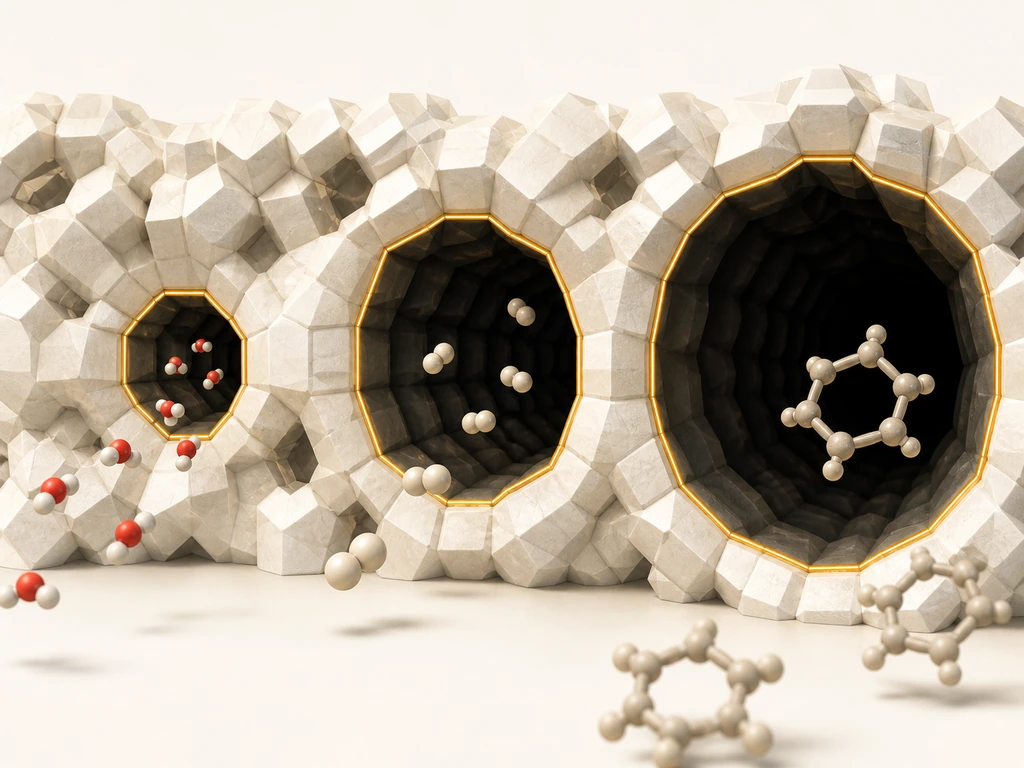
The 3A–4A–5A–13X Spectrum
The commercial molecular sieve types are not different materials. They are variations on the same two frameworks — LTA and FAU — tuned by swapping the cations that sit inside the pore openings.
Start with the baseline: the LTA framework, in its sodium form, has an effective pore opening of approximately 4 Å. This is 4A molecular sieve (Na₁₂[(AlO₂)₁₂(SiO₂)₁₂]·mH₂O). The sodium cations occupy positions near the 8-membered oxygen rings that serve as the cage entrances.
Now substitute potassium for sodium. A K⁺ ion has an effective ionic radius of 1.38 Å, significantly larger than Na⁺ at 1.02 Å (six-coordinate Shannon radii). The larger potassium ions physically crowd the pore opening, reducing the effective aperture to roughly 3 Å. You’ve just made 3A molecular sieve: same LTA skeleton, narrower door.
Go the other direction: replace two monovalent Na⁺ ions with one divalent Ca²⁺ ion. The calcium ion has a similar radius to sodium (~1.00 Å), but one Ca²⁺ replaces two Na⁺, so the total number of cations occupying pore-opening sites is cut in half. The result is less obstruction at the doorway and an effective pore opening that expands to about 5 Å. That’s 5A molecular sieve.
The 13X molecular sieve takes a different path entirely. It uses the FAU framework (Faujasite), whose 12-membered oxygen rings create a naturally wider pore opening of ~7.4 Å. Combined with the larger FAU supercage (~12 Å), 13X can admit molecules that LTA-based sieves cannot touch, including aromatics like benzene (5.85 Å) and branched hydrocarbons.
Which Molecule Fits Which Pore? — A Quick Reference
| Molecular Sieve | Effective Pore Opening | Traps These Molecules | Lets These Pass |
|---|---|---|---|
| 3A | ~3 Å | H₂O (2.65 Å), NH₃ (2.6 Å) | Ethanol (4.3 Å), most organics |
| 4A | ~4 Å | H₂O, CO₂ (3.3 Å), N₂ (3.64 Å), O₂ (3.46 Å), CH₄ (3.8 Å) | Propane (4.9 Å), larger hydrocarbons |
| 5A | ~5 Å | All of the above + n-butane (4.3 Å) | i-butane (5.0 Å at limit), SF₆ (5.5 Å), benzene (5.85 Å) |
| 13X | ~7.4 Å opening* | All of the above + SF₆ (5.5 Å), benzene, toluene, H₂S | Very large organics, polymers |
*13X is often described as a “10 Å” molecular sieve based on its nominal pore size or supercage dimensions; its effective 12-membered-ring pore opening is approximately 7.4 Å. Molecular kinetic diameters in this table follow the commonly used values reported by Breck (1974); values can differ between reference datasets and measurement conventions.
The rule of thumb: the target molecule’s kinetic diameter must be smaller than the pore opening. But not vastly smaller — if it is, selectivity drops and you’ll co-adsorb unwanted species.
Traps: H₂O, NH₃
Type: 3A (K⁺-LTA)
Traps: H₂O, CO₂, N₂, O₂, CH₄, n-C₄H₁₀
Type: 4A (Na⁺-LTA), 5A (Ca²⁺-LTA)
Traps: All above + benzene, toluene, H₂S
Type: 13X (Na⁺-FAU)
The Cation Exchange “Tuning Knob”
If pore size is the gatekeeper, then cation exchange is the mechanism that sets the gate’s width. And this mechanism is more subtle than simply “big ion equals small pore.”
Three effects operate simultaneously when you swap cations in a zeolite framework. First, the size effect: a physically larger cation occupies more space in the pore window, reducing the effective aperture. Second, the charge effect: divalent cations replace two monovalent cations, halving the number of pore-blocking ions and expanding the opening. Third, and most overlooked, is site selectivity. Different cations prefer different crystallographic positions within the framework. In FAU-type zeolites, only cations at Site II (facing the supercage) and Site III (along the supercage wall) directly influence adsorption. Cations buried at Site I or Site I’ — inside the hexagonal prisms or sodalite cages — are invisible to passing molecules.
This three-way tuning mechanism is what makes molecular sieves so versatile. By selecting the cation type and adjusting the exchange level, manufacturers can dial in the precise effective pore opening for a given separation task. Industrial molecular sieve producers — JALON, for instance — offer cation customization across the full range: Na⁺, K⁺, Ca²⁺, Li⁺, Ag⁺, and Ba²⁺, combined with crystal type selection spanning LTA, FAU, CHA, MFI, and HEU frameworks. The tunability that chemists exploit at lab scale is, in other words, a production parameter you can specify at industrial volumes.
One framework, three doors. 3A, 4A, and 5A all share the same LTA crystal skeleton. The only difference is which cation sits in the pore opening — K⁺ narrows it, Na⁺ sets the baseline, Ca²⁺ widens it. When you specify a molecular sieve type, you’re really choosing a cation.
Physisorption: How Molecules Actually Get Trapped
Once a molecule passes through the pore opening and enters the cage, what keeps it there? The answer is physisorption: a physical attraction driven by van der Waals forces, not chemical bonds.
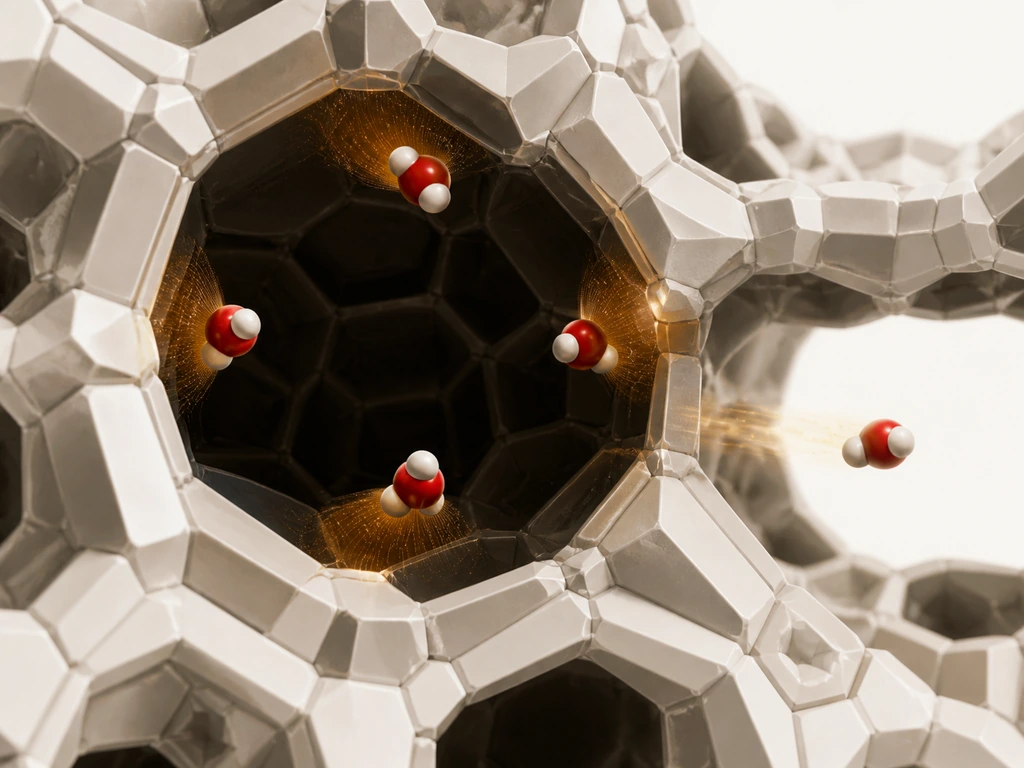
Unlike chemisorption, which forms actual chemical bonds (binding energies typically >200 kJ/mol), physisorption relies on weak, non-specific attractions in the range of 5–40 kJ/mol. These forces are reversible. Raise the temperature or drop the pressure, and the adsorbed molecule detaches and exits the pore. This reversibility is the entire basis for regenerating and reusing molecular sieves over thousands of cycles.
Three operating parameters control adsorption efficiency. Temperature is the most powerful lever. Because adsorption is exothermic, lower temperatures favor higher adsorption capacity. Pressure drives molecules into the pores. In pressure swing adsorption (PSA) systems, adsorption occurs at elevated pressure (typically 3–10 bar for oxygen production), while desorption happens at or below atmospheric pressure. Polarity introduces an additional selectivity mechanism: the negatively charged AlO₄⁻ sites in the zeolite framework exert an extra electrostatic pull on polar molecules like water and ammonia. That’s why molecular sieves adsorb water so aggressively even at extremely low humidity.
This last point has practical consequences. At relative humidity below 10%, a molecular sieve can still adsorb water at close to its maximum capacity. Silica gel and activated alumina, whose adsorption depends primarily on capillary condensation, see their capacity drop sharply under the same conditions. If your application demands a dew point of -40°C or below, molecular sieves are the only practical choice.
Need help specifying the right adsorbent for your separation process?
Inside an Industrial PSA Cycle
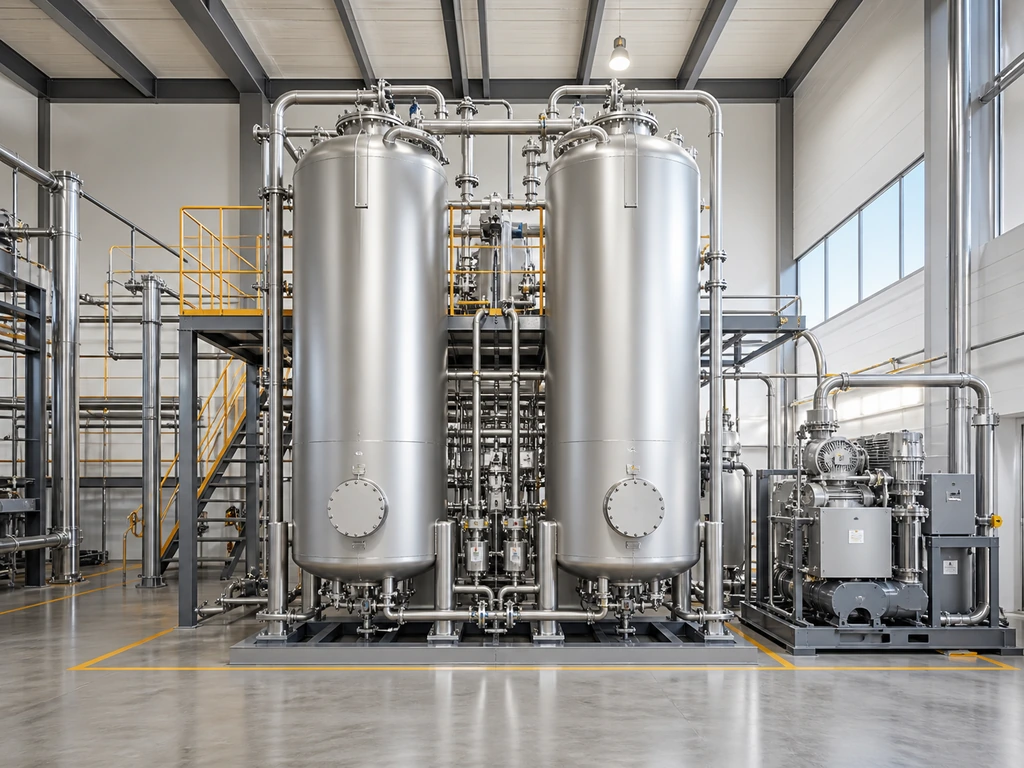
Theory becomes practice inside a pressure swing adsorption (PSA) unit, the workhorse of industrial gas separation. A PSA system for oxygen production passes compressed air through a bed packed with molecular sieve, capturing nitrogen while letting oxygen through. But a single bed saturates quickly. To keep production continuous, PSA systems cycle through multiple beds, each moving through a choreographed four-step sequence.
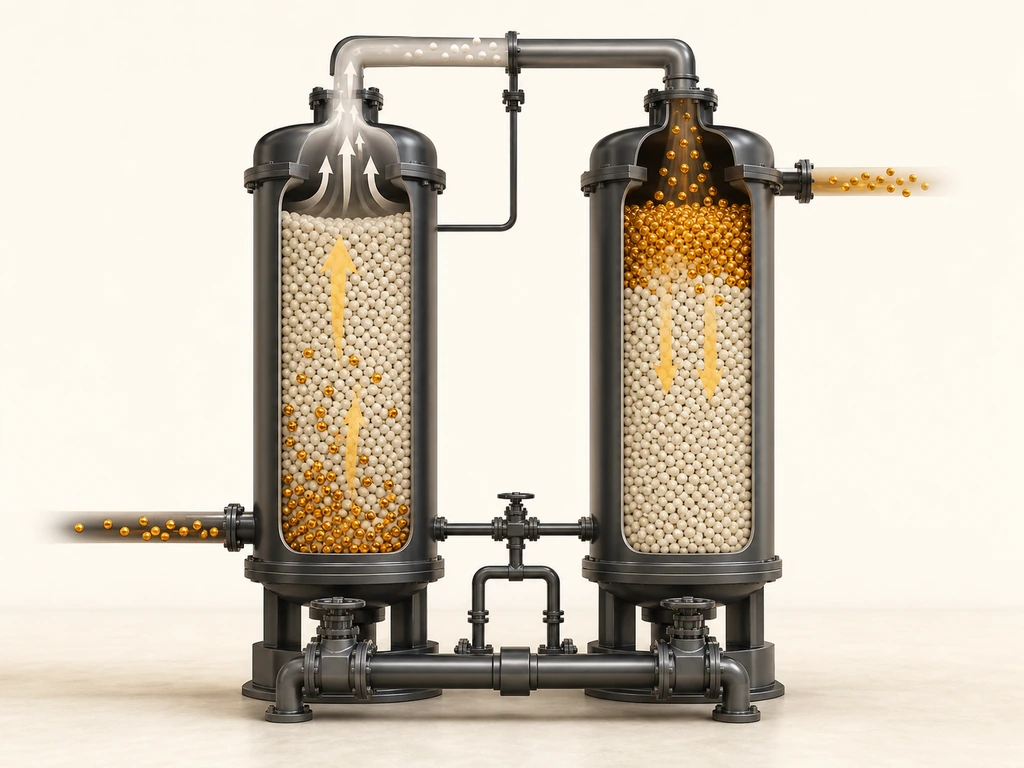
The Four-Step Cycle: Adsorption → Depressurization → Regeneration → Cooling
Step 1 — Adsorption: Compressed air (typically at 3–10 bar) enters the bottom of the sieve bed. Both nitrogen (kinetic diameter 3.64 Å) and oxygen (3.46 Å) can enter the ~7.4 Å pores of 13X or LiX adsorbents. The separation is driven by equilibrium selectivity, not size exclusion: nitrogen’s quadrupole moment interacts strongly with zeolite cations, particularly Li⁺, so nitrogen is preferentially adsorbed. Oxygen remains comparatively weakly adsorbed and exits as the product stream. Argon also passes with the oxygen primarily because it is chemically inert and weakly adsorbed; it is therefore a principal residual impurity in PSA oxygen product. The bed temperature rises slightly from the exothermic heat of adsorption. This step consumes 25–35% of the total cycle time.
Step 2 — Depressurization (Blowdown): The feed valve closes and the exhaust valve opens to the atmosphere. Pressure inside the bed drops rapidly: to near-ambient in standard PSA designs, or below 100 mbar in VPSA (vacuum swing adsorption) systems. The sudden pressure drop reduces the sieve’s adsorption capacity. Nitrogen molecules begin to desorb and exit through the exhaust. The bed pressure equalizes with downstream beds to recover energy.
Step 3 — Regeneration (Purge): A slipstream of the product gas — now dry and nitrogen-free — is diverted back through the bed, flushing out the desorbed nitrogen. In some cycles, this purge gas is heated to 200–300°C (temperature swing adsorption, or TSA). In PSA-only systems, the purge runs at ambient temperature with a higher flow rate. This step is the longest, consuming 40–50% of cycle time (ScienceDirect, 2024).
Step 4 — Cooling and Repressurization: The bed is brought back to operating pressure by reintroducing feed gas or product gas. Temperature stabilizes, and the bed is ready to begin the next adsorption step. Repressurization must be controlled: pressurizing too rapidly can fluidize the bed and cause attrition of the molecular sieve particles.
Industrial PSA trains typically use 2-bed or 4-bed configurations with switching valves that actuate in under one second. The entire cycle — all four steps — completes in 2 to 10 minutes, repeating continuously 24 hours a day for years.
Real PSA Parameters: Pressure, Temperature, and Timing
For engineers specifying or operating a PSA system, three parameter families matter most:
Pressure: Adsorption pressure for oxygen PSA ranges from 3 to 10 bar; hydrogen purification PSA may operate at up to 30 bar. Bed pressure drop should stay below 0.3 bar to keep compression costs manageable. The bed L/D ratio (length to diameter) is typically 2:1 to 5:1. Too low, and gas channels through the bed without contacting the adsorbent. Too high, and pressure drop becomes excessive.
Temperature: The optimal adsorption temperature is as low as practically achievable — typically 20–40°C for most industrial operations. If thermal regeneration is used (TSA mode), the regeneration gas is commonly heated to 200–320°C. Heating must be controlled to limit thermal stress; industrial heating ramps are often about 5–10°C per minute, with the appropriate rate depending on vessel size, bed design, adsorbent type, and the supplier’s operating guidance.
Timing and Lifespan: Under clean operating conditions — feed gas properly filtered for compressor oil, no exposure to liquid water or acidic gases — a well-maintained molecular sieve bed can operate for 3 to 5 years before replacement (Gabruś et al., 2015). The primary degradation mechanisms are hydrothermal aging (prolonged exposure to high-temperature steam), fouling by heavy hydrocarbons, and poisoning by sulfur compounds like H₂S.
N₂ captured,
O₂ passes through
N₂ begins
to desorb
N₂ flushed out
40–50% of cycle
Bed ready
for next cycle
Activation, Regeneration, and Practical Know-How
New molecular sieves contain manufacturing moisture and must be activated before use. Typical activation uses dry inert gas or vacuum for 4 to 12 hours at 250–300°C for 3A/4A/5A, or 200–315°C for 13X; some deep-activation applications use up to 350°C.
Regeneration restores capacity through a dry-gas thermal cycle, pressure reduction to ambient or vacuum, or both. Keep activated material sealed until use: it begins taking up moisture as soon as it is exposed to air. With clean feed and proper operation, industrial beds can deliver stable performance for hundreds of thousands to millions of cycles.
Specify Your Molecular Sieve with Confidence
From cation selection to crystal type, get a custom adsorbent solution built around your separation requirements.
Request a Free ConsultationReferences
- International Zeolite Association (IZA) Structure Commission. “Database of Zeolite Structures.” 2024.
- MarketsandMarkets. “Molecular Sieves Market — Global Forecast to 2026.” 2021.
- ScienceDirect. “Pressure Swing Adsorption — an overview.” 2024.
- Gabruś, E. et al. “Experimental studies on 3A and 4A zeolite molecular sieves.” Chemical Engineering Journal, 2015.
- Sigma Aldrich. “Molecular Sieves — Technical Information.” 2024.
- JALON. “Molecular Sieve Regeneration Methods & Process.” 2026.
- JALON. Homepage.
- Breck, D. W. Zeolite Molecular Sieves: Structure, Chemistry, and Use. John Wiley & Sons, 1974.
 EN
EN  DE
DE  ES
ES  JA
JA  RU
RU  PT
PT  FR
FR