Desiccant Air Dryer Troubleshooting: Four Common Failure Modes and What to Do Next
Water is coming out of lines it should never reach. The dew point reading is drifting, the after-filter is loading up with reddish powder, or the dryer that used to hold -40 °F now struggles to hold anything at all. Desiccant air dryer troubleshooting starts with one discipline: a desiccant dryer can lose performance for several reasons, and a failed dew point does not automatically mean the desiccant bed needs replacing. This guide walks the full chain: what the dryer owes you, how the four failure modes differ, and how to triage a repair against a refill. From there it covers what to put back in the towers, and how to keep the next bed alive.
Core Functions and Expected Performance
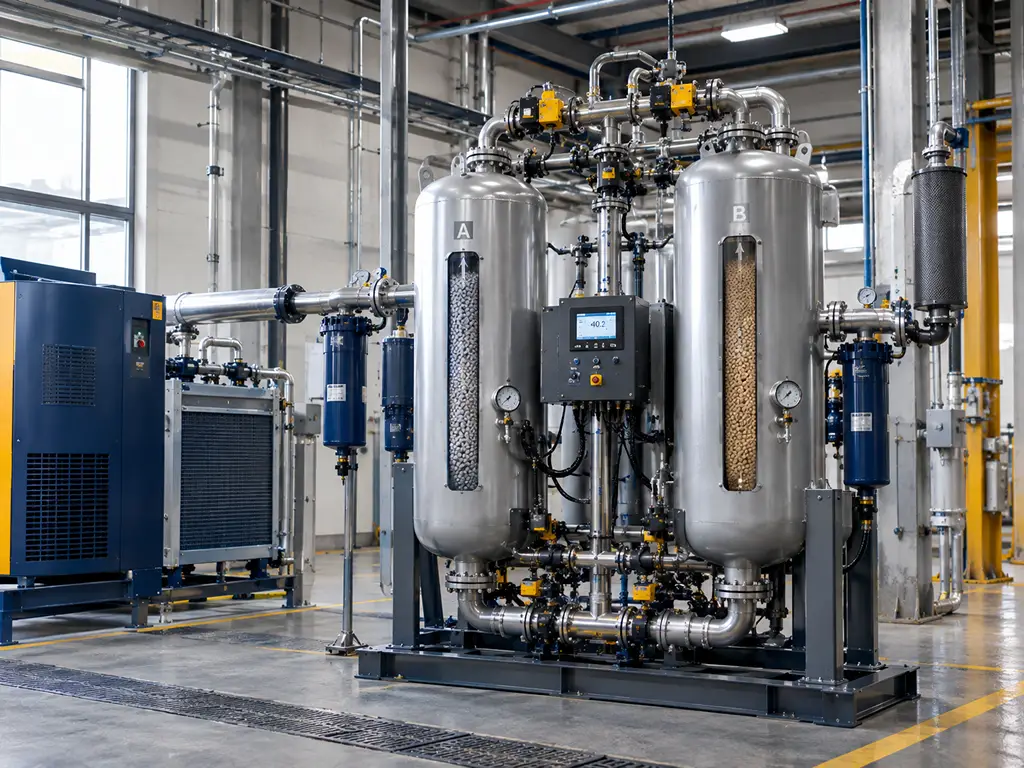
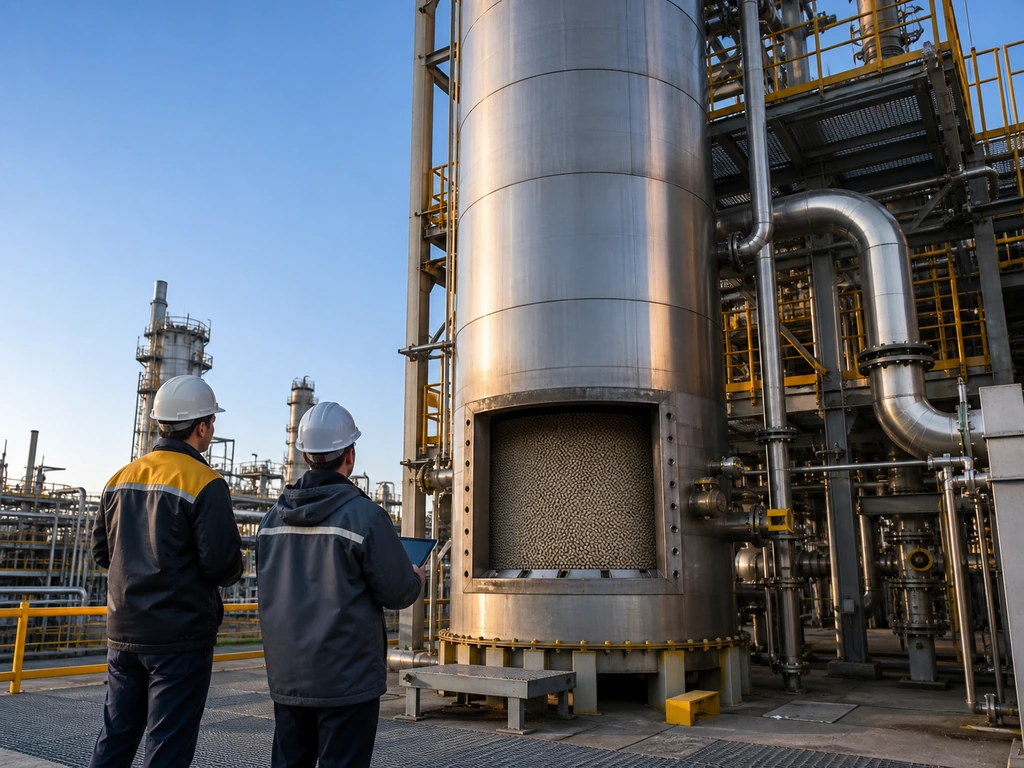
A desiccant dryer is a shift worker, not a hero. Two towers alternate: one bed of adsorbent pulls water vapor out of the compressed air while the other regenerates, and a set of valves swaps their jobs every few minutes. For many instrument-air and critical industrial applications, a pressure dew point around -40 °C/-40 °F is commonly specified, but the required dew point depends on the application and system conditions. Under ISO 8573-1, a pressure dew point of ≤ -40 °C corresponds to Water Class 2, while ≤ -70 °C corresponds to Water Class 1. The complete compressed-air specification should also state the particle and oil classes.
Two design families do this job. Conventional heatless purge dryers use a portion of dried compressed air to regenerate the offline bed. Because conventional fixed-cycle systems may use a relatively constant purge pattern, dew-point-controlled regeneration can reduce unnecessary purge consumption. Heated and blower-purge dryers pay for regeneration with heat instead, cutting the purge air bill. That distinction matters later, because each family fails in slightly different ways.
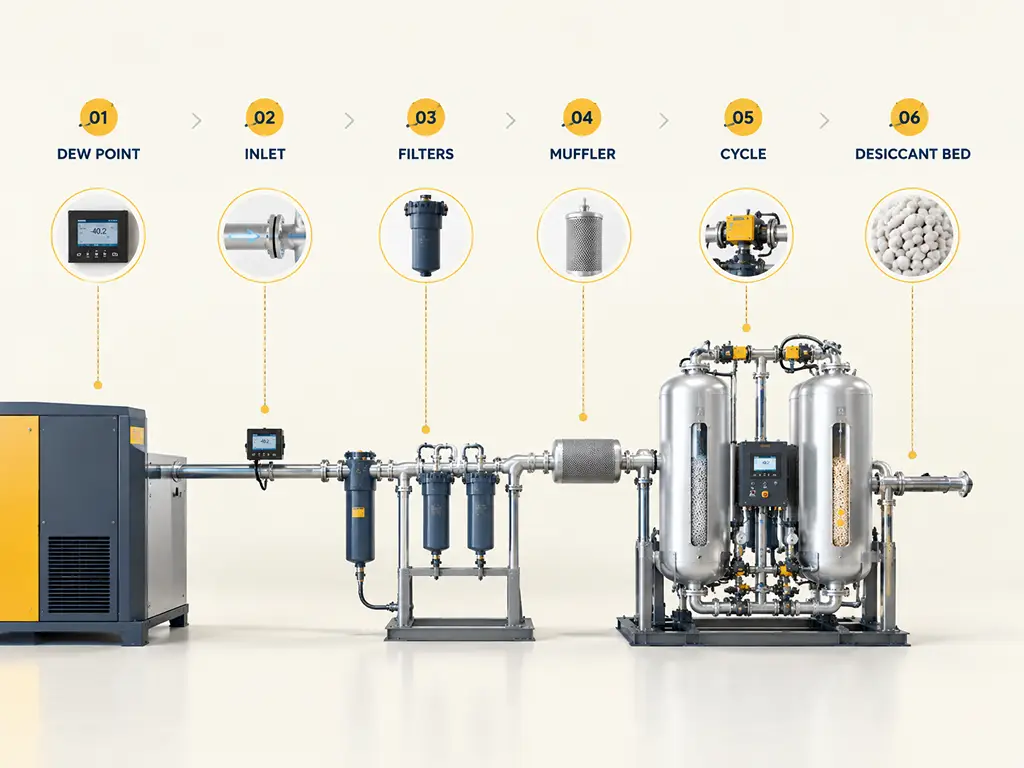
One boundary before the troubleshooting begins: this guide covers industrial and shop compressed-air systems, the twin-tower dryers fed by a compressor. Truck and trailer air dryers, plastics resin dryers, and the appliance in your laundry room all carry the word “desiccant,” and each has its own failure logic. If that is your machine, this is not your manual. If your machine is the one feeding air tools, instruments, or a plant floor, the four failure modes below are your map.
Field Diagnosis
Four Common Failure Modes in Desiccant Dryers
When the dew point slips or water shows up downstream, the fault sits in one of four places. Each has a signature, a mechanism, and a first check. Reading them in order turns “the dryer is broken” into a diagnosis.
Moisture Overload — When Inlet Conditions Exceed the Design
The signature: dew point creeps up during hot afternoons or production peaks, and recovers when demand drops. The mechanism: adsorption beds are sized for a moisture load, and inlet air hotter or wetter than design fills the working bed before the switchover. Temperature is the quiet driver here: for saturated compressed air at a given pressure, a 20 °F reduction in inlet temperature roughly halves the moisture content. First check: inlet temperature and the upstream cooling. A fouled aftercooler or a failed cooler drain can rapidly overload an otherwise healthy bed. The fix is upstream: restore the cooling, fix the drain, and the “failing” desiccant performs again.
Oil Contamination — When Adsorption Capacity Is Permanently Reduced
The signature: dew point degrades within weeks of a fresh fill, the pre-filter element comes out soaked, and the desiccant itself has a yellow-brown tint instead of a chalky white. The mechanism is simple and unforgiving: compressor lubricant coats the adsorbent surface, and an oil film works on desiccant beads the way plastic wrap works on a sponge. The surface can no longer hold water. No regeneration temperature reverses it, because the oil is not water; baking a poisoned bed only bakes the oil deeper. Significant oil contamination can permanently reduce the adsorption capacity of desiccant media. If the bed has been heavily contaminated, replacement is typically required after the oil source and upstream filtration problem have been corrected.
The One Failure Regeneration Can’t Reverse
Once compressor oil coats the bed, the desiccant cannot be saved: oil film survives every regeneration cycle. An oil-poisoned bed is not a maintenance item; it is a replacement, and the oil source has to be fixed first or the new bed dies the same death.
First check: cut open the pre-filter element. Oil loading in the pre-filter is a warning that the upstream oil-separation system should be investigated. If oil has reached the desiccant bed, inspect the media for contamination before deciding whether replacement is required. Fix the compressor’s oil carryover and the filtration, then refill. In that order.
Excessive Attrition — When the Bed Generates Too Much Dust
The signature: after-filter elements clogging repeatedly, desiccant dust collecting at low points, dew point holding but pressure drop climbing. The mechanism: beads grind against each other and against the tower walls, and every bed makes some dust; a bed that disintegrates, though, is telling you something. A field case reported a combination of excessive desiccant dust and heater-related failures, illustrating why both media condition and dryer hardware should be checked. Dust has two contributors: bead quality and bed disturbance. Quality is measurable before purchase, because crush strength and attrition percentage are published specification numbers (more on both in the refill section below). Disturbance comes from high velocity, loose bed support, and chronic pressurization-depressurization shocks. First check: when did the dust start? After a recent refill points to handling or wrong-grade material; after a valve malfunction points to flow disturbance.
Valve and Regeneration Failures — When the Hardware Stops the Cycle
The signature: one tower never seems to dry, switching failure alarms, or purge exhaust barely breathes. The mechanism: a repressurization valve, purge valve, or shift valve that sticks leaves a bed “regenerated” only on paper, and a purge muffler clogged with desiccant dust can increase back pressure and reduce regeneration effectiveness. First check: watch a full cycle. Both towers should pressurize, hold, and depressurize on schedule; compare purge exhaust behavior with the OEM’s normal operating pattern. The boundary that saves money here: valve and muffler faults are fixed with repair parts costing a fraction of a desiccant fill. A crew that reflexively refills the bed when the real fault is a stuck valve pays for a new bed and still has the old problem.
Fix or Refill? The Triage Order
Every troubleshooting session wants the same discipline: check the cheap and the upstream before the expensive and the internal. The order that works:
The Triage Chain
Verify the dew point instrument: a drifting sensor makes every other reading a lie.
Check inlet conditions: temperature, aftercooler performance, condensate drains.
Check pre-filter and after-filter differential pressure.
Inspect purge exhaust mufflers for dust loading.
Watch one full shift cycle: both towers pressurize, regenerate, repressurize on time.
Only then judge the desiccant bed itself.
The decision rule at the end of the chain: valve, muffler, and instrument faults get repaired; overload conditions get engineered away upstream; a refill is normally justified when the desiccant has reached end of life, suffered irreversible contamination or damage, or is no longer suitable for the required dew point. Skip the chain and the refill decision gets made on vibes, which is how a stuck valve ends up costing a full bed of fresh desiccant.
When replacement is justified, the calendar question follows. Published guidance refuses to give one number for good reason: replacement intervals vary by dryer design, desiccant chemistry, and operating conditions. As a rough industry reference, some suppliers cite 3–5 years for clean, stable heatless twin-tower systems and 2–4 years for some heated or blower-purge systems. These figures should not replace OEM guidance or condition-based monitoring. Dew-point trending should be one of the main indicators, alongside the OEM service interval and operating-condition history. That state-based approach has one precondition. The dew point instrument has to be calibrated, or the trend is fiction. Calibrate the sensor before trusting it to schedule a refill.
Material Selection
Choosing the Replacement Fill
When the bed is due, the purchase order asks a question most spec sheets never answer: what exactly goes back in the towers? Desiccant for compressed-air dryers is not one material. Picking by price alone ignores what each type is actually good at.
Activated alumina is widely used in regenerative compressed-air dryers, particularly for general-duty applications and as part of layered beds. It holds more water than molecular sieve at high relative humidity, shrugs off liquid splashes better, and resists crushing and grinding. For example, Jalon publishes the following specifications for its dryer-grade materials: 1.0–2.2 mm up through 8.0–10.0 mm beads, with static water adsorption of at least 17% by weight (at 60% RH, 25 °C), crush strength from 25 N up to 280 N on the largest beads (average of 25 beads), and attrition loss kept at or below 0.3%. Heating regeneration for alumina runs 180–350 °C.
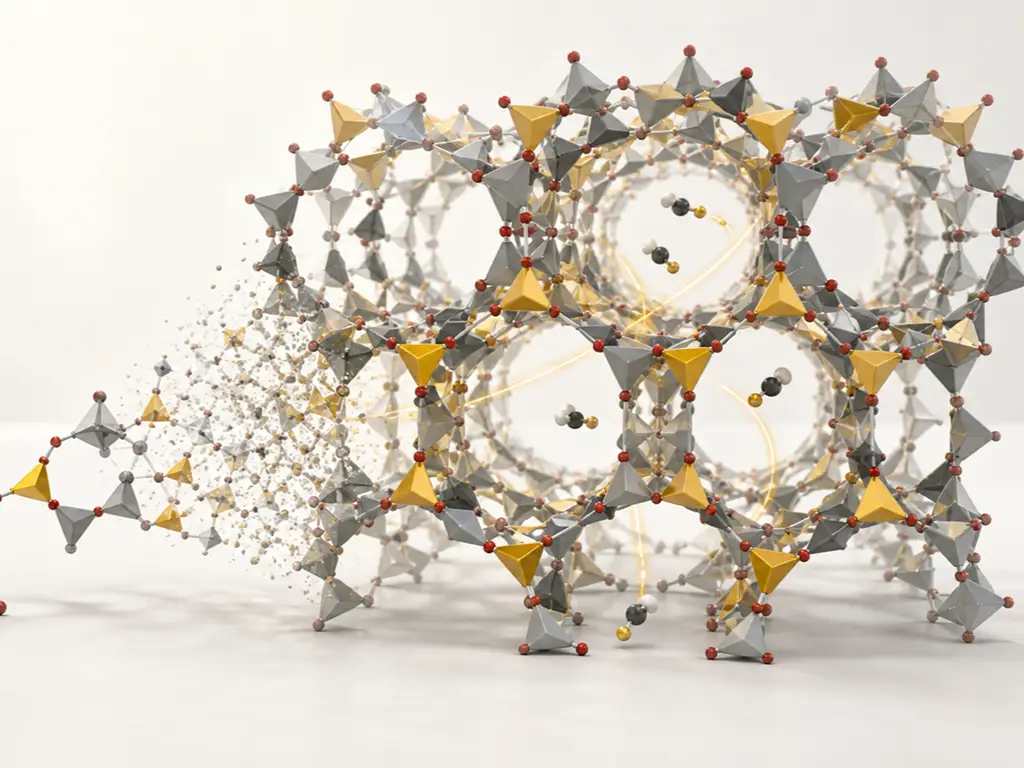
Molecular sieve 4A is often selected when a lower pressure dew point is required than a conventional activated-alumina bed is designed to provide. It is also commonly used as a polishing layer in applications targeting very low PDPs. Its tightly controlled 4-angstrom pores pull water down to the deepest dryness, which makes it the deep-layer material in beds chasing Class 1-grade air. It is also the standard choice for static dehydration in closed systems. Published dryer-grade 4A delivers static water adsorption of at least 22.5% by weight (at 75% RH, 25 °C), crush strength of at least 40 N (small beads) to 80 N (large), with bead sizes of 1.6–2.5 mm and 3.0–5.0 mm plus 1/16″ and 1/8″ pellets. One-line map of the rest of the shelf: 13X molecular sieve is more relevant to applications where both water and CO₂ removal are required; it should not be treated as a drop-in replacement for 4A in a conventional compressed-air dryer. Silica gel remains an established desiccant for many drying applications, but activated alumina is often preferred in regenerative compressed-air dryers because of its mechanical robustness and tolerance of operating conditions.
How the Materials Compare Before You Buy
| Material | Primary Applications | Deep dew point ability | Oil / liquid water tolerance | Fails when | Switch to |
|---|---|---|---|---|---|
| Activated alumina ⭐ | Widely used for general duty and layered beds | Good (to about -40 °C PDP service) | Best of the group | Oil-coated, or ground to dust by bed disturbance | Add 4A layer if dew point target drops |
| Molecular sieve 4A | Lower PDPs / polishing layer | Deepest (Class 1-level service) | Poor: demands clean, dry pre-filtered air | Oil poisoning is irreversible; also liquid slugs | Alumina pre-layer to protect it |
| Molecular sieve 13X | When CO₂ adsorption is also targeted | Deep, plus CO₂ removal | Poor, same as 4A | Same as 4A | N/A: chosen for CO₂, not swapped |
| Silica gel | Established desiccant, depends on design | Modest | Poor with liquid water: beads fracture | Slugged with water; heat regen limits | Alumina (modern standard) |
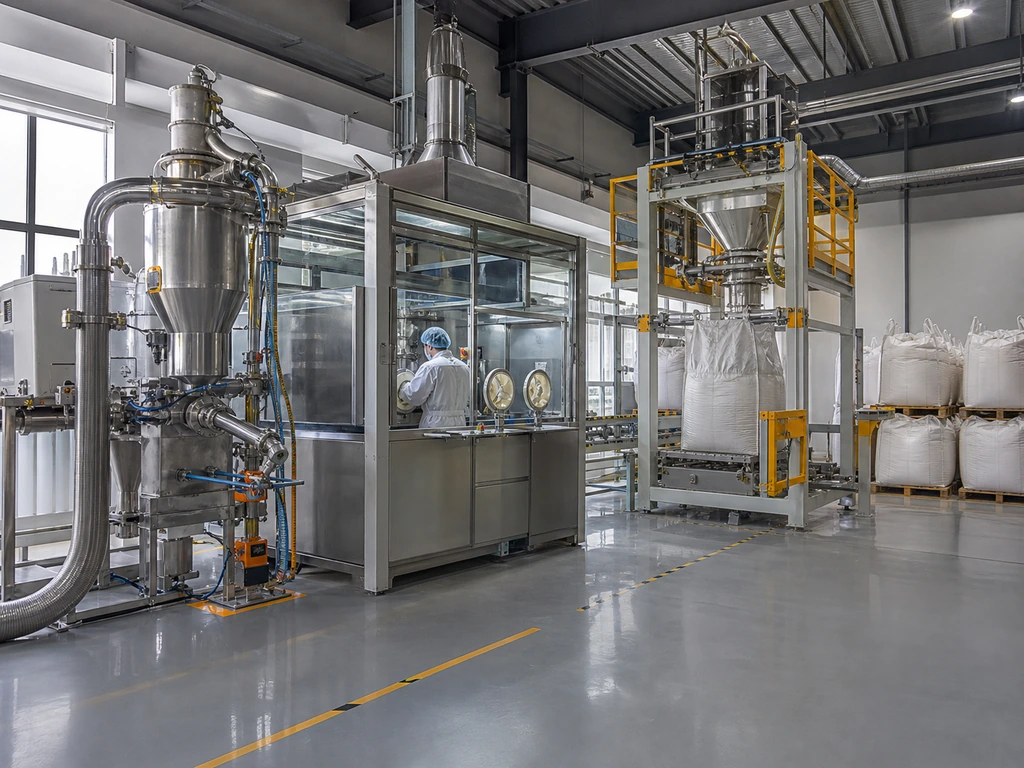
Two practices turn this table into a working installation. First, layered beds exist because each material guards a stretch of the drying curve. An alumina layer takes the high-humidity load off the top of the cycle, and a 4A layer polishes the air to the deep dew point, protecting the expensive sieve from the dirtiest part of the job. Second, run acceptance checks before filling. The three numbers that settle any “your material turned to powder” dispute are crush strength, attrition loss, and static water adsorption; all three belong on the supplier’s published spec sheet, and the delivered drums should match them. Estimate quantity from bed geometry: tower cross-section times bed height times the supplier’s specified bulk density for the exact grade being loaded. Use the OEM-specified fill weight or calculate the required mass from the actual bed volume and the supplier’s bulk density, allowing for the manufacturer’s specified settling/loading procedure. Load the beads slowly through a screen to avoid bridging and free-fall crushing.
Comparing quotes? Jalon’s published specifications can serve as one reference point when comparing supplier data sheets.
Request the Spec SheetsKeep the Next Bed Alive
A fresh bed is an investment; these are the actions that protect it. The order of operations starts upstream of the dryer, because the bed’s worst enemies never pass through the towers: they are removed, or not, before the air arrives.
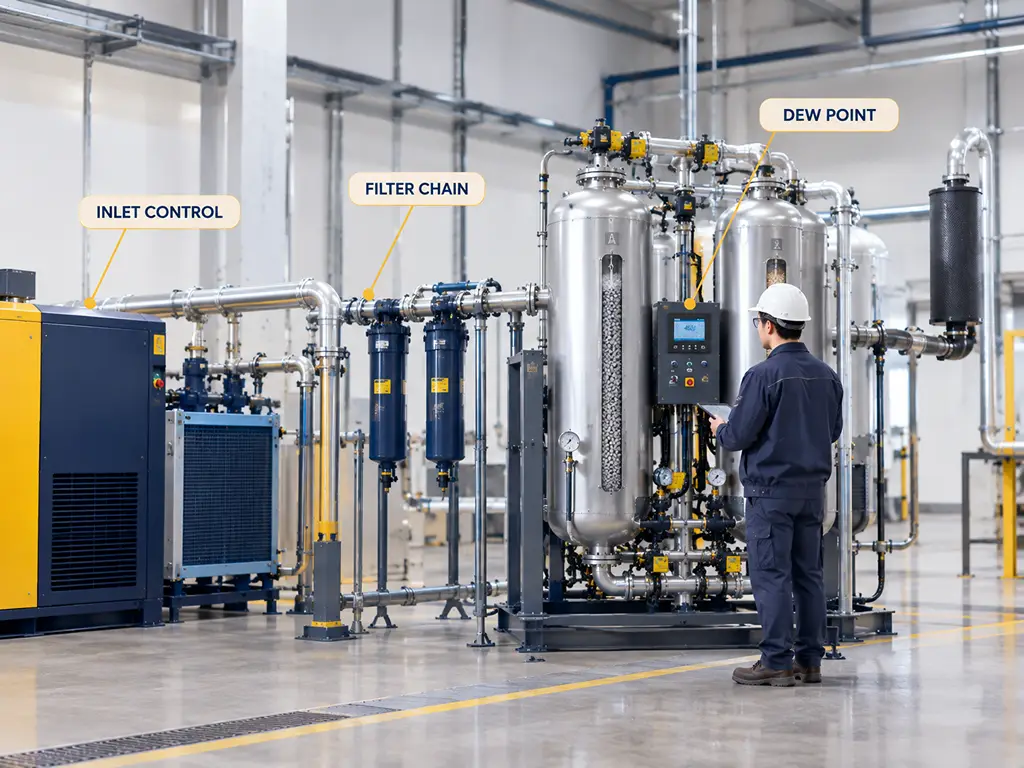
- Control the inlet. For saturated compressed air at a given pressure, a 20 °F reduction in inlet temperature roughly halves the moisture content. Clean aftercooler surfaces and working condensate drains are desiccant life-extension equipment.
- Service the filter chain. The pre-filter is the bed’s bodyguard against oil and slugs of water; the after-filter catches the dust the bed sheds; the purge mufflers choke on that dust over time, so inspect and replace them every 6 to 12 months.
- Close the monitoring loop. A calibrated dew point sensor plus a logged trend line converts replacement from calendar guesswork to condition-based scheduling, and it gives you the evidence to challenge a bad batch of desiccant before it is six months too late.
One boundary no checklist escapes: if the compressor passes oil, every filter is a delay, not a cure. Oil carryover is the source problem; the filtration chain only buys the bed time. Fix the compressor first, or plan the next refill now.
Shift-Start Quick Check
Inlet control. Clean coolers, working drains.
Filter chain. Pre-filter, after-filter, mufflers on schedule.
Dew point trend. Calibrated sensor, logged history.
The Distributor View
The Refill Business
Read the four failure modes again through a supplier’s eyes and the aftermarket reorganizes itself. Oil poisoning and normal exhaustion are the two failures that end in a refill order, which makes replacement desiccant a recurring purchase tied to diagnosis, not a one-time sale. Distributors and compressed-air service companies who stock accordingly lean on activated alumina for volume (it is widely applicable across many general-duty dryer configurations) and keep 4A sieve for the deep-dew-point accounts.
The attrition dust failure, meanwhile, is where disputes get won or lost. When a customer brings in a bag of reddish powder and blames the material, the conversation changes the moment someone can point to published crush-strength and attrition numbers and ask for the delivered-batch comparison instead of a refund fight. And the state-based replacement logic from the triage section is a scheduling tool for the service side: a logged dew point trend tells a service company when each account’s refill is due. It turns the refill from an emergency call into a planned visit, and lets a distributor ship the right material ahead of the breakdown instead of after it.
Refill demand is diagnostic: understanding the failure mode helps determine the right maintenance strategy.
Get a Refill Recommendation That Fits Your Towers
Send your dryer model, dew point target, and bed dimensions — Jalon’s engineers will match the fill and the acceptance numbers.
Request a Refill QuoteReferences
- Pneumatic Tips. “Is it worth buying dew point control for an air dryer?” (2018).
- Air Best Practices. “Desiccant Dryers – Ten Lessons Learned.” (2014).

 EN
EN  DE
DE  ES
ES  JA
JA  RU
RU  PT
PT  FR
FR  AR
AR  KO
KO  TH
TH  ID
ID