What Is Synthetic Zeolite?
Synthetic zeolites are man-made crystalline aluminosilicates — three-dimensional frameworks of silica and alumina tetrahedra that form a honeycomb of uniform, molecule-sized pores. Unlike their natural counterparts, which form over geological timescales from volcanic ash and saline water, synthetic zeolites are produced under controlled hydrothermal conditions. This gives them three decisive advantages: purity (no gangue minerals like clays or quartz), precision (pore size tuned to the ångström level), and consistency (batch-to-batch reproducibility that natural deposits simply cannot deliver).
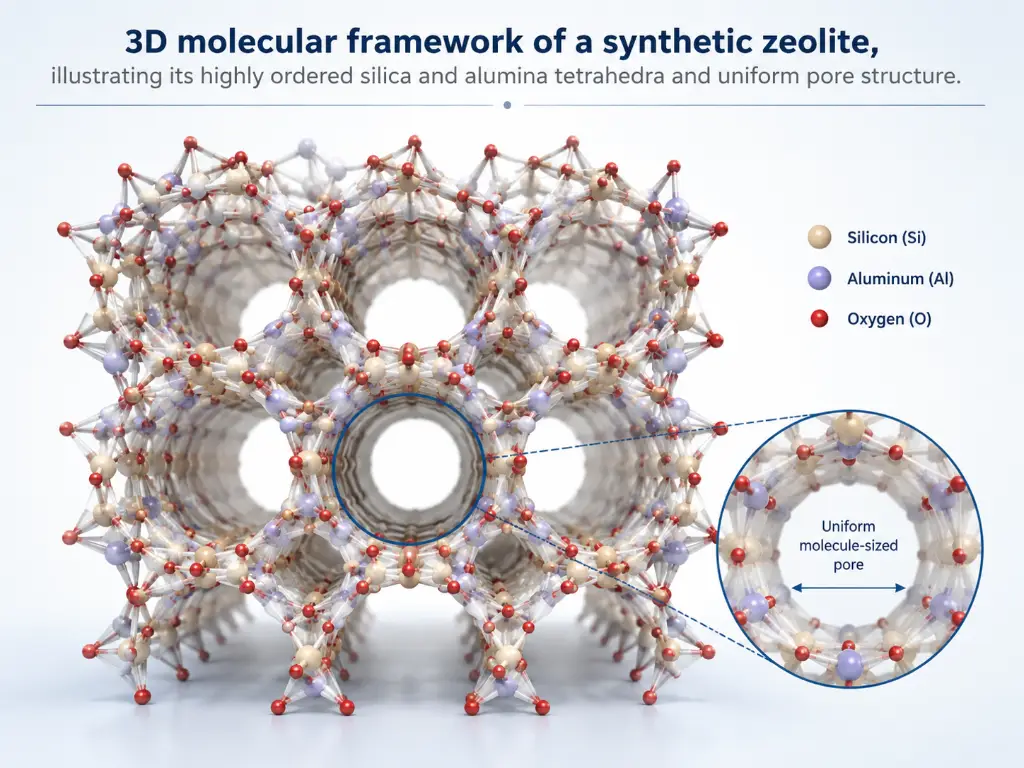
The numbers tell the story. While geologists have identified roughly 50 natural zeolite species, the International Zeolite Association’s Structure Commission database now recognizes over 250 synthetic framework types — many with no natural equivalent. Pore diameters span from approximately 3 to 10 ångströms, a range that covers virtually every small-molecule separation challenge in industry.
Synthetic zeolites — often called molecular sieves — are the default choice whenever an industrial process demands selective adsorption. The 3A type lets water molecules pass while blocking ethanol. The 13X type traps CO₂ from natural gas streams. ZSM-5 catalyzes methanol into gasoline with shape selectivity no amorphous catalyst can match. The question is never “should I use a synthetic zeolite?” but rather “which one?”
Key Types of Synthetic Zeolites
Before diving into individual types, it helps to understand what actually differentiates them. Every synthetic zeolite varies along three axes: pore size (determined by the ring structure — 8-ring, 10-ring, or 12-ring openings), silica-to-alumina ratio (Si/Al, which governs hydrophilicity and acid strength), and cation type (the exchangeable ions sitting in the framework that fine-tune adsorption selectivity). Keep these three dimensions in mind as you read through the families below.
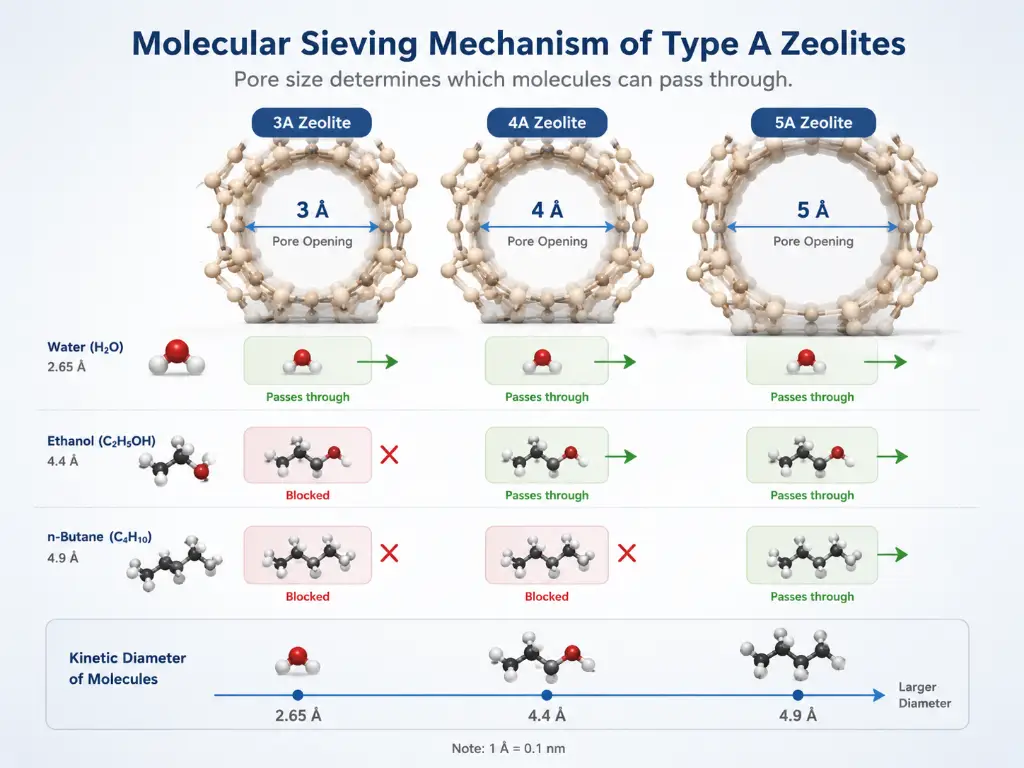
Type A Zeolites (3A, 4A, 5A) — Small-Pore Molecular Sieves
The Type A family is the workhorse of industrial adsorption, and the three variants differ by a single variable: which cation occupies the exchange sites.
| Type | Pore Size | Key Adsorbates | Primary Industrial Role |
|---|---|---|---|
| 3A | ~3 Å | H₂O only | Selective drying of polar solvents (ethanol, methanol) without co-adsorbing the product |
| 4A | ~4 Å | H₂O, CO₂, H₂S, SO₂ | General-purpose dehydration, natural gas sweetening, refrigerant drying |
| 5A | ~5 Å | n-paraffins, n-olefins, H₂O, CO₂ | PSA hydrogen purification, normal/iso-paraffin separation, air pre-purification |
The underlying chemistry is straightforward. The 4A form is the sodium-exchanged version — Na⁺ ions sit in the framework, leaving an effective pore opening of roughly 4 Å. Exchange roughly half those sodium ions with potassium, and the larger K⁺ ions partially obstruct the windows: you get 3A, which admits water but excludes anything larger. Exchange with calcium instead, and the divalent Ca²⁺ occupies fewer sites, opening the pores to roughly 5 Å and allowing straight-chain hydrocarbons to enter.
In practice, this means a single raw material (sodium zeolite A) can be cation-tuned for three distinct jobs: selective ethanol drying (3A), bulk gas dehydration (4A), or PSA hydrogen recovery (5A). If you are unsure which variant you need, the deciding question is almost always: what molecules, besides water, are present in my stream — and which of them must not be adsorbed?
Type X Zeolites (13X, LSX) — Large-Pore Adsorption Specialists
Where Type A zeolites handle small molecules, Type X zeolites open the door to everything larger. 13X has a 12-ring pore opening of approximately 10 Å and a Si/Al ratio close to 1.0. This makes it strongly hydrophilic — it adsorbs branched hydrocarbons, aromatics, and larger polar molecules that 5A cannot touch.
This makes 13X the default choice for three high-volume industrial separations. In cryogenic air separation, 13X removes CO₂ and residual moisture from feed air before it enters the cold box — CO₂ outlet levels below 0.1 ppm are standard to prevent dry ice formation at cryogenic temperatures. A single large ASU (80,000 Nm³/h) may load hundreds of tons of 13X. In PSA oxygen generation, 13X selectively adsorbs nitrogen over oxygen, producing 90–95% purity O₂ for steel mills, wastewater ozonation, and medical gas supply. In natural gas processing, 13X strips CO₂, H₂S, and mercaptans to pipeline specifications.
The premium variant in this family is LSX (Low Silica X), with a Si/Al ratio pushed down to approximately 1.0. The higher aluminum content means more cation sites, which translates to higher N₂ adsorption capacity — a critical advantage in PSA oxygen cycles. Exchange those sites with lithium, and you get Li-LSX, the current benchmark adsorbent for medical and portable oxygen concentrators: higher O₂ recovery per kilogram of sieve than any standard 13X.
High-Silica Zeolites (ZSM-5, Beta, Mordenite) — Catalytic Specialists
At the opposite end of the Si/Al spectrum sit the high-silica zeolites. With Si/Al ratios exceeding 10 (and in the case of ZSM-5, exceeding 100 or approaching infinity in the pure-silica Silicalite-1 form), these materials are hydrophobic, thermally stable beyond 1,000 °C, and possess strong Brønsted acid sites — properties that make them catalysts, not just adsorbents.
ZSM-5 (MFI framework) is the star of this category. Its 10-ring channels (~5.4–5.5 Å) provide shape selectivity that revolutionized petrochemistry: in the Methanol-to-Gasoline (MTG) process, ZSM-5 converts methanol into a gasoline-range hydrocarbon blend while its pore architecture prevents the formation of molecules too large to exit the channels. Beta zeolite (BEA framework) offers larger 12-ring pores and serves as a versatile catalyst in fine chemical synthesis and cumene production. Mordenite (MOR) finds its niche in alkylation and isomerization reactions.
If Type A and Type X are the “sieves” of the zeolite world — physically sorting molecules by size — high-silica zeolites are the “machine tools,” driving chemical reactions with a precision that amorphous catalysts cannot replicate.
Industrial Applications Across Major Sectors
The table below maps the most common industrial applications to the zeolite types they typically employ. Use this as a quick-reference landscape before diving into the selection framework in the next section.
| Application Sector | Typical Zeolite | What It Does | Key Performance Metric |
|---|---|---|---|
| Cryogenic air separation | 13X, JLPM-series | Removes CO₂ + H₂O from feed air before the cold box | CO₂ outlet < 0.1 ppm |
| PSA oxygen generation | 13X, Li-LSX | Selectively adsorbs N₂, concentrates O₂ | O₂ purity 90–95% |
| PSA hydrogen purification | 5A, JLPH5 | Adsorbs CO, CH₄, N₂ from syngas | H₂ purity > 99.9% |
| Natural gas dehydration | 4A, 5A | Strips water vapor to pipeline dew-point spec | Dew point < -40 °C |
| PU / coatings / sealants | Activated 3A/4A powder | Scavenges moisture to prevent bubble formation | System moisture < 500 ppm |
| Solvent drying (ethanol, electrolyte) | 3A | Removes water without co-adsorbing solvent | Moisture < 10 ppm |
| Refrigerant / HVAC drying | XH-series | Dries refrigerant to prevent ice blockage and corrosion | Moisture < 10 ppm |
| Petrochemical FCC | USY, ZSM-5 | Catalyzes heavy oil cracking into gasoline and olefins | Gasoline yield per barrel |
| Detergent builder | 4A (Zeolite A) | Exchanges Na⁺ for Ca²⁺/Mg²⁺ in wash water | Ca²⁺ binding capacity |
Beyond these core applications, synthetic zeolites play supporting roles in biogas upgrading (CO₂/CH₄ separation), lithium-ion battery electrolyte dehydration (moisture below 10 ppm to prevent HF formation), and selective catalytic reduction of NOx in diesel emissions (Cu-SSZ-13). The breadth is substantial — but the selection logic, once you learn it, is surprisingly consistent.
How to Choose the Right Synthetic Zeolite for Your Application
If you have made it this far, you already know more about zeolite types than most first-time buyers. But knowing the types and knowing which one fits your process are different things. This section bridges that gap.
Before you match anything to anything, answer two questions. First: what molecule(s) do you need to capture or exclude? This determines the pore size. Second: what are your operating conditions? Temperature, pressure, and the presence of competing adsorbates determine whether you need a standard grade or a specialized formulation.
Match Your Application to the Right Zeolite Type
The quickest way to narrow your options is to work from your process goal backward to a zeolite type. The table below covers the most common industrial scenarios.
| If You Need To… | Consider This Type | Why |
|---|---|---|
| Dry ethanol or polar solvents without losing product | 3A | Pore excludes ethanol (kinetic diameter ~4.5 Å), admits only water |
| Dehydrate natural gas to pipeline spec | 4A | Adsorbs H₂O + CO₂ + H₂S; cost-effective for bulk drying |
| Purify hydrogen from syngas (PSA) | 5A or JLPH5 | Adsorbs CO, CH₄, N₂; H₂ passes through unadsorbed |
| Remove CO₂ from air before cryogenic distillation | 13X or JLPM-series | High CO₂ capacity at low partial pressure; < 0.1 ppm outlet |
| Generate oxygen by PSA/VPSA | 13X or Li-LSX | Selectively adsorbs N₂; Li-LSX gives highest O₂ yield per kg |
| Scavenge moisture in PU sealants or coatings | Activated 3A or 4A powder | Dispersed as fine powder; prevents CO₂ bubble formation during cure |
| Dry Li-ion battery electrolyte solvents | Specialty 3A or dedicated electrolyte-grade | Must achieve < 10 ppm moisture without leaching cations into electrolyte |
| Adsorb VOCs from exhaust streams | High-silica ZSM-5 or hydrophobic Y | Hydrophobic surface avoids water competition at moderate humidity |
| Catalyze a petrochemical reaction | ZSM-5, Beta, USY | Choose by reaction type and desired shape selectivity |
A word of caution: two suppliers can sell you “13X” and deliver noticeably different performance on your specific gas stream. Pore accessibility, binder type, and trace cation impurities all shift real-world adsorption behavior. This is not a commodity where specification sheets tell the whole story.
Two suppliers can both sell you “13X” and deliver measurably different performance. Pore accessibility, binder type, and trace cation impurities all shift real-world adsorption capacity — sometimes by 15% or more. Specification sheets alone won’t tell you which one works in your plant.
Before committing to a bulk order, ask whether the supplier can test against your actual process conditions.
Key Performance Parameters to Specify
Once you have identified a candidate type, the next step is defining what “good enough” looks like. When you send a request for quotation, make sure the supplier’s certificate of analysis covers at least these five parameters:
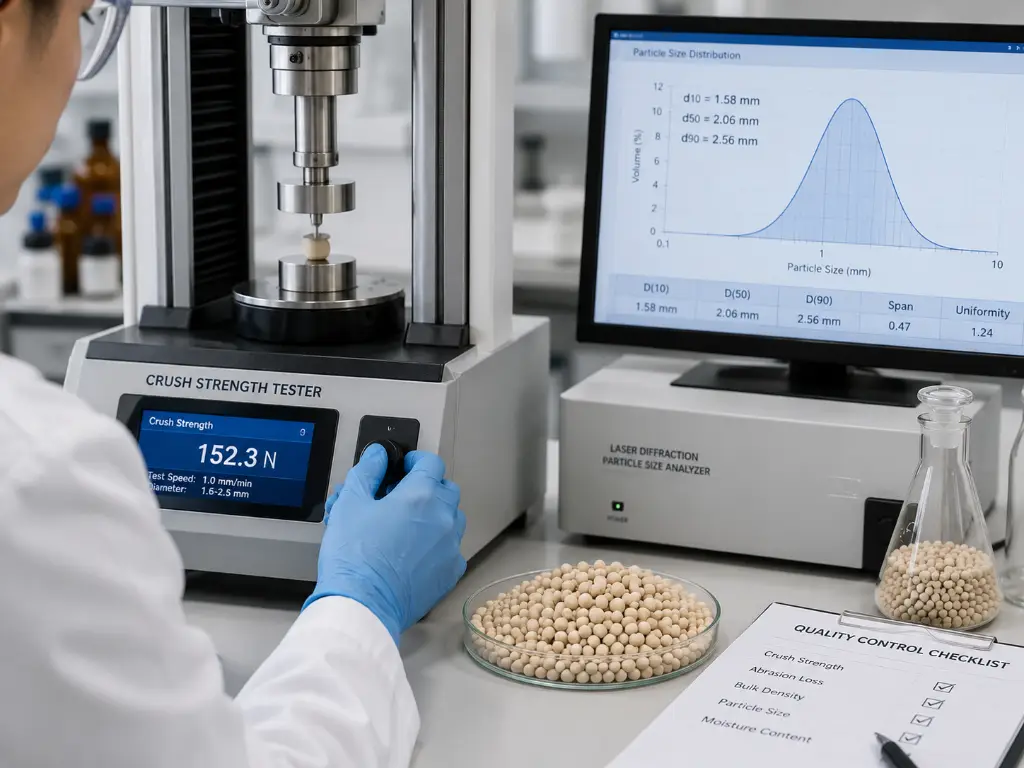
- Static water adsorption capacity — The most basic quality indicator. For 4A and 13X, expect ≥ 20 wt% at saturated humidity. Lower values suggest low crystallinity or binder dilution.
- Crush strength — Measured as force per pellet or bead (≥ 30 N for 1.6–2.5 mm extrudates). This directly predicts bed settlement and dust generation in service.
- Attrition loss — Should stay below 0.5 wt% in standard tumbling tests. High attrition means more dust, higher pressure drop, and more frequent screen cleaning.
- Bulk density — Typically 650–750 g/L for 13X. Significant deviation from the supplier’s historical average can indicate formulation drift or incomplete crystallization.
- Particle size distribution — Look for ≥ 95% within the specified mesh range. Fines increase pressure drop; oversized particles reduce mass transfer efficiency.
Each of these parameters ties directly to an operating cost — adsorbent replacement frequency, energy consumption from pressure drop, or process downtime from dust fouling. They deserve the same scrutiny as unit price.
Generic specification sheets only get you so far. Some manufacturers — particularly those with in-house R&D platforms and application testing laboratories — can test against your actual process conditions before you commit to a bulk order. This kind of application-specific validation, using both proprietary and international test methods, reveals whether a zeolite grade delivers on your specific stream composition — before thousands of kilograms go into your adsorber.
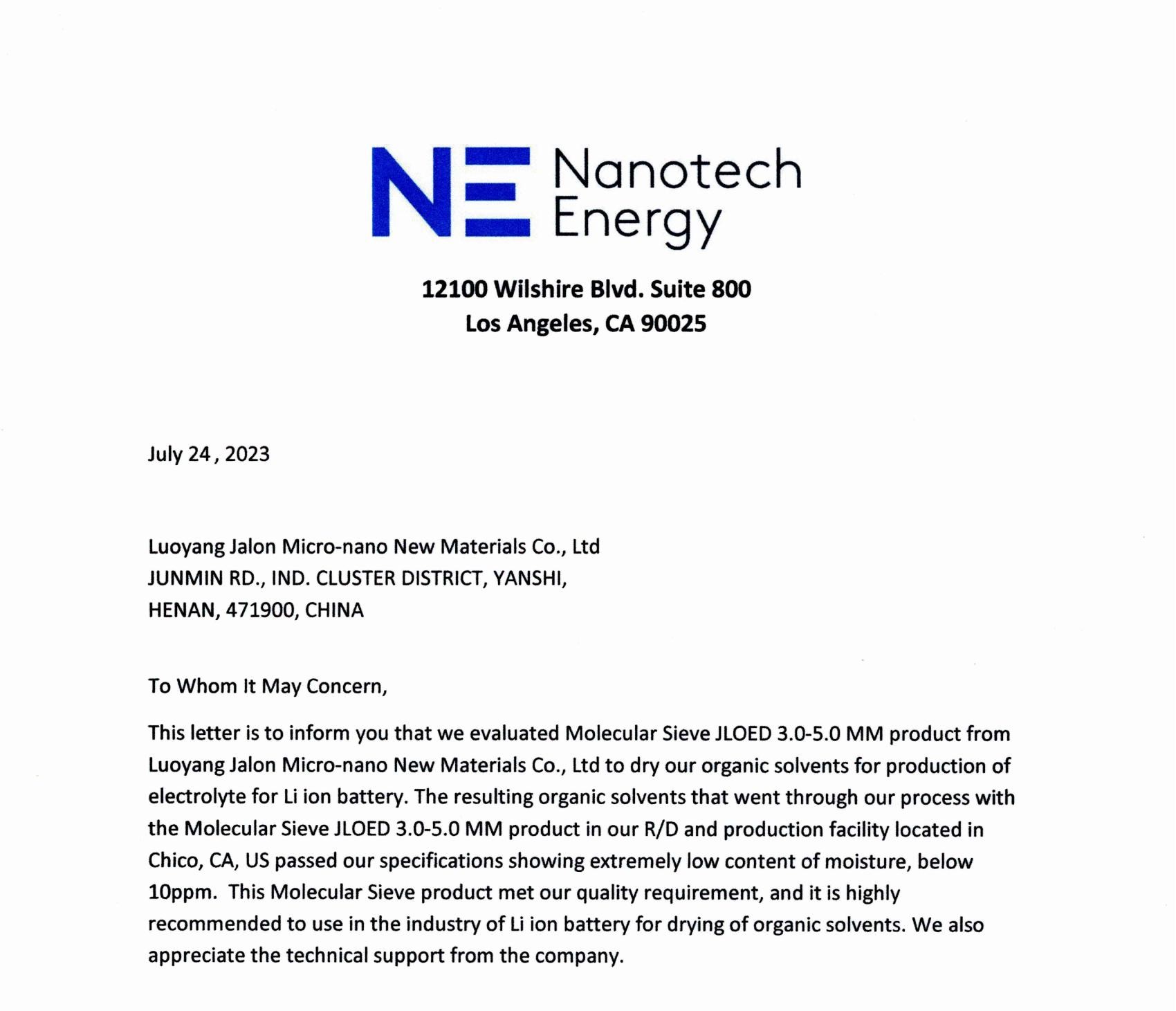
Jalon, for instance, maintains technical service capabilities that include application-specific testing and adsorbent selection recommendations. Our cryogenic-grade molecular sieve achieved measurably higher CO₂ capacity than previous formulations, enabling smaller adsorber footprints. When the difference between “meets spec” and “works in my plant” can mean tens of thousands of dollars in downtime, supplier technical depth is worth verifying early (application testing services).
Ensuring Quality in Synthetic Zeolite Procurement
Getting the type right is half the battle. Getting the quality right is the other half — and arguably the half where most procurement mistakes happen. Synthetic zeolite quality varies more between manufacturers than most first-time buyers expect, and the consequences of a subpar batch (premature bed replacement, off-spec product, unplanned shutdown) always exceed the price difference.
Essential Certifications and Test Reports to Request
Before evaluating a supplier, set a baseline for documentation. At minimum, request these with every quotation:
Certifications:
- ISO 9001:2015 — This is the baseline quality management system certification. If a supplier cannot produce a valid, current certificate, eliminate them from consideration.
- ISO 14001:2015 — Environmental management. Increasingly a hard requirement for EU and North American buyers.
- REACH (EC 1907/2006) — Mandatory for any zeolite entering the European market. Confirm the supplier’s REACH registration covers the specific grade you are buying, not just the product family.
- RoHS compliance — Required if the zeolite will be used in equipment ultimately sold into consumer or electronics markets.
Test reports (per batch):
- XRD (X-ray Diffraction) — Confirms crystal phase purity and relative crystallinity. A batch with low crystallinity (below 85–90% vs. a reference standard) will underperform on adsorption capacity even if other parameters look normal.
- BET surface area and micropore volume — Expect 300–700 m²/g depending on type. A lower-than-expected BET number may indicate amorphous content or incomplete crystallization.
- ICP-MS trace metal analysis — Especially important for catalyst-grade, food-grade, and pharmaceutical-grade zeolites. Heavy metals (lead, arsenic, cadmium, mercury) should be quantified and below regulatory thresholds.
- Particle size distribution (laser diffraction) — Confirms the supplier’s mesh claim and reveals whether excessive fines are present.
One more thing: ask about batch traceability. A supplier that retains physical samples from every production batch for multi-year traceability — and can produce those records — operates at a fundamentally different quality level than one that ships and forgets.
Red Flags When Evaluating Suppliers
After the paperwork is in order, trust your procurement instincts. These signals are not hard disqualifiers on their own, but two or more in combination should give you serious pause:
- Refusal to provide third-party test reports. Any legitimate manufacturer has SGS, Intertek, or Bureau Veritas reports on file. If they hesitate, ask why.
- ISO certificates that are expired or unverifiable. Check the issuing body’s online registry. A forged or lapsed certificate is an immediate disqualification.
- Samples that perform well but bulk shipments that do not. This is the most common quality complaint in the industry. Address it contractually: specify that the bulk shipment must match the sample’s key parameters within a defined tolerance, and reserve the right to reject non-conforming deliveries.
- Pricing significantly below market reference. At the time of writing, standard-grade synthetic zeolites typically range from approximately $380 to $450 per metric ton FOB China for bulk adsorbent grades, with specialty catalyst grades commanding multiples of that. A quote conspicuously below this range rarely reflects manufacturing efficiency — more often it reflects cut corners on quality control, lower crystallinity, or binder over-dilution.
- Technical questions that go unanswered or get deflected to sales. A supplier whose technical team cannot discuss pore volume, crush strength, or regeneration conditions in detail is a trading company, not a manufacturer. Trading companies have their place, but they add a layer of opacity between you and the production line.
- Verify third-party test reports exist (SGS, Intertek, Bureau Veritas)
- Confirm ISO certificates are current and verifiable online
- Contractually tie bulk shipments to sample performance within defined tolerance
- Benchmark pricing against market reference ($380–450/MT FOB for standard grades)
- Test the supplier’s technical depth — ask about pore volume, crush strength, regeneration
The best suppliers welcome scrutiny. They will send you samples without being asked. They will share batch records. They will arrange a factory visit — virtual or in-person — and walk you through their quality control stations from raw material intake to final packaging. In an industry where the product looks identical to the naked eye (off-white beads or powder), transparency is the real differentiator.


 EN
EN  DE
DE  ES
ES  JA
JA  RU
RU  PT
PT  FR
FR  AR
AR  KO
KO  TH
TH  ID
ID