What Are Adsorbent Catalysts? — The Dual-Function Materials
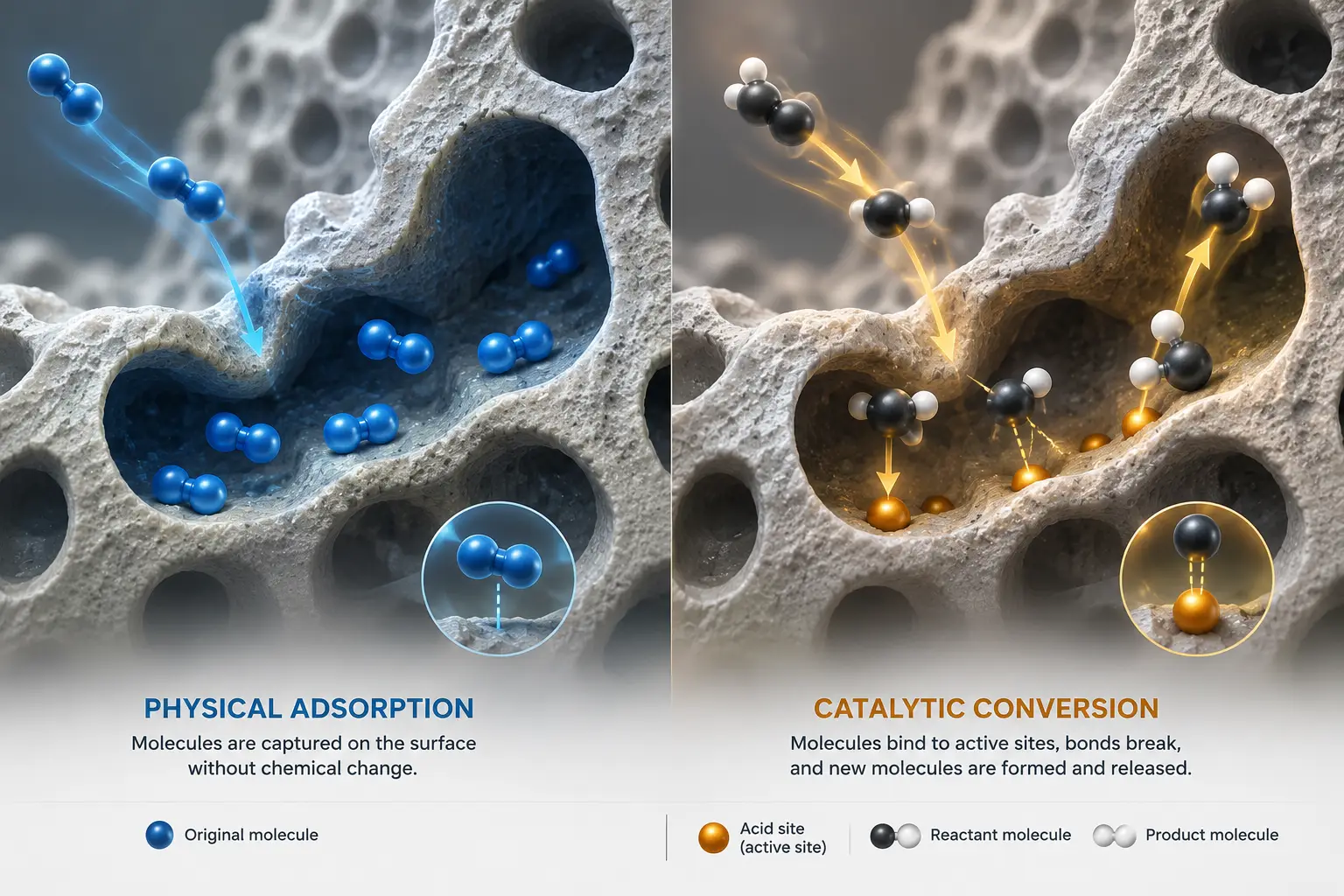
Not all solid materials in an industrial reactor do the same job. Some simply trap molecules and hold them. Others grab molecules, break their chemical bonds, and reassemble them into entirely new products — then release them unchanged, ready for the next cycle.
The first group are adsorbents. The second are catalysts. And a growing class of materials occupy the space between, functioning as adsorbent catalysts — materials engineered to both concentrate target molecules on their surface and drive a chemical transformation.
In heterogeneous catalysis, this relationship is built into the physics. Every solid catalyst is, at its most fundamental level, also an adsorbent. The catalytic cycle runs on a three-step loop: adsorption (reactant molecules bind to the surface), reaction (adsorbed species chemically transform), and desorption (products leave, freeing active sites for the next cycle). The difference between a pure adsorbent and an adsorbent catalyst lies in what happens between adsorption and desorption.
Think of a molecular sieve as a high-rise building. Pure physical adsorption is like tenants checking into apartments — they occupy the space but don’t change the building. Catalysis is like tenants who set up workshops inside their rooms, process raw materials into finished goods, and ship them out. The building (the zeolite framework) remains unchanged, but value has been created inside it.
The strength of the surface bond dictates which role dominates. Physical adsorption (physisorption) relies on weak van der Waals forces in the range of 3–10 kcal/mol — enough to trap a molecule, not enough to break its bonds. Chemical adsorption (chemisorption), at 20–100 kcal/mol, forms actual chemical bonds between the surface and the adsorbate, weakening the molecule’s internal bonds and making reaction possible. The Sabatier principle captures the trade-off: bind too weakly and you can’t activate the reactant; bind too strongly and the product can’t leave.
This spectrum — from pure adsorbent to dual-function adsorbent catalyst — maps directly onto the materials we’ll explore next.
Major Types of Adsorbent Catalyst Materials
A framework helps before looking at individual materials. Industrial adsorbent catalysts fall into three broad families: crystalline microporous materials (zeolites and molecular sieves), amorphous porous materials (activated carbon and activated alumina), and metal oxides and emerging structures. Their core differences come down to three variables: pore architecture (how precisely can you control what enters?), thermal stability (how hot can you run?), and active-site designability (how much can you tune the chemistry?).
Zeolites & Molecular Sieves — The Crystalline Workhorses
Zeolites are crystalline aluminosilicates whose defining feature is a three-dimensional pore network with openings measured in angstroms — sub-nanometer gates that admit some molecules while excluding others. This is shape selectivity, and it is the property that separates zeolites from every other class of adsorbent material.
The same framework can serve radically different roles depending on its chemical composition. The table below maps eight of the most important types:
| Type | Framework Code | Pore Size (Å) | Primary Role | Typical Application |
|---|---|---|---|---|
| 3A | LTA | 3.0 | Adsorbent | Unsaturated hydrocarbon drying |
| 4A | LTA | 4.0 | Adsorbent | General dehydration, solvent drying |
| 5A | LTA | 5.0 | Adsorbent | n-/iso-paraffin separation |
| 13X | FAU | 10.0 | Adsorbent + Support | CO₂ capture, air separation |
| ZSM-5 | MFI | 5.5 | Acid Catalyst | Methanol-to-olefins, xylene isomerization |
| Beta | BEA | 6.7 | Acid Catalyst | Hydrocracking, fine chemical synthesis |
| USY | FAU | 7.4 | Acid Catalyst | FCC catalytic cracking |
| SSZ-13 | CHA | 3.8 | Catalyst + Adsorbent | Diesel SCR NOx reduction |
different career
Notice that 13X and USY share the same FAU framework. The difference? USY (ultra-stable Y) has been dealuminated to raise its silicon-to-aluminum ratio, which increases hydrothermal stability and tunes the density of Brønsted acid sites — the bridging hydroxyl groups (Si–OH–Al) that protonate hydrocarbons and initiate cracking reactions. The same cage architecture, two entirely different industrial careers.
Activated Carbon & Activated Alumina — The Amorphous Workhorses
If zeolites are precision instruments, activated carbon and activated alumina are workhorses — less architecturally elegant but indispensable at scale.
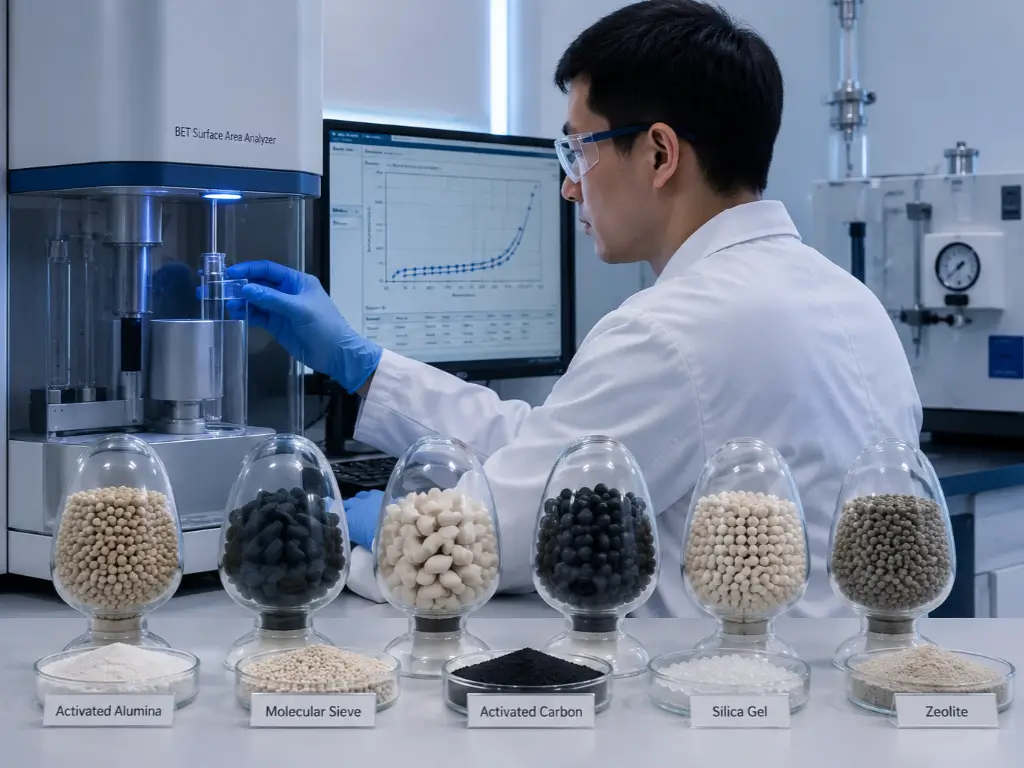
Activated carbon offers BET surface areas of 500–1,500 m²/g — unfold one gram and you get roughly a football field of internal surface. This makes it the default choice for organic molecule adsorption: VOC removal from air streams, color/odor removal in food processing, and gold recovery from cyanide leach solutions. Its catalytic side emerges when the carbon surface is impregnated with transition metals. Nickel oxide on activated carbon, for example, has demonstrated ~90.8% sulfur removal from diesel fuel under mild conditions (90 °C, 90 minutes) through a combined adsorption-catalytic desulfurization pathway.
Activated alumina (γ-Al₂O₃, surface area 200–350 m²/g) is the standard for gas dehydration in applications where molecular sieve’s deep-drying capability is overkill. Its surface carries both acidic and basic sites, making it bifunctional — it can adsorb fluoride from drinking water and simultaneously serve as the Claus process catalyst support for sulfur recovery in refineries. One critical technical note: activated alumina undergoes a series of phase transitions with temperature (γ → δ → θ → α-Al₂O₃), each step reducing surface area. Operating above 450–500 °C risks permanently degrading the material.
The choice between activated alumina and molecular sieve for dehydration often distills to a single number: target dew point. Activated alumina reliably delivers −40 °C to −50 °C. For −70 °C and below — the requirement in cryogenic air separation or LNG pretreatment — molecular sieve is non-negotiable.
Metal Oxides & Emerging Materials — The Next Generation
Beyond the established categories, several material classes are pushing the performance frontier. Titanium dioxide (TiO₂, anatase phase with a 3.2 eV band gap) drives photocatalytic oxidation of VOCs under UV light. Mesoporous molecular sieves like MCM-41 (pore diameter tunable from 20–80 Å) solve a persistent problem with microporous zeolites: when your reactant or product molecule is larger than ~7 Å, it simply cannot enter or exit a standard zeolite pore. The result is diffusion-limited reaction rates and accelerated coking. Hierarchical zeolites — microporous crystals engineered with a secondary network of mesopores (2–50 nm) — provide the solution: the micropores supply acid sites for reaction, while the mesopores act as molecular highways for transport.
Metal-organic frameworks (MOFs) offer the ultimate in design flexibility — theoretically, you can tune pore size, shape, and chemical functionality at the atomic level. For now, they remain largely in the lab and pilot-stage, held back by higher manufacturing costs and lower hydrothermal stability compared to zeolites.
Industrial Applications Across Key Sectors
Selecting the right material starts not with a product catalog but with four questions about your process stream: What is the feed composition? What are the target product specifications? What are the operating temperature and pressure windows? And what is the acceptable space velocity or cycle time? The answers to these four questions narrow the material field dramatically — before you ever look at a data sheet.
Petrochemical Refining & Chemical Processing
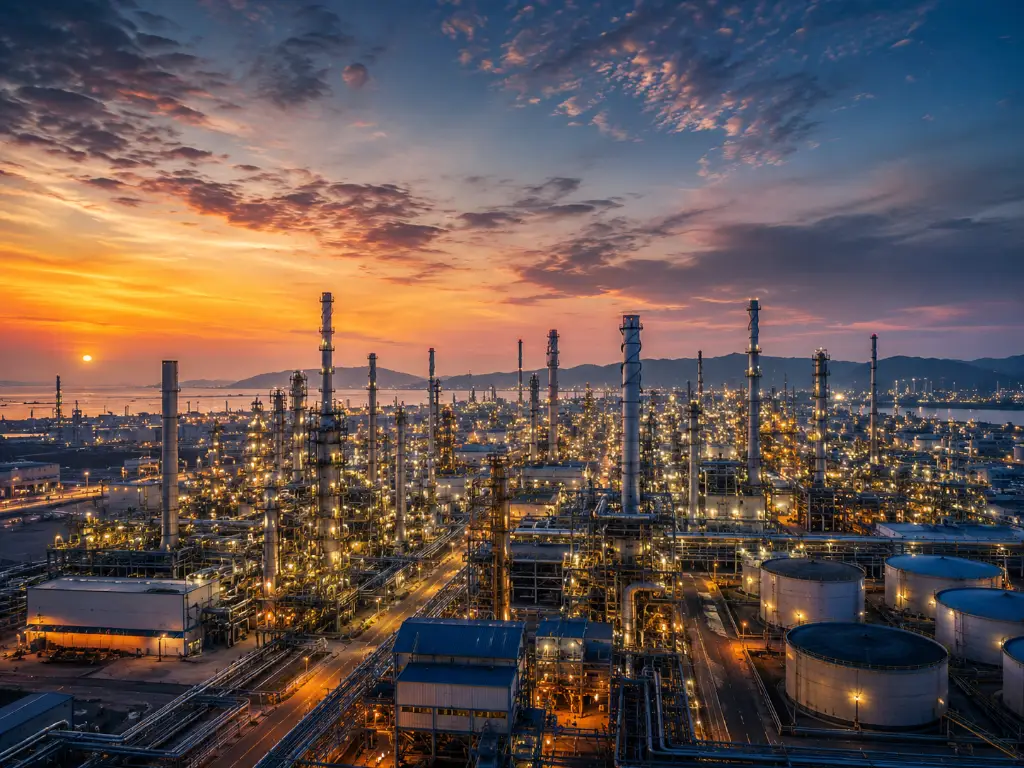
Petroleum refining is the largest single market for adsorbent catalysts, accounting for roughly 40% of sector revenue. Two processes define the category.
Fluid catalytic cracking (FCC) is the workhorse of every refinery. Heavy gas oil is sprayed into a riser reactor at 480–540 °C, where it contacts USY zeolite catalyst particles. Within 2–10 seconds, the zeolite’s Brønsted acid sites protonate hydrocarbon chains, generating carbocation intermediates that crack into smaller, more valuable molecules — gasoline, LPG, and light olefins. The unit cell size (UCS) of the USY crystal is the master control knob: smaller UCS indicates more extensive dealumination, which suppresses hydrogen-transfer reactions and shifts the product slate toward lighter olefins. While total gasoline yield may decrease relative to fresh REY catalysts, the olefin-to-paraffin ratio rises significantly — a trade-off every refinery calibrates differently depending on downstream olefin demand.
Hydrocracking pairs a hydrogenation metal (Pt, Pd, or Ni–Mo sulfide) with an acidic zeolite support, typically Beta or USY. The metal sites dissociate H₂ and hydrogenate aromatics; the acid sites isomerize and crack the saturated intermediates. Getting the metal–acid balance right is the central challenge — too much hydrogenation and you waste expensive H₂ producing light gases; too little and you leave unconverted aromatics that degrade diesel cetane number.
(480–540°C)
(2–10s)
Beyond FCC and hydrocracking, ZSM-5 drives xylene isomerization (converting low-value meta-xylene into high-demand para-xylene for PET production), MCM-22 catalyzes benzene alkylation with ethylene to ethylbenzene (the styrene precursor), and SAPO-34 selectively converts methanol to light olefins in the MTO process — a route that decouples ethylene and propylene production from crude oil.
Environmental & Emissions Control
Environmental catalysis is the fastest-growing segment for adsorbent catalysts, driven by tightening emissions regulations across every major economy.
Diesel NOx abatement relies on Cu-SSZ-13, a small-pore zeolite with the CHA framework. Its 3.8 Å pores admit NH₃ and NOx while excluding larger hydrocarbons that would otherwise poison the active sites. The standard SCR reaction — 4NH₃ + 4NO + O₂ → 4N₂ + 6H₂O — proceeds across a broad temperature window (200–550 °C) with NOx conversion efficiency typically exceeding 95%. Compared to the previous generation of vanadium-based catalysts, Cu-SSZ-13 avoids vanadium’s toxicity classification and survives the hydrothermal aging that occurs during diesel particulate filter regeneration.
VOC catalytic oxidation replaces thermal incineration (700–1,000 °C) with catalyst-driven destruction at temperatures as low as 150 °C. Cobalt and nickel oxides supported on biomass-derived activated carbon have demonstrated effective oxidation of benzene, toluene, and n-hexane at these dramatically lower temperatures, reducing fuel and energy consumption by 60–85% compared to thermal incineration.
Carbon capture (CCUS) completes the environmental picture. 13X zeolite selectively adsorbs CO₂ from flue gas at 40–60 °C. When paired with a downstream methanation catalyst (Ni supported on ZSM-5 or Al₂O₃), the captured CO₂ is hydrogenated to synthetic methane — transforming a waste stream into a fuel. The IEA’s net-zero roadmap projects global CO₂ capture capacity reaching approximately 1.2 gigatonnes per year by 2030, which will drive unprecedented demand for both CO₂-selective adsorbents and CO₂-hydrogenation catalysts.
Industrial Gas Separation & Purification
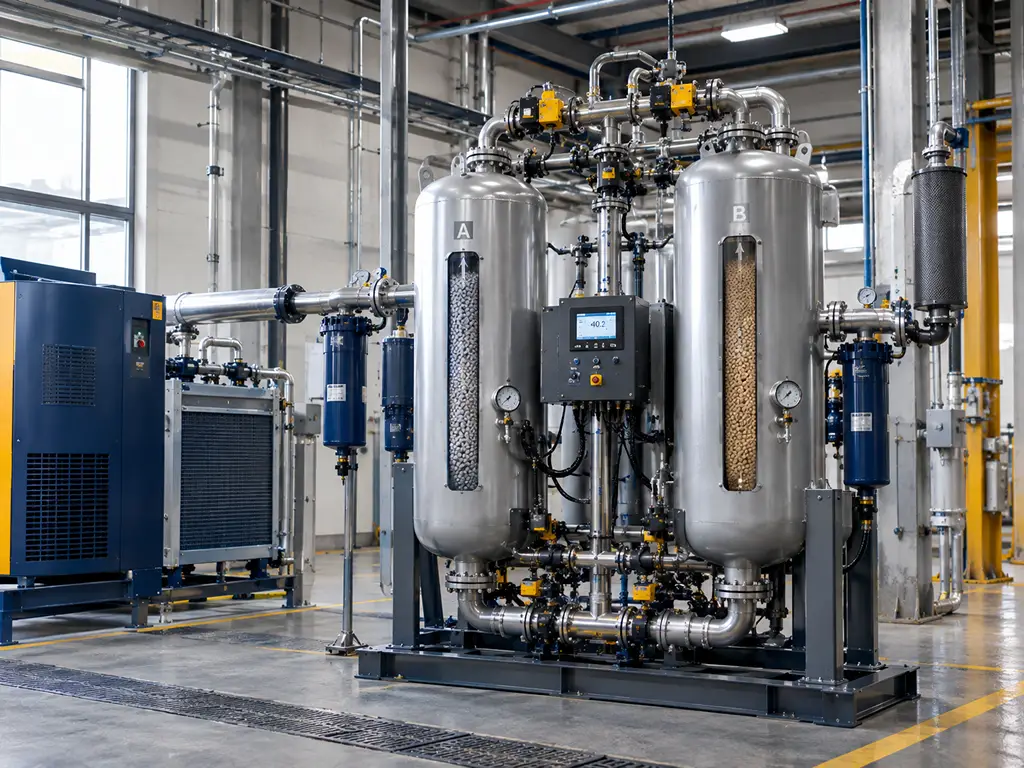
Pressure swing adsorption (PSA) and its vacuum-assisted variant (VPSA) are the dominant technologies for on-site industrial gas production. A typical PSA cycle runs five steps: adsorption (feed gas enters, impurity adsorbs, product exits) → co-current depressurization → counter-current blowdown → purge → repressurization. The entire cycle completes in minutes, and the adsorbent choice determines both product purity and recovery rate.
For oxygen production via VPSA, lithium-exchanged low-silica X zeolite (Li-LSX) is the state of the art. Li⁺ cations, with their higher charge density compared to Na⁺, interact more strongly with the N₂ quadrupole moment, boosting N₂ adsorption capacity by roughly 30–40% over conventional NaX. This translates directly to smaller adsorbent beds and lower compression energy for the same oxygen output. Typical VPSA oxygen plants deliver 90–95% purity at capacities from 300 to over 10,000 Nm³/h.
Hydrogen purification via PSA demands a different approach. The feed — typically steam methane reformer effluent or refinery off-gas — contains H₂ mixed with CO, CO₂, CH₄, and N₂. Binderless 5A molecular sieve (where the zeolite crystal is formed directly into pellets without a clay binder that would block pore access) achieves hydrogen recoveries above 85% at 99.99%+ purity. The absence of binder means higher effective adsorption capacity per kilogram of material loaded.
Carbon molecular sieves (CMS) separate O₂ from N₂ through kinetic selectivity — O₂ diffuses into the micropores faster than N₂, so N₂ exits as the product stream. Zeolites, by contrast, operate on equilibrium selectivity — N₂ adsorbs more strongly than O₂, leaving O₂ as the product. Different physics, different process designs, different optimal applications.
| Target Gas | Recommended Adsorbent | Typical Purity | Key Parameter |
|---|---|---|---|
| O₂ (VPSA) | Li-LSX | 90–95% | N₂/O₂ selectivity at 1.1–1.2 bar |
| N₂ (PSA) | Carbon Molecular Sieve | 99.999% | O₂/N₂ kinetic selectivity |
| H₂ (PSA) | Binderless 5A | 99.99%+ | Multi-bed recovery, H₂ yield >85% |
| CO₂ capture | 13X | >90% capture rate | Flue gas inlet at 40–60 °C |
| Natural gas drying | 4A | Dew point < −70 °C | Dual-tower TSA cycle |
How to Select the Right Adsorbent Catalyst for Your Process
Having covered the material landscape, we now turn to the question that matters most for an engineer facing a real project: given my specific process conditions, how do I choose?
Start with three questions — and resist the urge to skip to the product catalog before answering them.
Matching Materials to Your Process Conditions
Temperature is the first-order filter. Below approximately 300 °C, your options are broad: molecular sieves (3A, 4A, 5A, 13X), activated alumina, and activated carbon are all viable. Above 300 °C, the field narrows. Activated carbon begins to oxidize. Activated alumina undergoes phase transformation. You need either a high-silica zeolite (ZSM-5 with Si/Al > 200, which resists hydrothermal dealumination) or a metal oxide (TiO₂, CeO₂, or supported transition metals).
Next, look at your contaminant chemistry. Water removal — for moderate drying (dew point −20 to −30 °C), activated alumina works. For deep drying (dew point below −40 °C, required in cryogenic air separation and LNG), only molecular sieve (3A or 4A) can deliver. The reason lies in the shape of the adsorption isotherm: molecular sieves maintain high capacity even at extremely low water partial pressures, while alumina’s capacity drops off sharply below a few hundred ppmv of moisture. CO₂ removal at ambient to moderate temperature calls for 13X zeolite. Organic sulfur compounds (mercaptans, thiophenes) require either impregnated activated carbon or a Cu/Zn-based catalyst that chemisorbs sulfur. VOCs at trace concentrations are best handled by hydrophobic high-silica zeolites, which preferentially adsorb organics without being saturated by ambient humidity.
Here is a practical example. You’re designing a natural gas dehydration unit: feed pressure 30 bar, temperature 35 °C, target water dew point −70 °C (pipeline specification). Walk through the logic: 35 °C is ambient → both alumina and molecular sieve are options. Contaminant is water → alumina and molecular sieve both adsorb water. Target dew point is −70 °C → molecular sieve only. At −70 °C, the equilibrium water capacity of activated alumina is too low to be economically viable in terms of bed size and regeneration frequency. The path leads cleanly to 4A molecular sieve.
Critical Performance Parameters You Must Specify
Once you’ve narrowed the material type, the next step is specifying the performance parameters that will appear in your RFQ and technical evaluation. The table below provides a checklist:
| Parameter | Test Standard | Why It Matters |
|---|---|---|
| BET Surface Area | ASTM D3663 / ISO 9277 | Total active site capacity |
| Pore Size Distribution | BJH (mesopores) / HK (micropores) | Determines molecular accessibility |
| Crush Strength | ASTM D4179 | Bed integrity under PSA pressure cycling (recommended ≥55 N/particle) |
| Bulk Density | ASTM D2854 | Vessel sizing and fill quantity |
| Equilibrium Water Capacity | 25 °C, saturated humidity | Dehydration performance benchmark |
| CO₂ Adsorption Capacity | 25 °C, 250 mmHg CO₂ | Air separation and natural gas treating |
| Attrition Rate | ASTM D4058 | Dust generation in rapid-cycle PSA (target ≤0.5 wt%) |
| Loss on Ignition (LOI) | 550 °C / 950 °C | Residual moisture + organic template content |
Evaluating Suppliers — Beyond the Data Sheet
A technically strong material from a weak supplier produces the same result as a weak material: an unreliable process. Here are the five dimensions that separate suppliers worth shortlisting:
Certification baseline. ISO 9001 (quality management) and ISO 14001 (environmental management) are table stakes. For any material touching automotive or mobile emissions applications, IATF 16949 is the relevant standard — and it demands far more than ISO 9001 in terms of supply chain traceability and statistical process control (minimum process capability Cpk ≥ 1.33). For the European market, REACH registration is non-negotiable.
Batch consistency. A data sheet is a promise; a certificate of analysis (CoA) is evidence. Request CoAs for the last five production batches and check the variance on your two or three most critical parameters. A supplier whose BET surface area swings ±8% batch to batch will force you to oversize your beds to handle the worst-case material — adding capital cost that a ±2% supplier avoids entirely.
Application support capability. Many procurement evaluations miss the difference between a commodity supplier and a technical partner. Does the supplier offer application-specific testing — running your actual process stream through a bench-scale column before you commit to a bulk order? Do you have access to a technical team that understands your process, or are you talking through a generalist sales channel? This matters most when your operating conditions don’t match standard test protocols — which, in practice, is the majority of real industrial applications.
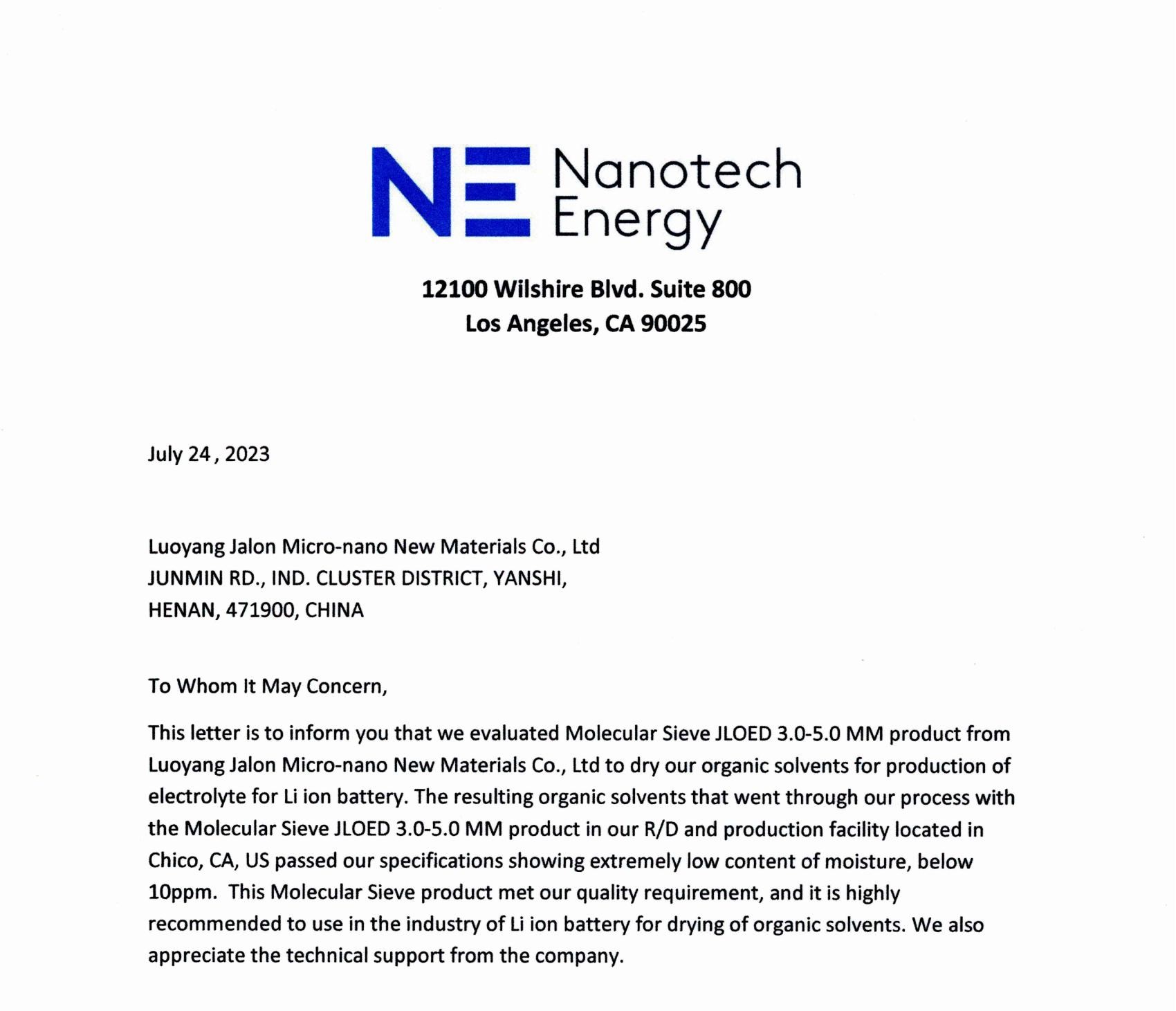
For illustration: some molecular sieve manufacturers operate dedicated application-testing laboratories where customer feed streams are evaluated under simulated process conditions using both proprietary and international standard methods. They provide adsorbent selection recommendations based on that data rather than generic selection charts. When sourcing for a non-standard gas stream or when switching between suppliers, prioritizing vendors who offer this level of pre-sales technical engagement — including application-specific adsorbent testing and selection support — can eliminate months of trial and error in commissioning.
Delivery reliability and production capacity. Does the supplier’s annual capacity match your consumption, and do they maintain sufficient inventory to cover your lead time? For critical materials, qualify a backup supplier before you need one — supplier qualification during an emergency shutdown is a losing position.
Total cost of ownership. Unit price is the most visible number and the least useful one for decision-making. A fuller TCO model includes: initial fill cost + installation labor + expected service life (in cycles or years) + regeneration energy cost per cycle + performance degradation rate + disposal cost at end of life. Low-cost material that lasts half as long as the mid-tier alternative often costs more on a per-cycle basis.
If your operating conditions fall outside standard reference cases, run parallel bench-scale trials with two or three shortlisted suppliers using your actual feed stream. The results of those trials — not the brochure — should drive the final decision.
Quality Assurance & The Evolving Supply Landscape
The global adsorbent catalyst supply chain is both concentrated and fragmenting at the same time. A handful of large multinationals dominate the refining catalyst segment, while a diverse ecosystem of specialized manufacturers — particularly in China — supplies the broader molecular sieve and activated alumina markets.
| Manufacturing Hub | Representative Capability | Competitive Edge |
|---|---|---|
| Henan, China | Full molecular sieve spectrum (3A–13X, Li-LSX, ZSM-5) | Scale + category completeness |
| Shandong / Jiangxi, China | Catalyst supports, chemical ceramics, silica gel | Integrated supply chain |
| Europe (Germany / Switzerland) | BASF, Clariant, Zeochem — specialty catalysts, high-end adsorbents | Brand equity + certification depth |
| North America | Honeywell UOP, W.R. Grace — refining catalysts, process licensing | Technology + catalyst bundling |
Three trends are reshaping this landscape. First, leading Chinese molecular sieve manufacturers are moving up the value chain from pure adsorbents into catalytic materials — ZSM-5, SAPO, and specialty zeolites that were historically the exclusive domain of Western and Japanese chemical conglomerates.
Second, the global energy transition is creating demand at a pace the industry hasn’t seen before. The combined process catalysts and adsorbents market was valued at approximately $20.4 billion in 2024 and is projected to grow at roughly 5.5% annually through 2033. The molecular sieve sub-segment is growing faster — approximately 8.1% CAGR — driven by CCUS, hydrogen purification, and biofuel processing.
Third, supply chain localization — the “China + 1” strategy — is driving new adsorbent production capacity in Southeast Asia, notably Thailand and India, aimed at serving regional markets with shorter lead times.
Regardless of where your supplier is based, the evaluation framework from the previous section remains the anchor. Certifications, batch consistency, application support, and TCO do not have a nationality — they are engineering facts. Judge suppliers against those facts.
References
- International Zeolite Association. “Database of Zeolite Structures.” https://www.iza-structure.org/databases/
- ASTM International. “ASTM D3663 — Standard Test Method for Surface Area of Catalysts and Catalyst Carriers.” https://www.astm.org/d3663-20.html
- Verified Market Reports. “Process Catalysts and Adsorbents Market Size, Share, Industry SWOT & Forecast 2033.” March 2025. https://www.verifiedmarketreports.com/product/process-catalysts-and-adsorbents-market/
- 6W Research. “Global Inorganic Microporous Adsorbents Market (2025–2031).” April 2025. https://www.6wresearch.com/industry-report/global-inorganic-microporous-adsorbents-market
- Evonik Industries. “New Line of Adsorbents and Catalysts Advances Pyrolysis Oil Purification.” Materials Performance, 2025. https://content.ampp.org/materials-performance/article-abstract/64/5/16/97478/New-Line-of-Adsorbents-and-Catalysts-Advances
- Jalon Zeolite. “Technical Services — Application-Specific Testing & Selection Support.” https://www.jalonzeolite.com/technical-services/
- Jalon Zeolite. “Homepage.” https://www.jalonzeolite.com/


 EN
EN  DE
DE  ES
ES  JA
JA  RU
RU  PT
PT  FR
FR  AR
AR  KO
KO  TH
TH  ID
ID