What Does SCR Stand For? The 2026 Guide to Selective Catalytic Reduction Systems
What Does SCR Stand For and What Does It Mean for Diesel Engines?
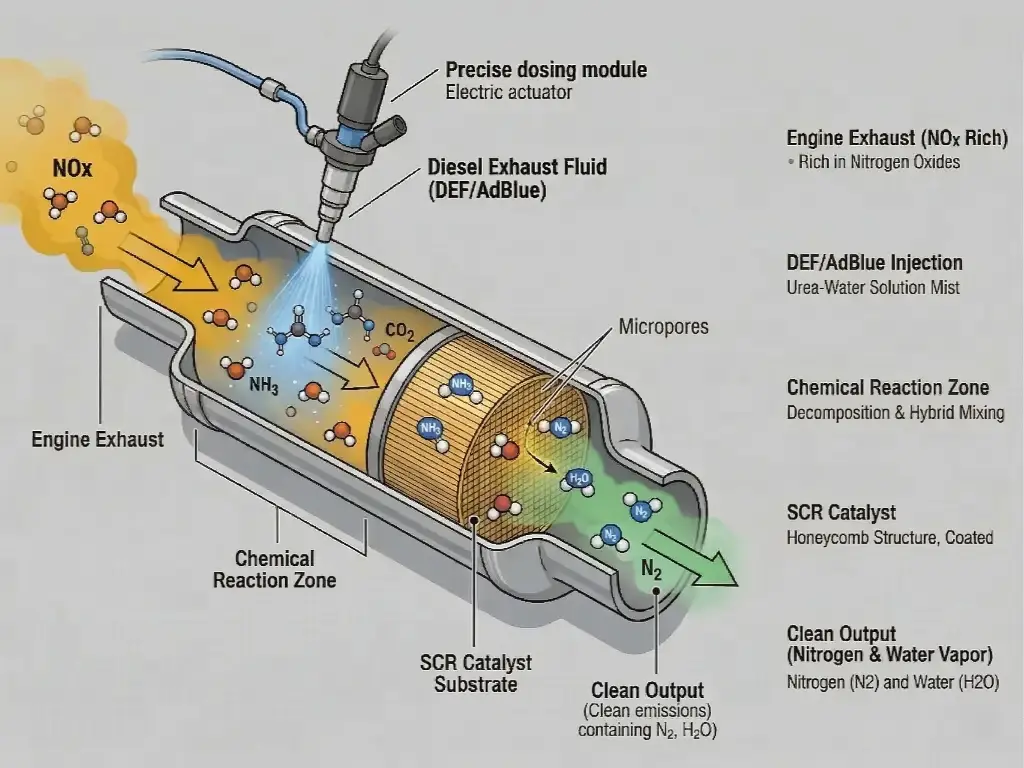
In the high-stakes arena of heavy-duty industrial machinery, commercial trucking, and marine propulsion, the acronym SCR has evolved from a niche engineering term into a mandatory compliance standard. SCR stands for Selective Catalytic Reduction. But what does it actually mean for the modern diesel engine operating in an era of unprecedented environmental scrutiny? At its core, an SCR system is an advanced active emissions control technology system that injects a liquid-reductant agent—typically automotive-grade urea, known as Diesel Exhaust Fluid (DEF) or AdBlue—through a special catalyst into the exhaust stream of a diesel engine.
The fundamental macro working principle is elegantly straightforward yet chemically profound: the DEF sets off a chemical reaction that converts nitrogen oxides (NOx), which are severe pollutants responsible for smog and respiratory issues, into harmless nitrogen (N2), water (H2O), and tiny amounts of carbon dioxide (CO2). Nitrogen and water are naturally occurring components of the air we breathe, meaning the SCR system effectively neutralizes the most toxic byproducts of diesel combustion before they ever reach the tailpipe.
For fleet managers, chief engineers, and OEM equipment buyers, understanding what SCR stands for goes far beyond chemical equations. It represents the ultimate line of defense against stringent global regulations like the EPA Tier 4 Final in the United States and Euro VI in Europe.
By treating exhaust gases post-combustion rather than choking the engine’s internal breathing process, SCR allows modern diesel engines to be tuned for maximum fuel efficiency and peak torque, severing the historical compromise between power output and environmental compliance.
The Core Anatomy: What is an SCR Catalyst and How Does It Work?
To truly grasp the technological leap that Selective Catalytic Reduction represents, we must dive beneath the macro system level and examine the micro-chemical battlefield. The heart of the system is the SCR catalyst itself—a highly engineered substrate structure coated with specialized active materials designed to facilitate and accelerate the reduction of NOx molecules.
The Micro-Chemical Reaction (NOx Meets Ammonia)
The magic of the SCR system does not happen by simply spraying urea onto hot metal. It is a precisely orchestrated sequence of thermodynamic and chemical events. When Diesel Exhaust Fluid (a solution of 32.5% high-purity urea and 67.5% deionized water) is dosed into the hot exhaust stream, the water instantly vaporizes. The remaining urea undergoes thermal decomposition (thermolysis) and hydrolysis, transforming into gaseous ammonia (NH3) and isocyanic acid, which further breaks down into more ammonia and carbon dioxide.
This gaseous ammonia then travels downstream and permeates the porous surface of the SCR catalyst substrate. As the engine’s exhaust gas—laden with NO and NO2—passes through this same catalytic matrix, the ammonia reacts with the NOx. The catalyst lowers the activation energy required for this reaction, allowing it to occur at typical exhaust temperatures. The result is pure, harmless nitrogen gas and water vapor. However, this process demands extreme precision. Engine Control Units (ECUs) must calculate the exact dosing rate of DEF based on engine load, exhaust flow, and temperature. If too much DEF is injected, the unreacted ammonia slips through the catalyst and out the tailpipe—a phenomenon known in the industry as “Ammonia Slip.” Ammonia slip not only produces a highly pungent, irritating odor but can also trigger secondary environmental violations and lead to strict regulatory penalties.
Inside the Substrate: Zeolite vs. Vanadium Catalyst Types
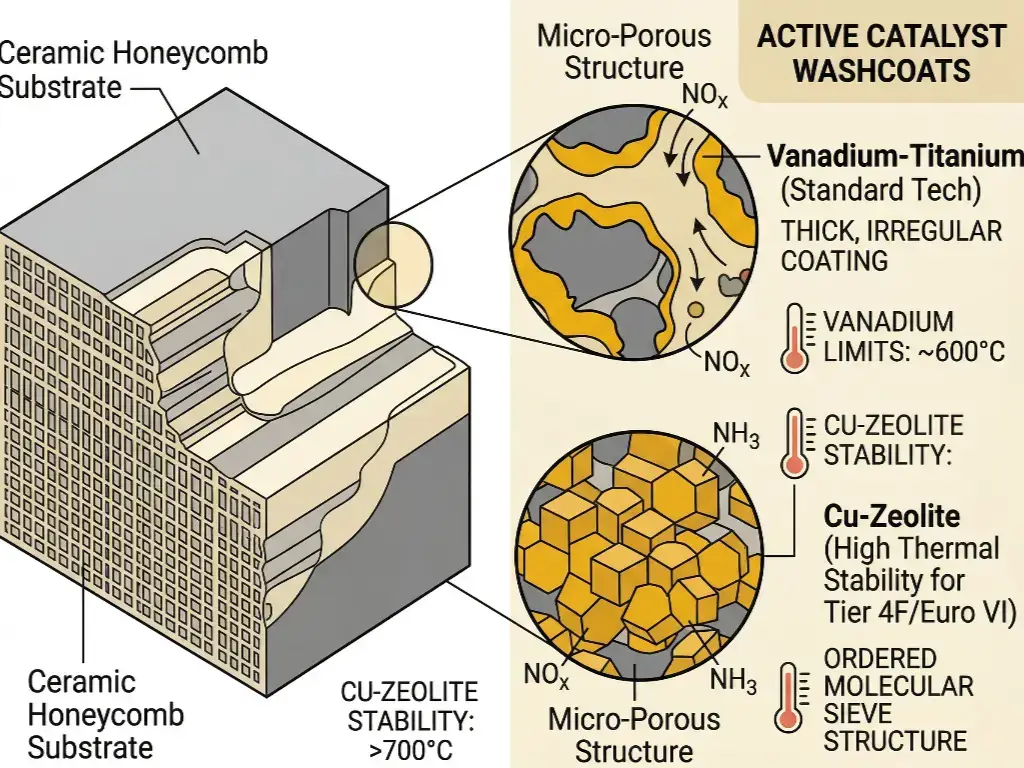
Not all SCR catalysts are created equal. The active chemical washcoat applied to the ceramic or metallic honeycomb substrate dictates the system’s thermal tolerance, conversion efficiency, and lifespan. Historically, the industry has relied on two primary formulations: Vanadium-based and Zeolite-based catalysts. Understanding the distinction is critical for equipment procurement and long-term reliability.
| Catalyst Material | Max Temperature Tolerance | Sulfur Resistance | Primary Application / Risk Profile |
|---|---|---|---|
| Vanadium-Titanium | ~550°C to 600°C | High (Highly resistant to sulfur poisoning) | Stationary power generation, marine engines using high-sulfur fuels. Risk: High-heat volatility. |
| Copper-Zeolite (Cu-Zeolite) | >700°C+ | Moderate (Requires Ultra-Low Sulfur Diesel) | Modern Tier 4 Final heavy-duty trucks and non-road machinery. Highly durable under thermal stress. |
Vanadium catalysts are cost-effective and highly resistant to sulfur, making them popular in marine applications where heavy fuel oil (HFO) is used. However, they possess a fatal flaw for modern on-highway applications: when exposed to temperatures exceeding 600°C, vanadium can become volatile and emit toxic compounds. In contrast, modern Tier 4 Final diesel engines utilize Diesel Particulate Filters (DPF) that require periodic “active regeneration”—a process that artificially spikes exhaust temperatures well over 600°C to burn off trapped soot. Consequently, specialty Zeolite-based catalysts (such as Cu-Zeolite or Fe-Zeolite) have become the absolute standard. These crystalline aluminosilicate structures can withstand extreme thermal shocks without degrading, ensuring the system survives the brutal thermal cycling of heavy-duty operations.
The Complete Aftertreatment Layout: From DOC and DPF to SCR
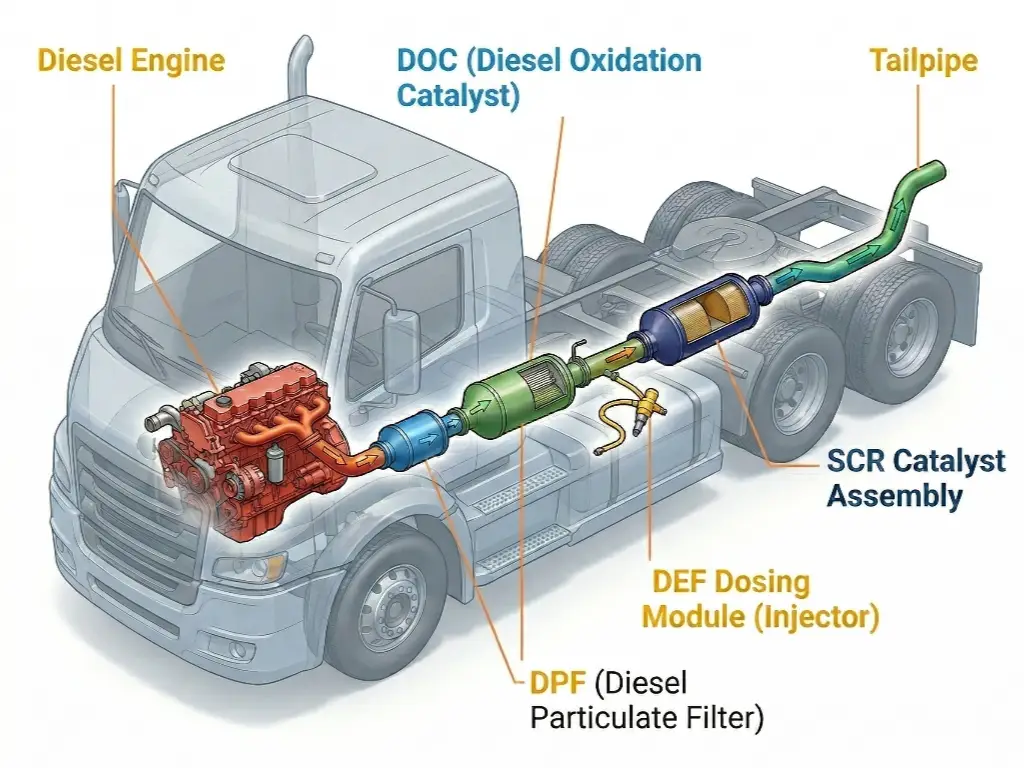
A common misconception is that the SCR system operates in isolation. In reality, it is the final, highly dependent stage of a comprehensive aftertreatment architecture. If the exhaust gas is not properly conditioned before it reaches the selective catalytic reduction chamber, the chemical conversion will fail catastrophically.
DOC
Diesel Oxidation Catalyst
DPF
Diesel Particulate Filter
SCR
Selective Catalytic Reduction
The Pre-treatment Phase (DOC & DPF Integration)
Before the exhaust stream ever encounters a drop of DEF, it must pass through two critical sentinels: the Diesel Oxidation Catalyst (DOC) and the Diesel Particulate Filter (DPF). The DOC acts as the system’s chemical pre-conditioner. Its primary job is to oxidize unburned hydrocarbons and carbon monoxide into carbon dioxide and water. More importantly for the SCR, the DOC utilizes precious metals (like platinum and palladium) to oxidize a specific portion of the Nitric Oxide (NO) in the exhaust into Nitrogen Dioxide (NO2). Achieving an optimal NO to NO2 ratio (ideally close to 1:1) is critical because it triggers the “Fast SCR Reaction,” drastically accelerating the NOx conversion rate at lower temperatures.
Immediately following the DOC is the DPF, which physically traps carbon soot particles (black smoke). If the DPF were to fail or be removed, raw soot would blast directly into the SCR catalyst. The microscopic pores of the zeolite substrate would quickly become physically blocked—a condition known as face plugging—rendering the catalyst completely inert and requiring a replacement that can cost tens of thousands of dollars.
The DEF Dosing and Hydrolysis Process
Once the exhaust is filtered and chemically conditioned, it enters the decomposition reactor pipe. This is where the DEF dosing module operates. This highly precise metering pump injects a fine mist of urea into the exhaust. However, there is a hard engineering constraint: the ECU will completely lock out DEF injection if the exhaust temperature is too low. Typically, exhaust temperatures must reach a strict threshold of 200°C to 250°C (392°F to 482°F) before dosing begins. Spraying liquid DEF into a cold exhaust pipe prevents proper hydrolysis. Instead of turning into ammonia gas, the urea pools, polymerizes, and bakes into a hard, white crystalline structure (cyanuric acid and melamine). These crystal deposits can rapidly choke the exhaust flow, increase engine backpressure, and physically destroy the dosing nozzle.
Common SCR System Failures and Troubleshooting Strategies
Despite their environmental brilliance, SCR systems are complex electromechanical networks operating in incredibly hostile environments. For maintenance directors and fleet operators, managing an SCR-equipped asset means understanding its vulnerabilities. The majority of downtime associated with modern aftertreatment systems stems not from catastrophic mechanical engine failure, but from fluid mismanagement and sensor faults.
DEF Crystallization and Fluid Management (ISO 22241)
The lifeblood of the selective catalytic reduction process is the Diesel Exhaust Fluid. It is a highly sensitive solution.
Introducing even microscopic amounts of heavy metals, tap water, or antifreeze into the DEF tank will permanently poison the catalytic washcoat.
Furthermore, DEF exhibits unique physical properties in extreme climates. It freezes solid at exactly -11°C (12°F). To combat this in cold weather operations, OEM engineers integrate a complex network of coolant-heated lines and electrically heated DEF tanks. During a cold start in sub-zero environments, the engine ECU will delay DEF injection, relying temporarily on engine thermal management while the heaters thaw the frozen DEF. Conversely, storing DEF in extreme heat (above 30°C/86°F) for prolonged periods accelerates its degradation, reducing its shelf life and ammonia yield.
Catalyst Face Plugging and Sensor Malfunctions
The system’s intelligence relies entirely on a closed-loop feedback mechanism provided by high-precision sensors. Upstream and downstream NOx sensors constantly monitor the exhaust to dictate the exact DEF dosing rate. Exhaust Gas Temperature (EGT) sensors ensure thermal conditions are safe for injection. Unfortunately, these sensors are exposed to extreme heat and soot. A soot-fouled NOx sensor will send drifting, inaccurate voltage signals to the ECU, tricking the computer into over-dosing or under-dosing DEF. Simultaneously, if the upstream DPF is compromised, ash and soot will cause catalyst face plugging, drastically increasing backpressure. Technicians must routinely perform forced regens and ensure sensor data matches physical realities using advanced diagnostic tooling.
The Dreaded “Limp Mode” (Engine Derate)
Environmental protection agencies mandate that emissions compliance cannot be voluntary. To enforce this, modern heavy-duty engines are programmed with an aggressive On-Board Diagnostics (OBD) inducement strategy. If a driver ignores a low DEF tank warning, if the system detects an unplugged NOx sensor, or if the tailpipe emissions exceed legal thresholds, the ECU will initiate an Engine Derate sequence. First, the engine will lose a percentage of its peak torque (e.g., a 25% power reduction). If the issue is not rectified within a specified timeframe or mileage, the system will escalate to severe derate, eventually locking the vehicle into a “Limp Mode.” In this state, the vehicle may be restricted to speeds as low as 5 mph (8 km/h) or locked at idle, completely paralyzing commercial operations until the SCR system is repaired and the codes are cleared.
Emission Control Clash: SCR vs. EGR (And Why Modern Engines Use Both)
For years, a fierce debate raged among engine manufacturers regarding the best path to NOx reduction: should we prevent NOx from forming inside the cylinder, or should we clean it up in the exhaust pipe? This led to the great divide between Exhaust Gas Recirculation (EGR) and Selective Catalytic Reduction (SCR) technologies.
Technical Comparison: In-Cylinder vs. Aftertreatment
EGR Technology
EGR works by routing a portion of the oxygen-depleted exhaust gas back into the engine’s intake manifold. This lowers the peak combustion temperature, which directly inhibits the formation of NOx. However, cooling exhaust gas and stuffing it back into the engine is fundamentally inefficient. It displaces fresh oxygen, leading to less complete combustion, higher soot generation (particulate matter), and significantly higher heat rejection into the engine’s cooling system. Vehicles relying heavily on EGR suffer from compromised Brake Specific Fuel Consumption (BSFC) and require massive radiators.
SCR Technology
SCR takes the opposite approach. It allows the engine to breathe 100% fresh, cool air. The engine is tuned to run as hot and efficiently as possible, maximizing fuel economy and power density while minimizing soot. The inevitable spike in raw NOx production is then entirely handled outside the engine by the SCR catalyst. The result is a much cleaner running engine, significantly extended oil drain intervals, and a cooler running cooling pack.
The Synergy: The SCR + EGR Combined Approach
While early adopters championed one over the other, the reality of near-zero emissions regulations (like EPA Tier 4 Final and Euro VI) proved that neither technology alone could handle the burden without severe compromises. Today, the industry standard for high-horsepower diesel engines is a highly synergistic, combined architecture: Moderate EGR + High-Efficiency SCR. By utilizing a light rate of EGR, engineers can shave the peak off the raw engine NOx output. This significantly reduces the total amount of DEF the SCR system needs to inject downstream. This balanced approach optimizes the total fluid consumption (Diesel + DEF), yielding the best possible economic return while maintaining bulletproof environmental compliance.
Navigating Global Emission Standards: Where are SCR Systems Mandatory?
The adoption of Selective Catalytic Reduction is not driven by operational convenience; it is strictly forced by global environmental legislation. The timelines and stringencies vary by industry, but the trajectory is universally pointing towards near-zero emissions, cementing SCR as a non-negotiable component of heavy industry.
Heavy-Duty On-Highway and Non-Road Regulations (EPA Tier 4 Final & Euro VI)
In the on-highway trucking sector, Euro VI and EPA 2010 standards mandated a 90% reduction in NOx compared to previous generations, limiting output to a staggering 0.2 g/bhp-hr. For non-road mobile machinery (NRMM)—including excavators, wheel loaders, and agricultural tractors—the EPA Tier 4 Final and EU Stage V regulations imposed similarly draconian cuts (down to 0.4 g/kWh). These limits completely shattered the physical boundaries of what in-cylinder combustion tuning (EGR) could achieve alone, making the integration of active SCR systems legally mandatory for almost all diesel engines above 74 horsepower (55 kW) operating in regulated markets.
High-Horsepower Marine and Industrial Applications (IMO Tier III)
The regulatory pressure has rapidly expanded beyond land. The International Maritime Organization (IMO) Tier III standards mandate massive NOx reductions for vessels operating within designated Emission Control Areas (ECAs), such as the North American coast and the Baltic Sea. For massive marine propulsion engines and large-scale industrial power generators, SCR is the only viable commercial pathway to achieve these drastic reductions without sacrificing the immense power density required to move cargo across oceans or power entire localized grids.
The True Cost of SCR Systems: CapEx, OpEx, and ROI Breakdown
For B2B decision-makers, fleet directors, and procurement officers, environmental compliance is ultimately a mathematical equation. Integrating an SCR system undeniably shifts the financial dynamics of equipment ownership, requiring a clear analysis of Capital Expenditure (CapEx) versus Operational Expenditure (OpEx).
End-User ROI: Balancing DEF Consumption and Fuel Savings
The initial CapEx of an SCR-equipped machine is noticeably higher. The system requires expensive catalyst substrates, precision dosing modules, heated fluid tanks, and complex wiring harnesses. Furthermore, it introduces a new continuous OpEx variable: Diesel Exhaust Fluid. Typically, a heavy-duty engine will consume DEF at a rate of 2% to 4% of its total diesel fuel consumption, depending on the engine load factor and ambient conditions.
However, the Return on Investment (ROI) becomes highly favorable when evaluating the Total Cost of Ownership (TCO). Because the SCR system removes the heavy burden of NOx control from the engine cylinders, OEM engineers can advance engine timing and optimize combustion. This physical unchaining typically yields a 3% to 5% improvement in base fuel economy. Given that diesel fuel is significantly more expensive per gallon than DEF, the financial savings from the reduced fuel burn almost always offset, and frequently exceed, the continuous cost of purchasing DEF. Over a 3-to-5-year lifecycle, the SCR system literally pays for its own operational costs through heightened thermal efficiency.
Future-Proofing the Supply Chain for Catalyst Manufacturers
For SCR catalyst manufacturers and OEMs, the ultimate system performance and end-user ROI hinge entirely on the quality of the substrate material—specifically the zeolite molecular sieve. As global emission standards tighten, sourcing high-performance raw materials is critical.
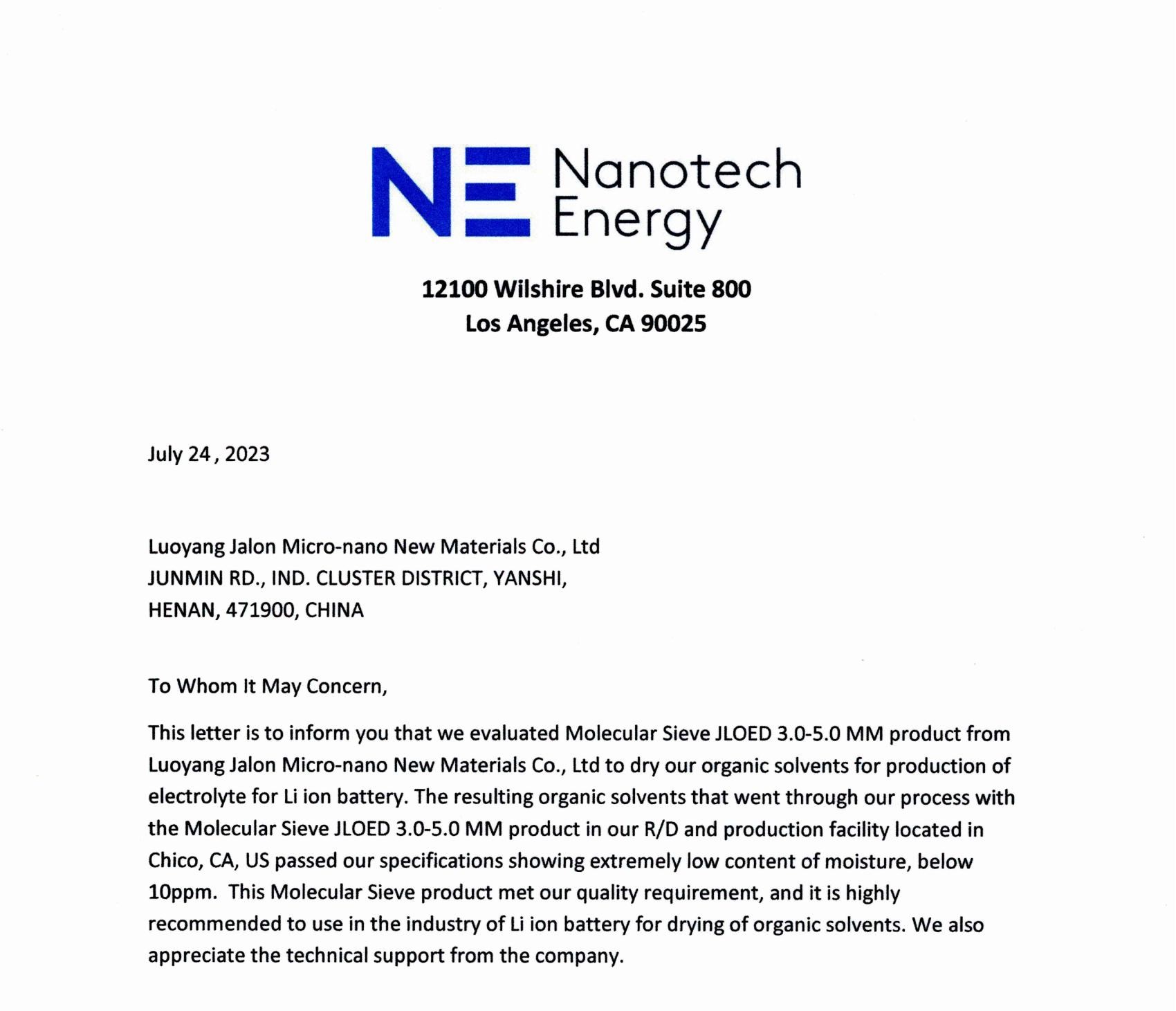
JALON (Jianlong Micro-Nano) stands as a premier global supplier of specialty zeolite powders, including the industry-leading SSZ-13 (JLDN-1) and ZSM-5. Engineered specifically for modern aftertreatment systems, JALON’s zeolites deliver exceptional low-temperature activity (ensuring rapid NOx conversion during urban cold starts), unmatched hydrothermal stability (withstanding extreme DPF regeneration temperatures without framework collapse), and superior coating performance with precisely controlled crystal sizes (D50=0.5-10μm) for optimal slurry adhesion.
Backed by a robust supply chain featuring a 55,000-ton annual capacity across dual manufacturing bases in China and Thailand, JALON guarantees supply security globally without trade barriers. Adhering strictly to ISO standards and upcoming IATF 16949 certification, and supported by a 78-expert R&D team, JALON provides the foundational compliance and technical support required for next-generation SCR architectures.
Ready to optimize your SCR catalyst performance?

 EN
EN  DE
DE  ES
ES  JA
JA  RU
RU  PT
PT  FR
FR