Molecular Sieve Product Care
and Loading Guide

  • Home
  • Molecular Sieve Product Care and Loading Guide


Correct storage, careful handling and proper loading into the adsorption vessel help protect the adsorption performance, mechanical integrity and service life of molecular sieves. Review the documents supplied with your order before opening or loading any JALON product.

Important: This page provides general guidance. Follow the applicable product label, MSDS, TDS, purchase documents and project-specific technical requirements. Contact JALON if any information is unclear or site conditions differ from those previously provided.


Documents & Support

ResourceWhat it provides
1. Product MSDS DownloadsMSDS for each product category.
2. Transportation & DeliveryTransport protection and delivery inspection.
3. Storage & HandlingStorage conditions and safe handling.
4. Loading GuidancePre-loading, loading and start-up guidance.
5. Used Molecular Sieve & UnloadingUsed-product and unloading precautions.
6. Technical SupportOn-site or remote project guidance.


1. Product MSDS Downloads


Select the relevant product category below to download its current JALON Material Safety Data Sheet (MSDS).

Synthetic Zeolite Powder – Download MSDS

Molecular Sieve – Download MSDS

Activated Alumina – Download MSDS

Activated Zeolite Powder – Download MSDS


2. Transportation & Delivery


● Use a clean, dry vehicle or container with a flat floor and no debris, protrusions or sharp edges that could damage the packaging.

● Protect the cargo from rain, snow, spray, condensation and other sources of moisture throughout transportation.

● Secure and protect packages against tipping, collision, abrasion and crushing. Handle them gently with suitable lifting equipment; do not drop or tumble them.

● For long-distance transport, inspect the load at suitable intervals and correct any movement or package damage promptly.

● On delivery, verify the product, quantity, batch identification and packaging against the delivery documents. Inspect for damaged seals, wet packaging or contamination.

● Keep affected packages separate. Record and photograph any shortage or transport damage and contact JALON before using damaged, opened, wet or unidentified material.


3. Storage & Handling

3.1 Storage Requirements

  • ● Store indoors in a clean, dry, well-ventilated warehouse, protected from direct sunlight, water, contamination, acids and alkalis.
  • ● Unless the product label or order documents specify otherwise, maintain the storage temperature between −10°C and 40°C and indoor relative humidity at or below 85%.
  • ● Keep packages sealed, upright where marked, off the ground and protected from puncture, crushing and unstable stacking. Retain all original labels and batch identification.
  • ● Outdoor storage is not recommended. If unavoidable, use high, well-drained ground; keep packages raised and fully protected from rain, freezing, sunlight and condensation. Do not exceed one week.

● Once opened, minimize exposure to ambient air, use the product promptly and reseal any unused material immediately while retaining its batch identity.

  • Package integrity: Keep the product in its original packaging whenever possible. Repacking or subdivision may expose it to moisture or contamination and compromise batch traceability.

3.2 Handling Precautions

  • ● Read the current MSDS and follow the specified safety and personal protection requirements.
  • ● Molecular sieves release heat when adsorbing water. Avoid rapid wetting and direct contact with wet skin.
  • ● Keep packages closed until use, minimize dust generation and handle the product carefully to reduce particle damage and fines formation.
  • ● Use clean, dry equipment and prevent contact with moisture, oil, grease, rust, chemicals or residues from other materials.
  • ● Before opening a steel drum, slowly loosen the vent screw to equalize pressure. Keep your face and body away from the lid while opening.


4. Loading Guidance

4.1 Before Loading: Mandatory Checks

  • ● Confirm the correct product grade, particle size and required quantity before loading.
  • ● Complete all required isolation, depressurization, gas freeing, lockout/tagout, confined-space and other site safety checks.
  • ● Confirm that the vessel, distributors, support grids, screens and contact surfaces are correctly installed, clean, dry and free from water, oil, rust, welding debris and other foreign material.
  • ● Ensure that the loading area is protected from rain, fog, spray and excessive moisture, and that all loading equipment is clean, dry and mechanically sound.
  • ● Brief the loading team on the loading sequence, responsibilities, communication, emergency measures and situations in which loading must be stopped.

Contact JALON Technical Service before loading if the loading sequence, bed arrangement or equipment requirements are unclear.

4.2 General Loading Recommendations

  1. (1) Stage the materials in the required loading sequence and keep packages closed until immediately before use.
  2. (2) Use a clean, dry hopper and loading sock or sleeve. Keep the discharge point close to the bed surface to limit free fall, segregation, particle damage and dust.
  3. (3) Load at a steady rate and distribute the material evenly. Avoid forming an uneven or strongly coned bed surface.
  4. (4) Do not walk directly on the molecular sieve. If access is permitted, use clean load-distribution boards or other suitable protection.
  5. (5) At each layer transition, verify the material, loaded quantity, bed level and surface levelness before continuing.
  6. (6) Level the final bed without crushing or excessive compaction. Install screens, ceramic balls, hold-down devices or other bed-restraint components according to the equipment and project requirements.
  7. (7) Record the product batches, quantities and key loading information, then close and seal the vessel promptly to prevent moisture or contamination from entering.

4.3 After Loading & Start-up

  • ● If start-up is delayed, keep the vessel sealed and isolated, or protect it with dry air or nitrogen having a dew point below −65°C.
  • ● Confirm that upstream separation, filtration, drainage and pretreatment systems are operating correctly before feed enters the bed.
  • ● Follow the product- and process-specific start-up and regeneration requirements. Control pressure and temperature changes to limit bed movement and particle damage.
  • ● Monitor pressure drop, temperature and outlet performance during commissioning. Contact JALON if abnormal conditions occur or if the vessel has been left open or exposed to moisture.


5. Used Molecular Sieve & Unloading


Hazard warning: Used molecular sieve may retain process substances that can be released when the vessel is opened or the adsorbent is exposed to air. Depending on the service, these substances may present toxic, flammable, corrosive or oxygen-deficiency hazards.

Prepare a service-specific unloading plan based on the process composition, operating history, vessel design and applicable regulations. Vessel opening, entry, unloading and disposal must be performed by competent personnel under the site safety system. Fresh-product loading guidance must not be used as an unloading procedure.


6. Technical Support


JALON can provide on-site or remote technical guidance based on the equipment and project conditions. Contact your JALON representative if the loading arrangement, operating requirements or site conditions are unclear.
In Needs of Molecular Sieve Solution?

JALON JLOED MOLECULAR SIEVES USED FOR ELECTROLYTE DEHYDRATION

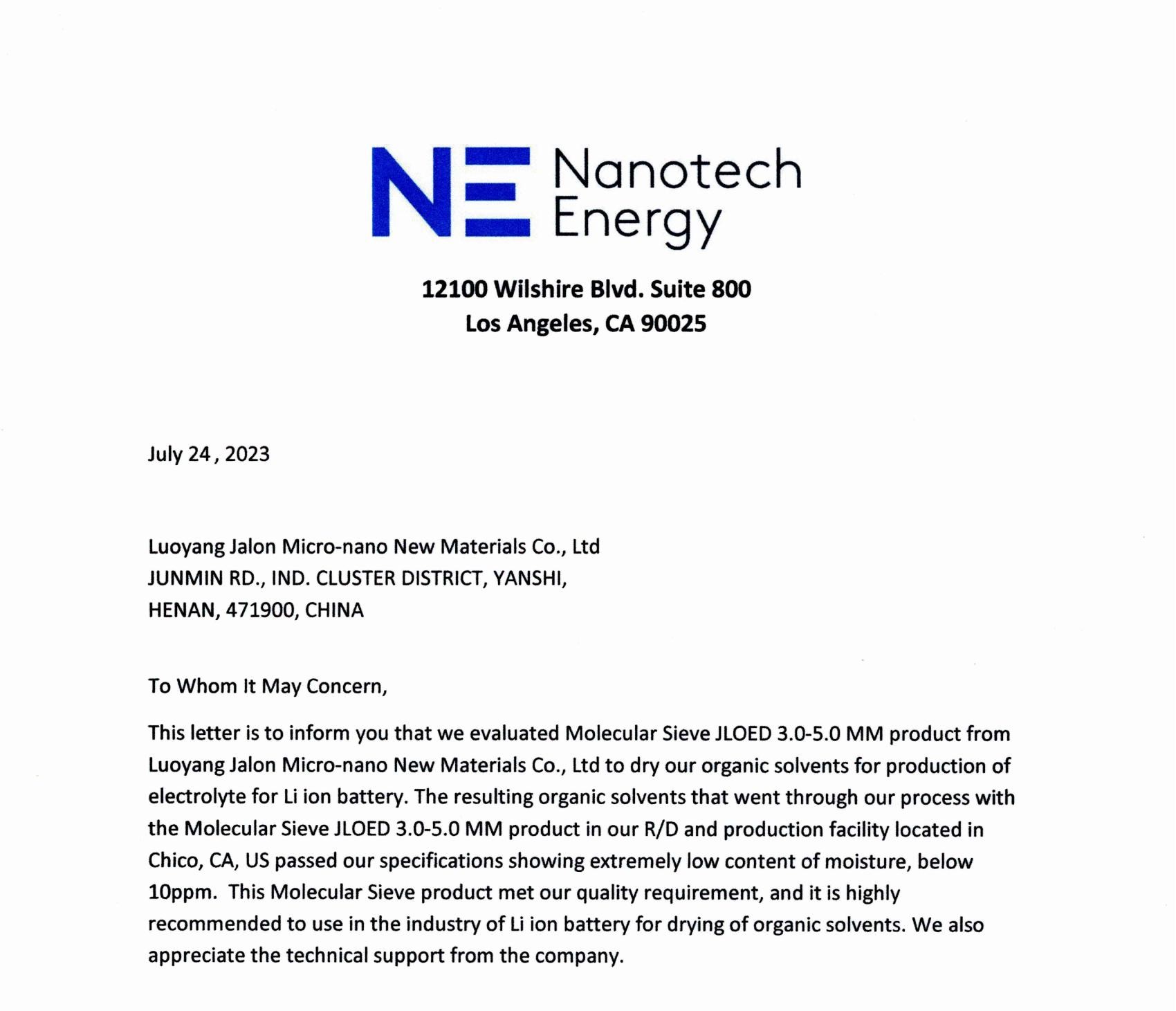
This letter is to inform you that we evaluated Molecular Sieve JLOED 3.0-5.0 MM product from Luoyang Jalon Micro-nano New Materials Co., Ltd to dry our organic solvents for production of electrolyte for Li ion battery. The resulting organic solvents that went through our process with the Molecular Sieve JLOED 3.0-5.0 MM product in our R/D and production facility located in Chico, CA, US passed our specifications showing extremely low content of moisture, below 10ppm. This Molecular Sieve product met our quality requirement, and it is highly recommended for use in the industry of Li ion battery for drying of organic solvents. We also appreciate the technical support from the company.

Nanotech Energy

Related Products
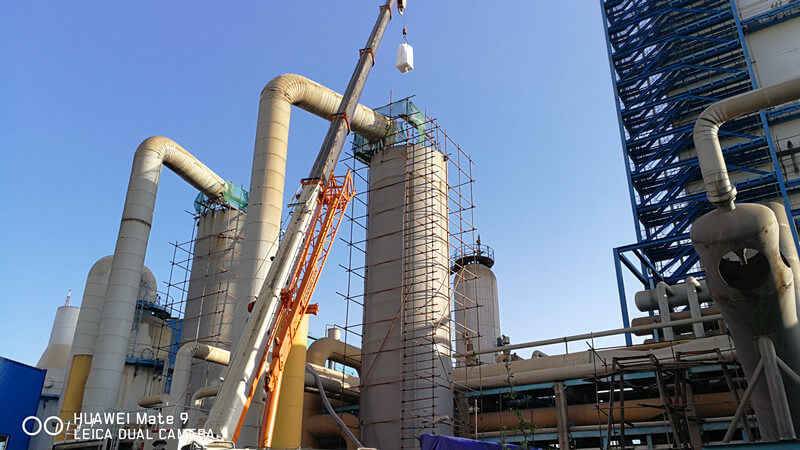
Cryogenic air separation unit Project
Yuntianhua United Commerce Co., Ltd. 52000 Nm3/Cryogenic air separation unit Project

Luoyang Jalon Micro-nano New Materials Co., Ltd. JLPM series molecular sieves are mainly used for cryogenic drying of general industrial gases. The purification system in the air separation unit removes H2O and CO2, as well as natural gas and other hydrocarbon desulfurization (removal of H2S and mercaptans) and CO2.


It is worth mentioning that Yuntianhua United Commerce Co., Ltd. Company 52000 Nm3/Cryogenic air separation unit project. The design and manufacture method of the air separation unit by air, adsorber adopt vertical radial flow design, processing capacity of 311352 nm3 / h, 5.13 Bar (A) adsorption pressure, loading type my company JLPM3 efficient molecular sieve 92 tons, 107 tons of activated alumina, can ensure that the CO2 content in the air mean 1000 parts per million (2000 PPM) instantaneous equipment and stable operation, export CO2 molecular sieve < 0.1 PPM.

The fifth-generation high-performance molecular sieve JLPM1 is an advanced molecular sieve used in the pre-purification unit (APPU) of air separation equipment. Compared with previous generations, the fifth-generation high-performance molecular sieve JLPM1 has significantly improved CO2 adsorption capacity; the fifth-generation high-performance molecular sieve JLPM1 will bring multiple benefits to air separation designers and operators. For the design of the new air separation plant, the application of the fifth-generation high-performance molecular sieve JLPM1 can make the air separation occupy a smaller area, thereby reducing equipment investment and operating costs. The fifth-generation high-performance molecular sieve JLPM1 can also be used for the transformation of old equipment, which can reduce energy consumption or improveair separation processing capacity.

Related Products
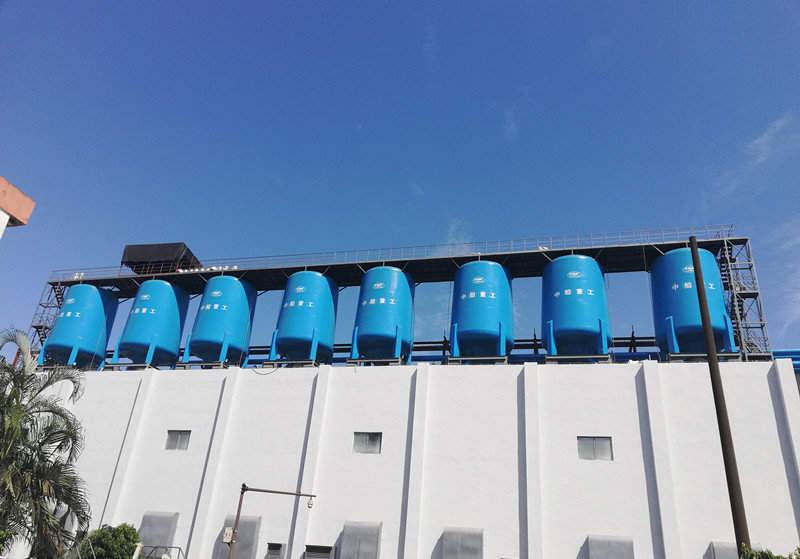
Zhuhai Yueyufeng Iron and Steel Co., Ltd. 30000Nm3/h pressure swing adsorption (VPSA) oxygen production project

Oxygen molecular sieve is an important material to ensure the work of VPSA oxygen production equipment. This project is another successful case of our JLOX-103 lithium-type high-efficiency oxygen molecular sieve.


The 30000Nm3/h pressure swing adsorption (VPSA) oxygen production project of Zhuhai Yueyufeng Iron and Steel Co., Ltd., designed and built by CSSC Huanggang Precious Metals Co., Ltd., was successfully started up on June 27, 2019. As of May 29, 2020, the device has been operating stably for 11 months, and all indicators are better than the design indicators. It has been highly recognized and praised by customers, and has created a cumulative effect of 150 million yuan per year for the enterprise. At the same time, the project has realized intelligent oxygen production, mobile control and remote monitoring to guide production, helping to realize the green and intelligent promotion of the industry.


The project uses 4 sets of pressure swing adsorption (VPSA) oxygen generators in parallel. The single set of device is designed to produce 7500Nm3/h of oxygen and 80% oxygen purity. It is filled with our company (Luoyang Jalon Micro Nano New Materials Co., Ltd.) JLOX-103 lithium-type high-efficiency oxygen molecular sieve is 68 tons, the actual oxygen output reaches 7650Nm3/h, and the oxygen concentration is above 82.3%. The 4 sets of equipment in this project are filled with 272 tons of our JLOX-103 oxygen molecular sieve, with a total oxygen production of more than 30000Nm3/h.


Oxygen molecular sieve is an important material to ensure the operation of VPSA oxygen production equipment. This project is another successful case of our company’s JLOX-103 lithium-type high-efficiency oxygen molecular sieve.

Luoyang Jalon Micro-nano New Materials Co., Ltd. JLOX-100 series high-efficiency oxygen generation molecular sieve is a lithium X-type aluminosilicate crystal, which is an oxygen generation molecular sieve with international advanced level. Widely used in: iron and steel, non-ferrous metallurgy, chemical industry, furnace energy-saving transformation, environmental protection, papermaking, aquaculture, medical care and other industries.

Related Products